










Elevate targets 10-12% yields from six projects by FY30
Key highlights
- Elevate has six projects under development for delivery between FY28 and FY30.
- Elevate underwrites 10-12% development yields on about Rs 650 crore of total capex.
- Elevate targets 5-6% same-store growth, while select existing assets achieved 7-9%.
- Elevate has more than 10 acquisition opportunities, including four under diligence.
powered by IRIS
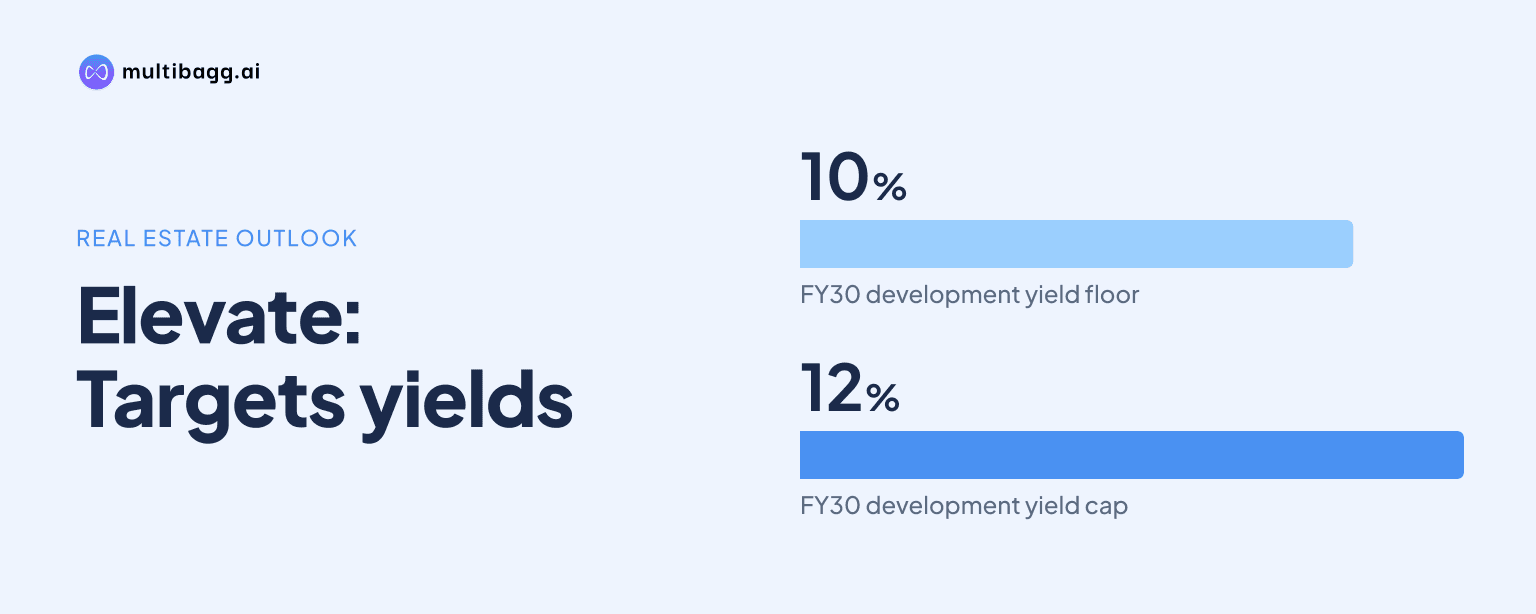
Elevate Campuses Ltd is targeting estimated development yields of 10-12% from six projects expected to be delivered between FY28 and FY30, based on about Rs 650 crore of total capital expenditure. Elevate combines this pipeline with 5-6% same-store growth from existing assets and more than 10 acquisition opportunities to expand earnings before interest, tax, depreciation and amortisation.
Know Elevate Campuses inside out
Results, valuation, peers and who's buying, in one view.
How will Elevate expand EBITDA?
Elevate plans to expand EBITDA through three drivers: growth from its existing portfolio, six development projects entering operations, and acquisitions funded through reinvestment of internal accruals. The company reported a 23% compound annual growth rate in proforma reported EBITDA from FY23 to FY26, which it presents as its record before the FY28-to-FY30 project deliveries.
The first driver is embedded growth from operating assets, where contracted annual escalations and operating leverage are expected to produce 5-6% same-store growth. The second is the development pipeline, underwritten for 10-12% estimated yields on about Rs 650 crore of total capex. The third is an acquisition pipeline of more than 10 opportunities, including four that were under diligence.
Elevate’s Q2FY27 financial summary reported total income of Rs 247.4 crore, up 28% year on year, and EBITDA of Rs 169.6 crore, up 16%. Its reported EBITDA margin was 68.5%, while normalised EBITDA, which primarily excludes specified Ind AS adjustments, was Rs 158.4 crore with a 71.6% margin. These reported figures provide the financial context for management’s three-part expansion plan.
What supports Elevate’s same-store growth target?
Elevate says contracted annual escalations and operating leverage support steady same-store growth, or SSG, of 5-6% across its existing portfolio. It separately says select existing assets achieved 7-9% SSG, a higher range than the broader portfolio expectation. The presentation does not provide asset-level pricing, occupancy or escalation-rate data behind either range.
The contractual base differs by segment. In student accommodation, Elevate describes long-term contracts of 50-60 years for its owned and managed portfolio. In K-12 campuses, it owns and leases assets under long-term lease agreements of 15-30 years. Management identifies minimum revenue escalations embedded in these contracts as a source of cash-flow visibility.
For its owned and managed student-accommodation business, 88% of the portfolio had minimum-guarantee arrangements as of September 30, 2026, excluding Woodstock. These arrangements include guarantees or take-or-pay structures with education institutions. The percentage applies at portfolio level and is not a measure of total company revenue or a guarantee for the K-12 segment.
What is Elevate’s six-project development pipeline?
Elevate has six projects under development, expected to be delivered between FY28 and FY30, with estimated development yields of 10-12% on about Rs 650 crore of total capex. About Rs 350 crore of this capex was pending at the time of the presentation. The stated yield is an underwriting estimate for projects still under development, rather than a completed-project return.
Elevate states that it can undertake greenfield development and campus expansions in both K-12 campuses and student accommodation at higher education institution, or HEI, campuses. Its asset-acquisition capability also covers both segments. The presentation does not disclose the location, capacity, individual capex or expected opening date of each of the six projects.
The pending Rs 350 crore represents the remaining disclosed investment required before the six projects are delivered across FY28, FY29 and FY30. Management’s development case therefore depends on project completion as well as the 10-12% yield underwriting. The source does not provide a project-level schedule that would show how much capex or delivery is assigned to each financial year.
Got a follow-up? Ask IRIS
How active is Elevate’s acquisition strategy?
Elevate reports more than 10 acquisition opportunities across its business segments at various stages, with four under diligence. Management describes disciplined acquisitions as the third growth lever, to be pursued through reinvestment of internal accruals. No target names, expected transaction values, signing dates or closing dates are disclosed for the opportunities.
The four opportunities under diligence are the most specifically identified part of the acquisition pipeline, while the remaining opportunities are described only as being at various stages. Elevate says its sector network, operating know-how and capital readiness support execution, but it does not quantify acquisition spending or forecast a number of completed transactions.
Elevate’s IPO proceeds provide additional context for its capital deployment. Of the Rs 2,100 crore IPO, Rs 1,100 crore was fully utilised for acquisitions of K-12 entities and campuses, while Rs 750 crore was fully used for debt repayment or prepayment. As of November 11, 2026, Rs 85.3 crore remained from the Rs 250 crore allocation for acquisitions, strategic initiatives and general corporate purposes.
Which operating model supports Elevate’s growth plan?
Elevate operates across owned student accommodation, managed student accommodation and K-12 campuses. It manages more than 78,000 beds across 23 HEIs, providing services such as room inventory management, food services, housekeeping, retail management and concierge services. This operating capability applies to its campus-linked accommodation model rather than an off-campus expansion strategy.
In its owned student-accommodation model, Elevate owns and manages the accommodation under long-term contracts of 50-60 years. In the managed Scholarz model, it provides management or service functions under management agreements. The company identifies campus management and value-added services as available for HEI-campus accommodation, while it marks off-campus accommodation as not presently a strategic priority.
For K-12 campuses, Elevate owns and leases campuses to schools under agreements lasting 15-30 years and receives rent payments. This differs from the accommodation model, which includes hostel and service-fee arrangements alongside operational services. The company lists partnerships with institutions including Manipal Academy of Higher Education, IIT Madras, O.P. Jindal Global University, UPES and Shoolini University.
Conclusion
Elevate’s stated growth framework combines 5-6% same-store growth, six projects with estimated 10-12% development yields on about Rs 650 crore of capex, and an acquisition pipeline of more than 10 opportunities. The plan links contractual escalations in the existing portfolio with new development deliveries and possible acquisitions across K-12 campuses and student accommodation.
The key milestones are delivery of the six projects between FY28 and FY30, deployment of the about Rs 350 crore of pending capex, and progress on the four acquisition opportunities under diligence. Management’s disclosed plan also leaves Rs 85.3 crore of IPO proceeds in the acquisitions, strategic initiatives and general corporate purposes category as of November 11, 2026.