










Elin cuts low-priced batten orders to protect profitability
Key highlights
- Elin reduced low-priced LED batten orders from August 2026 while retaining customers that accepted its pricing terms.
- Elin’s lighting, fans and switches revenue increased to Rs 77.8 crore in Q2 FY27 from Rs 72.4 crore a year earlier.
- LED-lighting revenue excluding flashlights rose to Rs 54.4 crore in Q2 FY27 from Rs 47.5 crore.
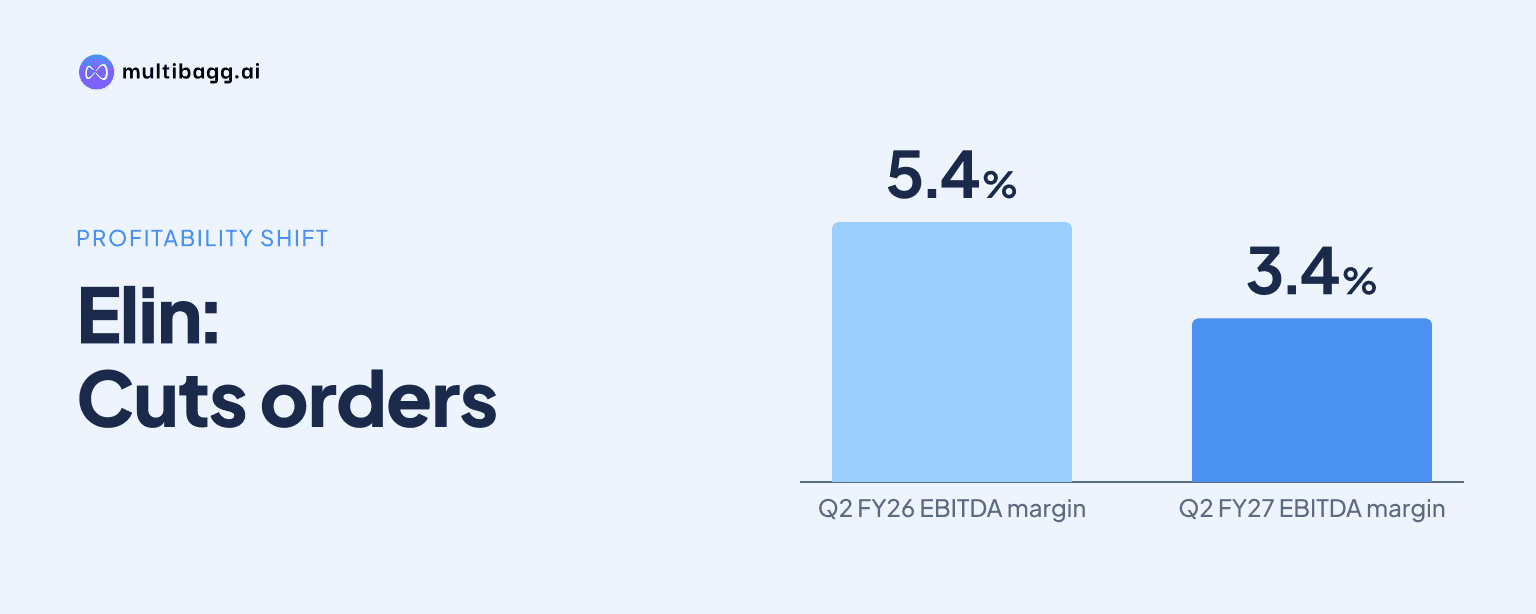
- Elin’s consolidated EBITDA margin was 3.4% in Q2 FY27, versus 5.4% in Q2 FY26 and about 1.1% in Q1 FY27.
powered by IRIS
Elin Electronics Limited cut back low-priced LED batten orders from August 2026 despite lifting lighting, fans and switches revenue to Rs 77.8 crore in Q2 FY27 from Rs 72.4 crore a year earlier. Management said continued production at the prior batten rate would have increased sales but produced a different bottom-line outcome.
Know Elin Electronics inside out
Results, valuation, peers and who's buying, in one view.
Why did Elin reduce LED batten orders?
Elin reduced LED batten orders because higher input costs were not reflected in market prices, making some orders uneconomic. Management said electronics and plastics costs had risen substantially while overall batten market prices had not increased, prompting the company to scale down the category from August 2026.
The decision was selective, not a complete withdrawal from battens. Elin said it would continue supplying customers that accepted its price terms, while avoiding a pursuit of customer or wallet share at prices that could lead to losses. Management said lighting revenue would have been above the reported Rs 77.8 crore if the earlier batten production rate had continued.
The move came within a broader pricing effort after raw-material inflation affected Q2 FY27 profitability. Management said polymer prices were up about 30% year on year, steel prices had risen 12% to 15%, and copper had reached an all-time high. It also cited a weaker rupee against the US dollar and Chinese yuan as increasing imported electronics, component and sea-freight costs.
How did Elin grow lighting revenue after cutting batten volumes?
Elin grew lighting, fans and switches revenue by Rs 5.4 crore year on year in Q2 FY27 because customers were ramping up LED-lighting capacity. LED-lighting revenue excluding flashlights increased to Rs 54.4 crore from Rs 47.5 crore, a Rs 6.9 crore rise that more than offset the effect of lower batten orders.
Elin said the lighting mix changed as downlights were replaced by battens. That mattered because battens faced price pressure, whereas management said it was expanding downlight and two-by-two product ranges with recently added customers. The company said it had added five or six customers beyond Signify, although it did not disclose individual customer revenue.
The segment also included a steady fan business of Rs 15 crore in Q2 FY27. Management described Q2 as seasonally weak for fans and expected pickup in Q3 and Q4, particularly in brushless direct-current, or BLDC, ceiling fans. Elin is adding BLDC fan capacity at its Bhiwadi plant, which began commercial production in mid-September 2026.
How is Elin seeking to restore profitability?
Elin is seeking customer prices that cover higher material and assembly costs while shifting its lighting mix towards products beyond battens. Management said the company was negotiating terms with customers willing to accept its price points instead of accepting every available order solely to expand revenue.
The assembly-cost discussions followed a 25% minimum-wage increase in Ghaziabad effective April 1, 2026, and a further increase of around 10% from October 1, 2026. Management said the Ghaziabad factory generates about 65% of Elin revenue. In the question-and-answer session, management estimated the wage impact on margin at close to 1 percentage point before recoveries.
Management said it still required a further broad price increase of about 4% to recover the remaining material-cost increase, assuming costs remained at prevailing levels. It qualified that estimate because Elin makes products with different price points, including motors, fans, ovens and heaters. Revenue growth in the quarter was driven overwhelmingly by price realisation, while volume growth was low single digit except in certain categories.
Got a follow-up? Ask IRIS
What changed in Elin’s margins and product mix?
Elin’s consolidated earnings before interest, tax, depreciation and amortisation, or EBITDA, margin declined to 3.4% in Q2 FY27 from 5.4% a year earlier because raw-material costs could not be fully passed through. Consolidated EBITDA fell to Rs 14.1 crore from Rs 20.3 crore even as operating revenue increased to Rs 413.2 crore from Rs 374.5 crore.
The 3.4% Q2 FY27 EBITDA margin was an improvement from about 1.1% in Q1 FY27, which management linked to pricing actions. However, management did not provide a firm margin forecast because of cost volatility. It said Q3 is historically a slower period after Diwali and suggested margins could be around the Q2 level, with a deviation of about 0.5 percentage points either way.
Product mix also changed between segments. Home-appliance revenue rose to Rs 175.8 crore in Q2 FY27 from Rs 140.6 crore in the preceding quarter, supported by mixer grinders, irons, electric kettles, hair dryers and sterilizers. In contrast, fractional horsepower, or FHP, motor revenue declined to Rs 56.8 crore from Rs 73.5 crore a year earlier because the segment records only third-party sales, while higher mixer-grinder and fan production consumed motors internally.
What does the Bhiwadi ramp mean for Elin’s outlook?
Elin expects the Bhiwadi plant to contribute about Rs 45 crore to Rs 50 crore of revenue in the remaining FY27 period and about Rs 150 crore in FY28. Management said those estimates are based on customer planning and are non-binding because the company does not operate an order-book system.
The plant started commercial production in mid-September 2026 and Elin plans to add fan and chimney production after its initial output. Management said customer visibility for FY28 revenue of about Rs 150 crore covers three product lines, including OFRs, ceiling fans and chimneys. It did not provide an expansion timetable beyond this stated production plan.
Elin had capitalised about Rs 65 crore for the first phase of Bhiwadi within total H1 FY27 capital expenditure of Rs 77.5 crore. Management said a further Rs 12 crore to Rs 14 crore may be required in the next year for another factory shed. It expects Bhiwadi EBITDA of about 2.5% to 3% on about Rs 50 crore of FY27 revenue and 6% to 6.5% if FY28 revenue reaches about Rs 150 crore.
Conclusion
Elin’s lower acceptance of low-priced batten orders means the Q2 FY27 lighting increase was not pursued at any price. The company raised lighting, fans and switches revenue to Rs 77.8 crore while directing customer discussions towards pricing that covers costs and seeking greater sales of downlights and two-by-two products. This strategy addresses a period in which group EBITDA margin fell from 5.4% to 3.4% year on year.
Next, investors can watch whether Elin recovers additional material and assembly costs through customer negotiations, and whether delayed Diwali demand supports Q3 revenue. Management also expects Bhiwadi revenue of about Rs 150 crore in FY28, but has said this is based on non-binding customer planning rather than assured orders.