










Elin says 4% more pricing is needed after Q2 margin fall
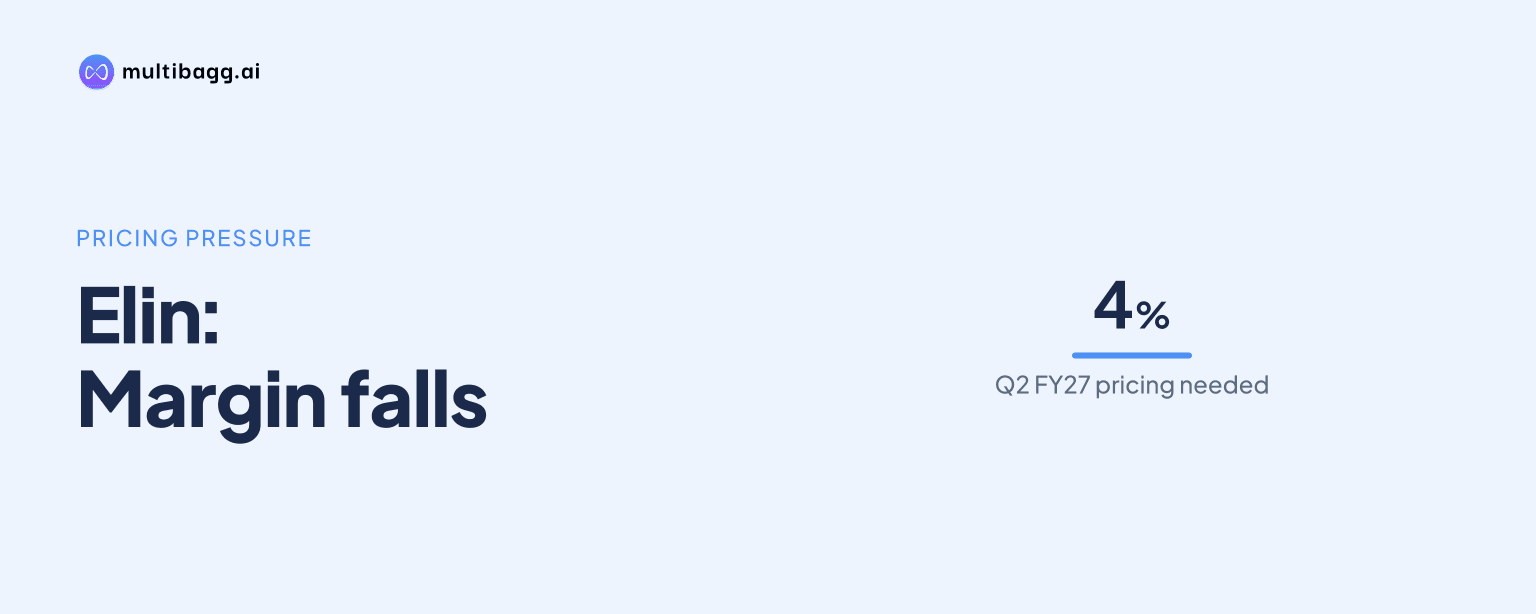
Elin Electronics Limited said roughly 4% more pricing is needed to recover higher material costs after Q2 FY27 EBITDA margin fell to 3.4% from 5.4% a year earlier, even as operating revenue rose 10% to Rs 413.2 crore. Management also said wage inflation was affecting margin by close to 1 percentage point.
Know Elin Electronics inside out
Results, valuation, peers and who's buying, in one view.
Why did Elin's Q2 FY27 margin fall despite revenue growth?
Elin's margin fell because material and wage costs rose faster than price recovery. Consolidated EBITDA, or earnings before interest, tax, depreciation and amortisation, declined to Rs 14.1 crore in Q2 FY27 from Rs 20.3 crore in Q2 FY26, while EBITDA margin contracted by 200 basis points to 3.4% from 5.4%. Management said the entire year-on-year margin decline resulted from raw-material costs that had not been fully passed on to customers.
Polymer prices were up about 30% year on year on average, according to management, following higher crude-oil prices associated with the Middle East conflict. Steel prices increased 12% to 15%, copper reached an all-time high, and the rupee's depreciation against the US dollar and Chinese yuan raised costs for imported electronics, components and sea freight. These costs offset the benefit of Q2 operating revenue increasing to Rs 413.2 crore from Rs 374.5 crore.
Product mix added to the pressure in Q2 FY27. Management cited lower sales of motors and select lighting products, which it described as higher-value-addition categories. In lighting, downlights were being replaced by battens, where market prices had not increased in line with electronics and plastic costs. Elin began scaling down battens from August unless customer pricing met its terms.
How much additional pricing does Elin need?
Elin said it needs about 4% further price increases, assuming material prices remain at their then-current levels, to pass through material-cost inflation. Management described this as a broad estimate rather than a common increase across all products because its range includes motors priced at Rs 300 to Rs 700, fans at about Rs 2,000, and ovens and heaters at about Rs 4,000.
Management said the additional pricing could take gross margin closer to 23% to 24%, not 25%, in response to an analyst's question. It also explained that most of the 10% to 12% growth referred to in the call reflected price realisation associated with material inflation. Volume growth was low single digit in most categories, apart from selected products, so reported revenue growth alone did not restore gross margin.
Elin is separately discussing assembly-cost recovery with customers following wage increases at its Ghaziabad operations. Minimum wages in the region rose 25% from April 1, 2026, followed by a further increase of around 7% from October 1, 2026, management said during the call. Ghaziabad accounts for about 65% of revenue, and management estimated the wage effect on margin at close to 1 percentage point.
Historically, management said annual wage increases of 4% to 7% could be absorbed through efficiency gains from higher volumes. The cumulative wage increase of roughly 33% to 35% over six months was different because of its scale. Elin said customer negotiations had begun but that recovery of higher assembly costs could take time.
Can Elin maintain its Q2 FY27 EBITDA margin?
Elin aims to make the Q2 FY27 EBITDA margin of 3.4% a base for improvement, but management would not commit to that outcome because of raw-material and macroeconomic volatility. The Q2 result improved from 1.1% in Q1 FY27, which management said reflected initial pricing actions. However, it cautioned that Q3 is historically its slowest quarter after the Diwali sales period.
For Q3 FY27, management expected margin to be broadly similar to Q2, with a possible movement of 0.5 percentage points on either side. It said the later Diwali timing should shift some revenue into Q3 compared with the prior year. That potential revenue benefit may be moderated by seasonal demand patterns and the early-stage ramp-up of the Bhiwadi factory.
For full-year FY27, management said EBITDA margin was unlikely to exceed the 3% to 3.5% range because of the weak first quarter, while adding that it should remain above 2.5%. These were management expectations rather than formal EBITDA guidance. Elin retained revenue guidance of about Rs 1,400 crore for FY27, with a variation of plus or minus 3%.
Management said it is prioritising profitability over revenue and is prepared to reject business that does not meet required pricing. The lighting strategy illustrates that approach: Elin said segment revenue would have been higher than Rs 77.8 crore in Q2 FY27 if it had continued accepting batten orders at the prior pace, but the resulting profitability would have differed.
Which segments and Bhiwadi factors affect Elin's margin recovery?
Home appliances and lighting added revenue growth, while FHP motor sales and Bhiwadi start-up costs affected the overall mix. Home-appliance revenue increased 25% sequentially to Rs 175.8 crore in Q2 FY27 from Rs 140.6 crore in Q1 FY27, supported by mixer-grinder and iron volumes. Elin also began regular electric-kettle supplies in the quarter, while personal-care revenue rose 28% year on year on hair dryers and sterilisers.
The lighting, fans and switches segment recorded revenue of Rs 77.8 crore in Q2 FY27, compared with Rs 72.4 crore a year earlier. LED lighting excluding flashlights rose to Rs 54.4 crore from Rs 47.5 crore, aided by customer capacity ramp-up. Fan revenue was steady at Rs 15 crore, and management expects demand to improve in Q3 and Q4 while it adds brushless direct-current, or BLDC, ceiling-fan capacity at Bhiwadi.
FHP, or fractional horsepower, motor revenue declined to Rs 56.8 crore from Rs 73.5 crore a year earlier. Management said this segment records only third-party motor sales, while motors consumed internally for mixer grinders and fans are reported within appliance revenue. It also cited one customer establishing its own motor facility and customers choosing to buy finished products rather than separately sourced motors.
Bhiwadi began commercial production in mid-September 2026, initially making oil-filled radiators, with fans and chimneys to follow. Management expects about Rs 50 crore of revenue from the plant in the remaining FY27 period, with EBITDA margin of about 2.5% to 3% at that scale. It has visibility of about Rs 150 crore for FY28 from oil-filled radiators, ceiling fans and chimneys, where it expects Bhiwadi EBITDA margin of 6% to 6.5%.
Conclusion
Elin's Q2 FY27 performance shows that revenue growth has not yet offset input-cost inflation. Operating revenue rose by Rs 38.7 crore year on year, but EBITDA declined by Rs 6.2 crore as polymers, metals, imported inputs and wages rose faster than recovered selling prices. The stated 4% further pricing requirement identifies the remaining material-cost gap, while the wage increase presents a separate assembly-cost recovery issue.
The next points to watch are customer acceptance of material and assembly-cost increases, Q3 FY27 margin relative to management's 0.5-percentage-point range around Q2, and Bhiwadi's ramp-up. Management has visibility for Rs 150 crore of FY28 revenue at Bhiwadi but said it does not have visibility for the facility's Rs 500 crore to Rs 550 crore full potential.