










Emami International Sales Fell 2% as Disruptions Hit Q2FY27
Key highlights
- Emami’s reported international sales declined 2% year on year in Q2FY27.
- Emami reported 6% underlying international growth in Q2FY27 excluding Nepal and Iraq.
- International business contributed 14% of Emami’s consolidated business in H1FY27.
- MENAP accounted for 44% of Emami’s international business in H1FY27.
powered by IRIS
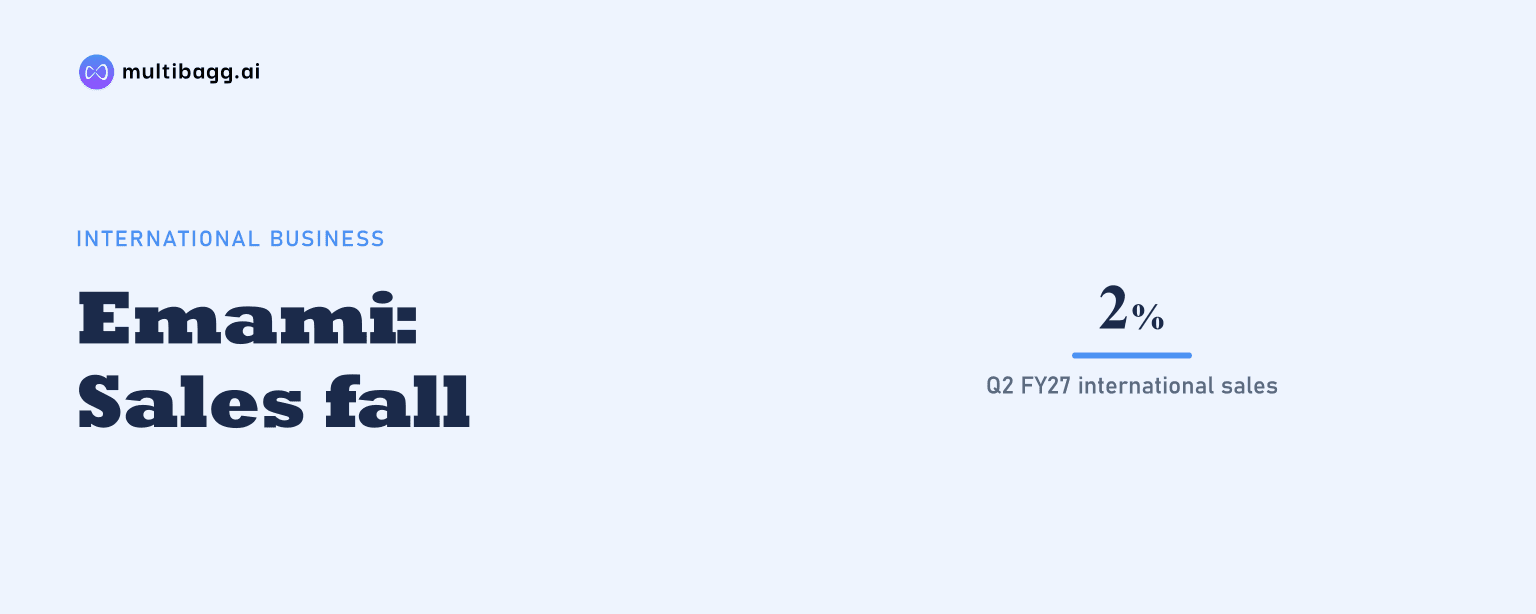
Emami Limited reported a 2% year-on-year decline in international sales in Q2FY27 as Nepal floods and Gulf supply disruptions caused stock-outs across multiple markets, while underlying growth was 6% excluding Nepal and Iraq. International business accounted for 14% of consolidated business in H1FY27.
Know Emami inside out
Results, valuation, peers and who's buying, in one view.
Why did Emami international sales fall in Q2FY27?
Emami’s international sales fell 2% year on year in Q2FY27 because Nepal floods and supply disruptions caused stock-outs across multiple markets. The presentation identifies the Gulf disruption as part of the overseas impact, but does not quantify the sales effect by country, product category or market.
The reported decline contrasts with 6% underlying international growth after excluding Nepal and Iraq. That is an 8-percentage-point difference between the reported 2% contraction and the adjusted growth measure, showing that the affected markets had a material effect on the reported result.
Emami did not disclose Q2FY27 international revenue in rupees, sales volumes, or the duration of stock-outs. It also did not provide a bridge separating the effects of Nepal floods, Iraq, Gulf supply disruption or other markets on the 2% reported decline.
How important is international business to Emami?
International business contributed 14% of Emami’s consolidated business in H1FY27. The presentation reports this contribution alongside a Q2FY27 international sales-growth figure, but does not disclose an H1FY27 international growth rate or a separate overseas revenue amount.
MENAP was the largest regional category, contributing 44% of international business in H1FY27, followed by SAARC & SEA at 37%. CIS & EE accounted for 13%, while Africa & Others represented 6%; together, MENAP and SAARC & SEA made up 81% of the international business.
The regional split shows a 38-percentage-point difference between MENAP at 44% and Africa & Others at 6%. SAARC & SEA’s 37% contribution was also 24 percentage points above CIS & EE’s 13%, although Emami did not provide prior-period regional mix data to show how these shares changed.
What is Emami doing to address overseas stock-outs?
Emami said it is using alternative shipping routes and container-load optimization to mitigate supply disruption and stock-outs across multiple markets. These actions address the logistics constraints cited for Q2FY27, though the presentation gives no count of affected routes, containers or countries.
The company also listed disciplined spends and price increases across most markets among its mitigation measures. Emami did not disclose the size, timing or market-level coverage of those price increases, nor whether they offset any logistics or supply-chain costs.
Separately, Emami’s Project SETU supply-chain transformation includes stock-keeping unit simplification, improved distributor and inventory visibility, logistics and technology modernisation, replenishment and forecasting. The presentation does not quantify Project SETU’s role in resolving the Q2FY27 international stock-outs.
Got a follow-up? Ask IRIS
Is Emami expecting international supply conditions to improve?
Emami expects supply conditions to progressively improve, according to its Q2FY27 international-business outlook. This is a management expectation rather than a numerical target, as the presentation gives no date for normalisation or forecast for subsequent-quarter international sales growth.
The outlook follows a quarter in which reported international sales fell 2% while the underlying measure rose 6% excluding Nepal and Iraq. A subsequent reduction in the gap between those two measures would indicate whether improved availability is reaching reported sales performance.
The presentation does not state whether Nepal flood effects have ended, whether Gulf disruption has been fully resolved, or how long stock-outs persisted. It also does not provide a country-level recovery plan for Nepal, Iraq or the other affected markets.
How does the overseas disruption fit Emami’s wider Q2FY27 results?
Emami reported consolidated revenue from operations of Rs 1,088 crore in Q2FY27, up 36% year on year, while international sales declined 2%. The presentation does not provide segment revenue sufficient to calculate international business’s contribution to the consolidated revenue increase.
For H1FY27, revenue from operations was Rs 2,127 crore, up 25% year on year, and international business represented 14% of consolidated business. Profit after tax was Rs 282 crore, down 10%; Emami attributed the movement to normalisation of the effective tax rate to about 25% following minimum alternate tax credit utilisation versus entitlement in the previous year.
Q2FY27 EBITDA, or earnings before interest, tax, depreciation and amortisation, margin was 20.4%, down 200 basis points from 22.4% in Q2FY26. The margin bridge shows a 5.2-percentage-point effect from cost of goods sold, partly offset by a 2.3-point staff-cost effect and a 1.2-point administration-and-other effect, without assigning any movement to international disruption.
Conclusion
Emami’s overseas result combined a 2% reported sales decline with 6% underlying growth excluding Nepal and Iraq. Nepal floods and Gulf supply disruption caused stock-outs, while the regional mix makes MENAP and SAARC & SEA, which together represented 81% of international business in H1FY27, central to the recovery in availability.
Next, the key disclosure will be whether alternative shipping routes, container-load optimization, disciplined spends and price increases support management’s expectation of progressively improving supply conditions. Emami has not set a recovery date or international sales target, leaving future reported growth and stock-out conditions unresolved.