










Emami Q2FY27 EBITDA Margin Falls 200 Basis Points Despite Growth
Key highlights
- Emami’s Q2FY27 EBITDA margin declined 200 basis points to 20.4%.
- Q2FY27 revenue from operations increased 36.2% to Rs 1,087.7 crore.
- COGS reduced Q2FY27 EBITDA margin by 5.2 percentage points.
- Q2FY27 EBITDA rose 24.5% to Rs 222.3 crore despite the margin decline.
powered by IRIS
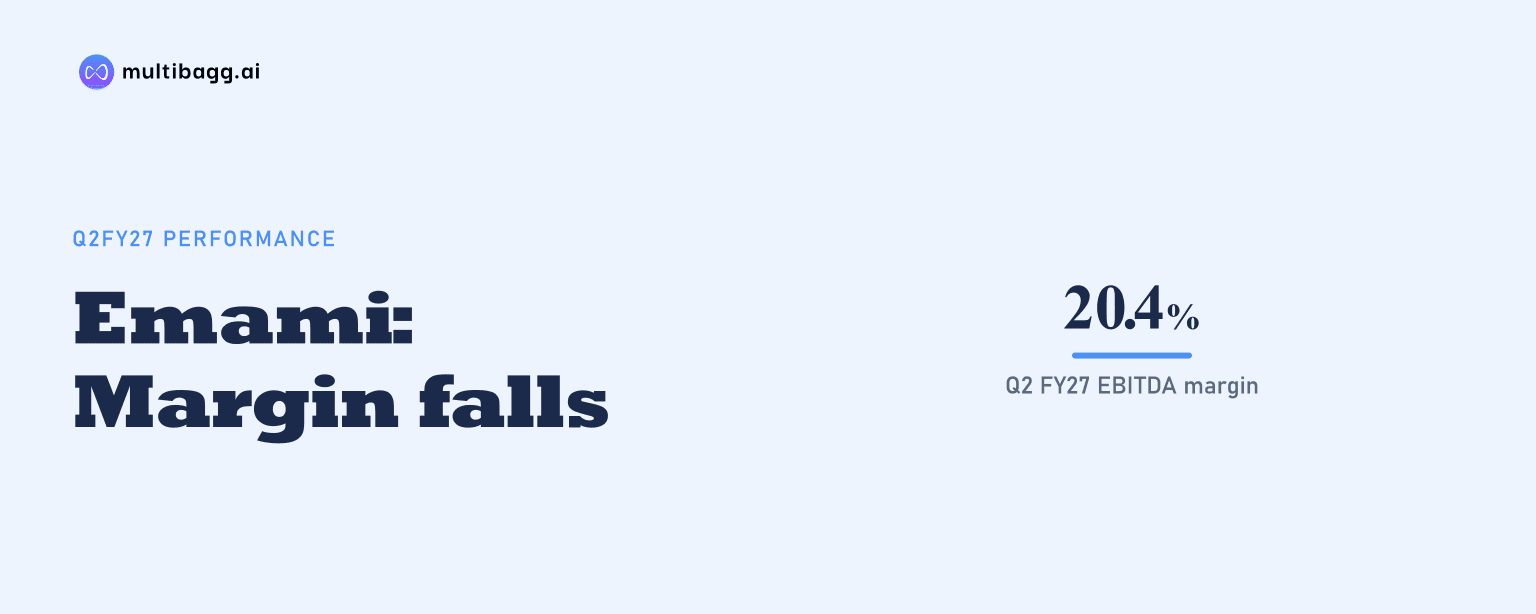
Emami Limited’s earnings before interest, tax, depreciation and amortisation (EBITDA) margin fell 200 basis points year on year to 20.4% in Q2FY27, despite EBITDA rising 24.5% to Rs 222.3 crore, as cost of goods sold reduced margin by 5.2 percentage points. Revenue from operations increased 36.2% to Rs 1,087.7 crore.
Know Emami inside out
Results, valuation, peers and who's buying, in one view.
Why did Emami’s EBITDA margin fall in Q2FY27?
Emami’s EBITDA margin fell because cost of goods sold, or COGS, reduced the Q2FY27 margin by 5.2 percentage points, exceeding savings elsewhere in the cost base. EBITDA amounted to Rs 222.3 crore, up from Rs 178.5 crore in Q2FY26, but its share of revenue declined from 22.4% to 20.4%.
The pressure is visible in materials cost, which climbed 60.7% year on year to Rs 371.7 crore, faster than the 36.2% increase in revenue from operations. Materials cost represented 34.2% of revenue in Q2FY27, compared with 29.0% a year earlier. Gross profit still rose 26% to Rs 716 crore, while gross margin declined 520 basis points to 65.8%.
Emami’s margin bridge records a net 200-basis-point reduction from Q2FY26’s 22.4% EBITDA margin to 20.4% in Q2FY27. The bridge measures costs as a share of revenue, explaining why EBITDA grew in rupee terms while margin contracted: revenue increased by Rs 289.2 crore, but materials cost absorbed a larger proportion of sales.
How did Emami offset higher input costs?
Emami partly offset the 5.2-percentage-point COGS impact through a 2.3-percentage-point benefit from staff costs and a 1.2-percentage-point benefit from administrative and other expenses. Staff cost rose 15.6% to Rs 140.1 crore, below revenue growth, reducing its revenue share to 12.9% from 15.2% in Q2FY26.
Administrative and other expenses increased 24.1% to Rs 137.8 crore, but declined as a proportion of revenue from 13.9% to 12.7%. This generated the 1.2-percentage-point bridge benefit. Together, staff and administrative costs supplied 3.5 percentage points of offsets, cushioning but not eliminating the 5.2-point input-cost impact.
A&P was the other adverse line in the bridge, reducing margin by 0.3 percentage points. A&P spending grew 37.9% to Rs 215.7 crore and represented 19.8% of revenue, against 19.6% in Q2FY26. The 200-basis-point net contraction therefore comprised a 5.5-point headwind from COGS and A&P, partly offset by 3.5 points from staff and administrative expenses.
Got a follow-up? Ask IRIS
Did Emami’s higher sales raise quarterly earnings?
Emami’s Q2FY27 sales growth raised operating profit and profit before tax, although profit after tax declined after tax expense increased. Net sales rose 37.2% to Rs 1,079.6 crore, revenue from operations reached Rs 1,087.7 crore, and EBITDA increased 24.5% to Rs 222.3 crore. Profit before tax (PBT) rose 28.9% to Rs 193.6 crore.
The difference between the operating result and net profit came principally from tax. Tax expense increased to Rs 48.1 crore in Q2FY27 from Rs 1.8 crore in Q2FY26, while profit after tax (PAT) declined 1.9% to Rs 145.5 crore. Emami attributed the PAT impact to normalisation of the effective tax rate to about 25%, compared with minimum alternate tax (MAT) credit utilisation versus entitlement in the prior year.
Profit for the period was Rs 144.4 crore in Q2FY27, down 2.7% from Rs 148.3 crore a year earlier, and its margin was 13.3% versus 18.6%. Other income rose 7.4% to Rs 23 crore, while interest cost increased 131.3% to Rs 6.1 crore. The quarterly comparison shows revenue growth of 36.2%, EBITDA growth of 24.5%, and a 200-basis-point EBITDA-margin decline.
How did Emami’s first-half margin compare with Q2?
Emami reported the same 200-basis-point EBITDA-margin contraction in H1FY27 as in Q2FY27, taking the first-half margin to 21.1% from 23.1%. First-half EBITDA increased 14.2% to Rs 448.5 crore on revenue from operations growth of 24.9% to Rs 2,126.9 crore. The H1FY27 margin was 0.7 percentage points above the Q2FY27 margin of 20.4%.
The first-half bridge shows a 4.4-percentage-point COGS impact, smaller than the 5.2-point impact in Q2 alone. Staff costs provided a 1.2-point benefit and administrative and other expenses added another 1.2 points, while A&P had no margin effect. Materials cost was Rs 726.9 crore, or 34.2% of H1FY27 revenue, compared with 29.8% in H1FY26.
First-half PAT declined 9.0% to Rs 284.4 crore even as PBT rose 15.3% to Rs 388.3 crore. Tax expense was Rs 103.9 crore, compared with Rs 24.3 crore in H1FY26, and PAT margin declined 520 basis points to 13.2%. The first-half pattern therefore matched Q2FY27: sales and EBITDA expanded in absolute terms, while higher input costs and tax normalisation reduced margins and net profit.
Conclusion
Emami’s results show that the rise in materials cost outpaced revenue growth in both Q2FY27 and H1FY27. In Q2FY27, materials cost grew 60.7% to Rs 371.7 crore, while staff and administrative cost efficiencies offset 3.5 percentage points of the 5.5-point combined COGS and A&P headwind. That left EBITDA margin at 20.4%, even as EBITDA rose to Rs 222.3 crore.
The next disclosed operational factors to watch are Emami’s Sales Code AI platform and Project SETU supply-chain programme, which cover stock-keeping-unit simplification, inventory visibility, replenishment and forecasting. Management also expects international supply conditions to progressively improve after disruptions linked to Nepal floods and the Gulf, while international business contributed 14% of consolidated business in H1FY27.