










Endurance says EU rules could unlock new European orders
Key highlights
- Endurance said a 350,000-vehicle cap on Chinese plug-in and mild-hybrid imports would begin on 1 December 2026.
- Management said a proposed rule could require 70% European origin for non-battery EV component value by February or March 2027.
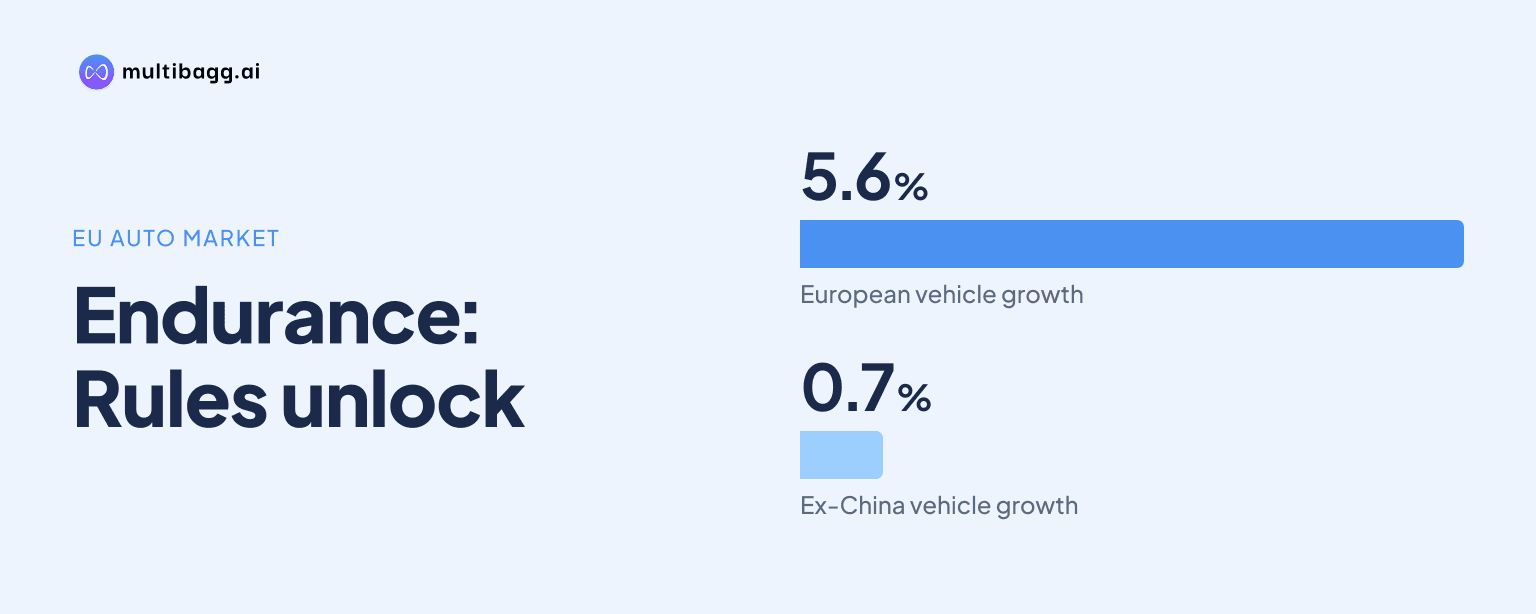
- Endurance said European vehicle-market growth was 5.6%, versus 0.7% excluding Chinese OEMs.
- Endurance said Fondalpress adds 16 automated die-casting machines rated from 2,300 tonnes to 2,800 tonnes.
powered by IRIS
Endurance says European measures described by management, including a 350,000-vehicle cap on certain Chinese hybrid imports from 1 December 2026 and a proposed 70% European-content threshold for non-battery electric-vehicle components, could create new supplier-order opportunities for its European manufacturing base.
Know Endurance Technologies inside out
Results, valuation, peers and who's buying, in one view.
Why does Endurance expect EU rules to create orders?
Endurance expects the measures cited by management to encourage more vehicle assembly and component sourcing within Europe. Management identified three potential drivers: a cap on Chinese plug-in and mild-hybrid vehicle imports from 1 December 2026, duties on Chinese electric vehicles, and the proposed Accelerator Act, which it expects could be approved by February or March 2027.
The opportunity is not a disclosed customer order or revenue commitment. Management said Chinese original equipment manufacturers, or OEMs, that export more than 350,000 vehicles during the preceding six months would need to establish production capacity in Europe, including for internal-combustion-engine vehicles. Endurance expects that requirement could generate requests for quotations from Chinese OEMs for locally supplied components.
Management’s argument is based on potential sourcing changes rather than a stated contract value. It said localisation could allow Endurance to increase use of European production capacity and potentially return to deeper volumes than in the past. The company separately cited its Mercedes award for two transmission components starting in 2029 as evidence that its European operations are continuing to win new programmes.
What EU measures did Endurance identify?
Endurance said the Chinese hybrid-import cap would start at 350,000 vehicles on 1 December 2026 and could increase by only 6% over the following four years. Management described the limit as applying to plug-in and mild-hybrid vehicle imports from China, creating a potential incentive for Chinese OEMs to localise production rather than rely on imports.
Management also said duties on Chinese electric-vehicle imports have been set at different levels by manufacturer. It cited rates of 27% for BYD, 29% for Geely, 45% for SAIC and 18% for Tesla, while placing other manufacturers in a 21% to 35% range. Endurance did not quantify how those duties may affect vehicle prices, supplier budgets or its own revenue.
The third policy factor is the Accelerator Act, which management said the European Community could approve by February or March 2027. According to management’s description, the proposal would require at least 70% of the value of non-battery components in electric vehicles to originate in Europe. Endurance said that rule, if approved as described, could support production-capacity expansion among European suppliers.
How dependent is European market growth on Chinese OEMs?
Endurance said the European vehicle market grew 5.6% in the prior quarter, but that growth would have been only 0.7% excluding Chinese OEMs. Management therefore estimated that Chinese manufacturers accounted for more than 90% of the reported year-on-year market expansion, making their future production and sourcing decisions relevant to European component suppliers.
Management cited a 23% increase for SAIC, 133% for BYD, 26% for Geely and 215% for Chery in that period. These rates explain why Endurance sees policy restrictions on Chinese imports as commercially relevant. They do not, however, confirm that any of those companies will establish European plants or award Endurance supply contracts.
Endurance said its own European business had grown more than three to four times faster than the market, which management attributed to electric-vehicle business wins secured over the last five years. The company did not provide a product-level split for that growth between castings, suspension, braking and battery-pack activity, nor did it link a specific part of the increase to Chinese OEM customers.
Got a follow-up? Ask IRIS
Which Endurance assets could support additional European orders?
Endurance said the Fondalpress acquisition adds 16 fully automated die-casting machines with capacities ranging from 2,300 tonnes to 2,800 tonnes. Management said the equipment is in working condition and can immediately increase manufacturing capacity, including for parts currently bought from external suppliers.
The Fondalpress site includes about 16,400 square metres of buildings and land for future growth, according to management. It is about 40 kilometres from an Endurance plant. Management also said the acquisition provides a new 5,000-square-metre machining facility, which it plans to use for diversification and future certification processes across automotive and other sectors.
A key integration opportunity involves Stöferle, where Endurance said 100% of raw parts are currently bought from the market. Management said Fondalpress could insource 100% of those raw parts, potentially creating economies of scale in contribution margin and earnings before interest, tax, depreciation and amortisation, or EBITDA. It did not disclose a timetable or financial value for the proposed transfer.
Endurance also described its European product base as relevant to electric vehicles because it supplies castings, suspension and braking products. It said battery-pack activity has started, while clutch assemblies remain mainly tied to internal-combustion-engine vehicles. That distinction matters because the proposed 70% origin requirement, as management described it, covers non-battery electric-vehicle component value.
When could the opportunity affect Endurance orders?
The first policy date cited by Endurance is 1 December 2026, when the 350,000-vehicle Chinese hybrid-import cap is expected to begin. The proposed Accelerator Act was described as a February or March 2027 event, meaning any benefit to Endurance would depend on the final law, customer compliance plans and decisions on European vehicle and component production.
Management’s confirmed order evidence is the Mercedes transmission programme, which is due to begin in 2029. Endurance said the award covers two components for a new Mercedes transmission. Its expectation of requests for quotations from Chinese OEMs remains a forward-looking management view, with no disclosed number of quotations, components, customers or likely conversion rate.
Capacity additions would also follow customer demand rather than precede it automatically. Endurance said that once a large facility is established, it can add production lines relatively easily when customer visibility emerges. This means a policy-driven increase in orders would still require customer nominations and subsequent production investment before it becomes revenue or plant utilisation.
Conclusion
Endurance’s European order opportunity rests on a potential shift in sourcing incentives. Management said a 350,000-vehicle Chinese hybrid-import cap from December 2026, electric-vehicle duties ranging from 18% to 45%, and a proposed 70% European-origin threshold for non-battery EV components could favour local supply. Its 16-machine Fondalpress asset base and Mercedes transmission award provide operating context, but not proof of Chinese-OEM business.
The next disclosed milestones are the planned 1 December 2026 cap and the expected February or March 2027 decision on the Accelerator Act. Investors can watch for evidence that Chinese OEMs establish European production, send Endurance requests for quotations or make supplier nominations, as well as progress toward the 2029 start of the Mercedes transmission programme.