










Endurance H1 income rises 31.6%, EBITDA margin falls to 12.6%
Key highlights
- Endurance’s H1 FY 26-27 consolidated income rose 31.6% to Rs 9,159 crore.
- Endurance’s H1 EBITDA margin declined to 12.6% from 14.0% a year earlier.
- Endurance’s H1 consolidated profit after tax increased 14.4% to Rs 519 crore.
- Indian operations including Maxwell contributed 76% of Endurance’s H1 consolidated income.
powered by IRIS
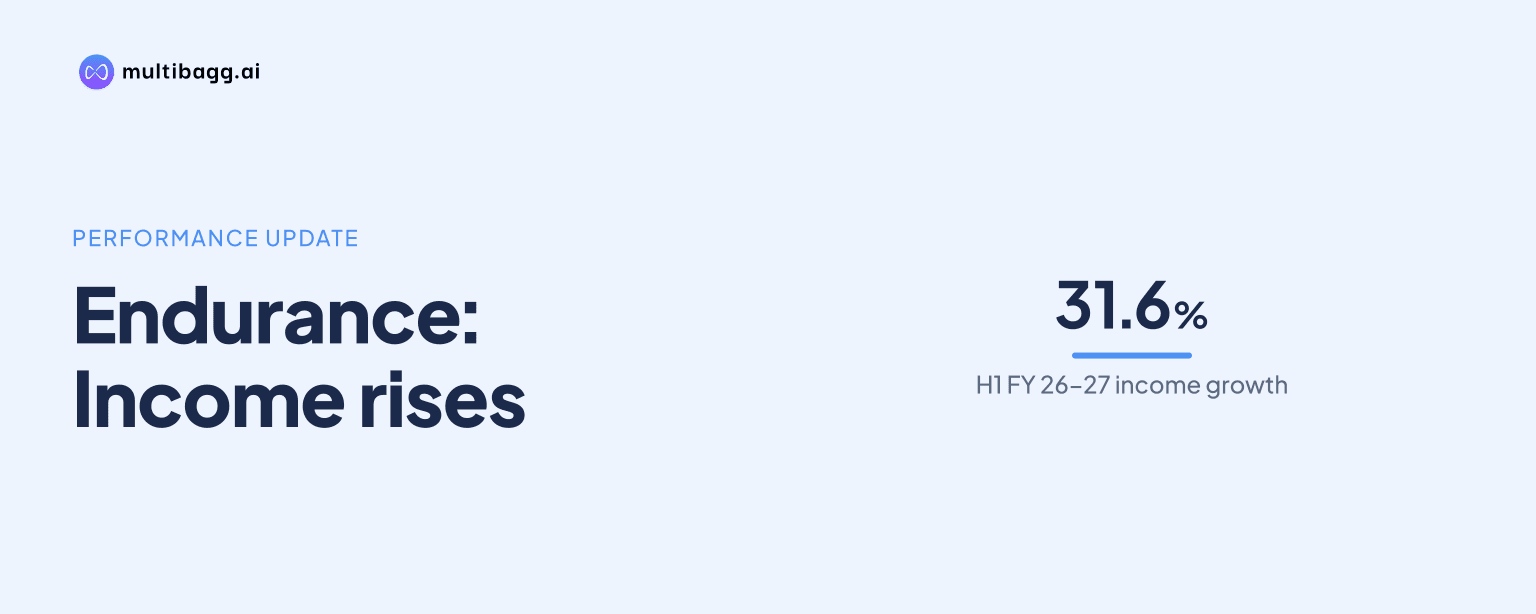
Endurance Technologies Limited reported H1 FY 26-27 consolidated total income including other income of Rs 9,159 crore, up 31.6% year on year, while earnings before interest, tax, depreciation and amortisation (EBITDA) margin fell to 12.6% from 14.0%. Consolidated profit after tax increased 14.4% to Rs 519 crore.
Know Endurance Technologies inside out
Results, valuation, peers and who's buying, in one view.
What drove Endurance’s H1 income growth?
Endurance’s consolidated total income including other income increased by Rs 2,201 crore to Rs 9,159 crore in H1 FY 26-27 from Rs 6,958 crore in H1 FY 25-26. The India business, represented by standalone total income including other income, grew faster at 37.9%, reaching Rs 6,955 crore from Rs 5,043 crore. Indian operations, including Maxwell, accounted for 76% of consolidated income, with European operations providing the remaining 24%.
The second-quarter comparison showed the same pattern. Consolidated total income rose 33.5% to Rs 4,811 crore in Q2 FY 26-27 from Rs 3,604 crore in Q2 FY 25-26, while standalone income increased 39.7% to Rs 3,761 crore from Rs 2,692 crore. Management linked the Indian performance to automotive-market volume growth in Q2 FY27, when two-wheeler sales rose 18%, three-wheelers 27% and passenger vehicles 24% year on year.
Why did Endurance’s EBITDA margin decline?
Endurance’s consolidated EBITDA margin fell by 140 basis points to 12.6% in H1 FY 26-27 from 14.0% a year earlier, even as EBITDA increased 18.0% to Rs 1,153 crore from Rs 977 crore. Total income grew 31.6%, faster than EBITDA, reducing the EBITDA proportion of income. Consolidated profit after tax margin also declined to 5.7% from 6.5%.
The Q2 FY 26-27 result showed a similar margin movement. EBITDA rose 17.3% to Rs 584 crore from Rs 498 crore, but the EBITDA margin fell to 12.1% from 13.8%; profit after tax rose 20.7% to Rs 274 crore from Rs 227 crore. Reported profit before tax was Rs 321 crore, while profit before tax after exceptional items was Rs 356 crore, compared with Rs 304 crore in Q2 FY 25-26.
How did Endurance’s India and Europe businesses compare?
Endurance’s India business supplied the larger part of H1 FY 26-27 consolidated income, contributing 76% through Indian operations including Maxwell, while Europe contributed 24%. Standalone income of Rs 6,955 crore expanded 37.9%, exceeding the 31.6% increase in consolidated income. Standalone EBITDA rose 17.3% to Rs 752 crore from Rs 642 crore, but its margin declined to 10.8% from 12.7%.
In Europe, management said new-car registrations grew 5.6% year on year in Q2 FY27, with Chinese original equipment manufacturers, or OEMs, providing a major share of the increase. Endurance said its European revenue in euro terms also grew 5.6%, matching the registration growth rate. In India, Endurance predominantly serves two- and three-wheeler OEMs, while its European operations supply aluminium castings to four-wheeler OEMs and two-wheeler aftermarket customers.
Endurance’s Indian aftermarket sales reached Rs 303 crore in H1 FY 26-27, compared with Rs 243 crore in the corresponding period a year earlier. That was an increase of Rs 60 crore. Across its operating footprint, Endurance has 37 plants, comprising 22 in India, five in Germany and 10 in Italy.
Got a follow-up? Ask IRIS
What is Endurance doing to improve profitability?
Endurance management said it expects an increasing trend in profitability from expected softening in aluminium prices, improved pass-through of higher costs, new-plant ramp-up, and cost-management and operational-efficiency efforts. This is management’s outlook rather than a quantified margin target. The identified measures follow the 140-basis-point H1 EBITDA-margin reduction to 12.6% in FY 26-27.
In India, the AURIC Shendra plant was commissioned during the period and is intended to make aluminium die-casting components for Indian and global four-wheeler OEMs across electric-vehicle and internal-combustion-engine platforms, as well as non-automotive applications. Endurance also began supplies of dual-channel anti-lock braking systems during Q2 FY27. Its battery-pack plant began two-wheeler battery-pack production in Q1 FY27 and was ramping up, according to management.
In Europe, Endurance acquired Fondalpress in Italy in October 2026, after the Q2 period, and management said the acquisition would strengthen the next quarter’s European results. During Q2 FY27, Endurance also accelerated the purchase of Stöferle’s remaining 32% stake, taking its ownership to 100%. Management said Fondalpress adds aluminium-casting and machining capability and creates opportunities for operational integration alongside organic growth and selective acquisitions.
Conclusion
Endurance’s H1 FY 26-27 result combined faster income expansion with a lower operating margin: consolidated income increased 31.6%, while EBITDA rose 18.0%, taking the margin to 12.6% from 14.0%. Profit after tax still rose 14.4% to Rs 519 crore, while India, including Maxwell, represented 76% of consolidated income and standalone income grew 37.9%.
The next results will show whether the factors cited by management, including aluminium-price movements, cost pass-through, operational efficiency and new-plant ramp-up, affect profitability. They will also include the first reported contribution from Fondalpress after its October 2026 acquisition and provide updates on the AURIC Shendra plant, dual-channel anti-lock braking system supplies and battery-pack production ramp-up.