










Endurance expects 1-point India margin support from Q3 FY27
Key highlights
- Endurance's India standalone raw-material cost rose to 70% of sales in Q2 FY27 from 66% in Q2 FY26.
- Management expects about 1.0 to 1.1 percentage points of Q3 FY27 gross-margin support from pricing and commodity changes.
- India standalone EBITDA was Rs 395 crore in Q2 FY27, up 18% year-on-year, while EBITDA margin was 10.5%.
- Four greenfield facilities created about 0.5% negative PBT-margin drag in Q2 FY27, according to management.
powered by IRIS
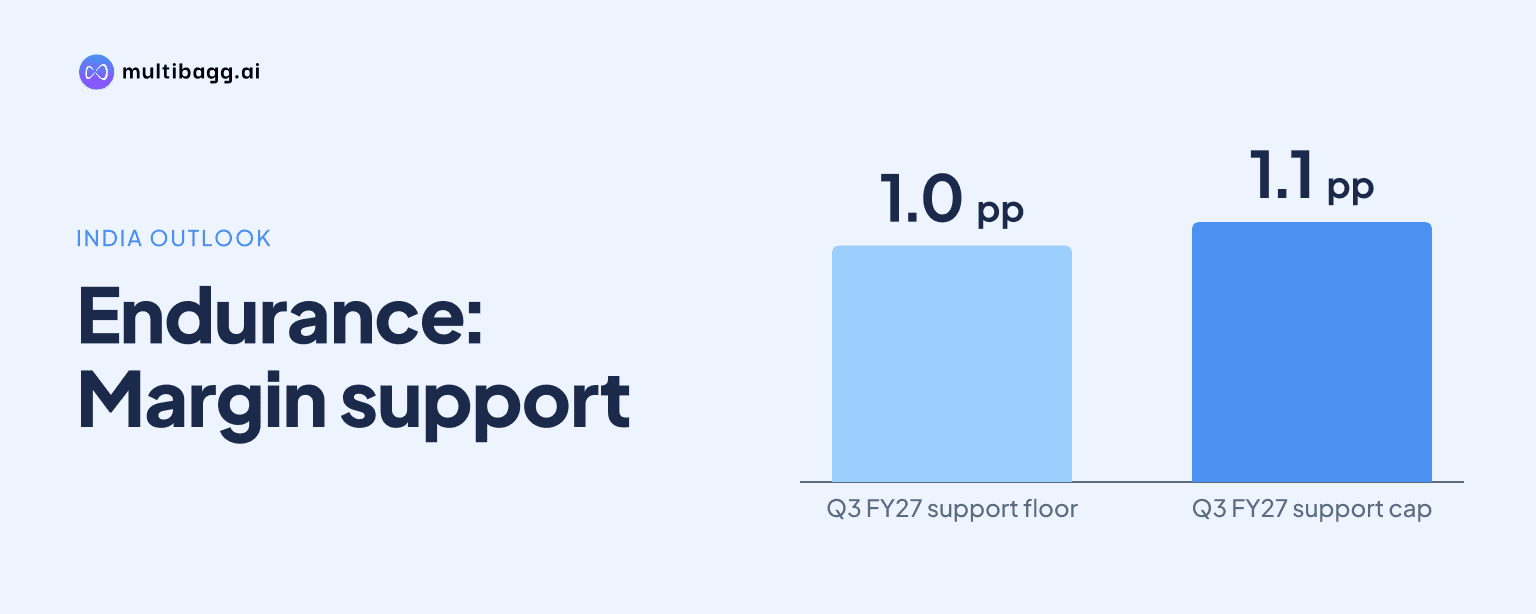
Endurance Technologies Limited expects 1.0 to 1.1 percentage points of India gross-margin support in Q3 FY27, as price increases effective 1 October 2026 contribute about 0.5 percentage points and a favourable commodity basket adds 0.5% to 0.6%, after Q2 raw-material cost reached 70% of sales.
Know Endurance Technologies inside out
Results, valuation, peers and who's buying, in one view.
Why did Endurance's India margin fall in Q2 FY27?
Endurance's India standalone earnings before interest, tax, depreciation and amortisation, or EBITDA, margin was 10.5% in Q2 FY27, after management said it declined by 2% despite EBITDA increasing 18% year-on-year to Rs 395 crore. The immediate pressure was raw-material cost: raw-material cost as a share of sales rose to 70% in Q2 FY27 from 66% in Q2 FY26, a 4-percentage-point increase.
Management also said higher conversion costs were not fully adjusted by most original equipment manufacturers, or OEMs, in Q1 and Q2 FY27. These costs included fuel expenses for diesel, compressed natural gas, or CNG, and liquefied petroleum gas, or LPG, as well as cutting tools. Some OEM settlements began only from Q3 FY27, or 1 October 2026 onwards.
The margin result lagged revenue growth in India. India standalone total income rose 40% year-on-year to Rs 3,761 crore in Q2 FY27, while EBITDA rose 18%. Endurance's European business, by comparison, reported a 17.8% EBITDA margin on total income of Rs 1,029 crore, while management's cost-recovery comments specifically addressed the India standalone business.
How much margin support does Endurance expect in Q3 FY27?
Endurance expects approximately 1.0 to 1.1 percentage points of gross-margin support in Q3 FY27 from two identified factors. Management estimated about 0.5 percentage points from customer price increases effective from 1 October 2026, alongside a 0.5% to 0.6% positive effect from its commodity basket.
The commodity outlook is mixed rather than uniformly favourable. Management expects steel prices to increase in Q3 FY27 but sees aluminium-alloy prices softening. Because aluminium alloys and steel are significant components of raw-material cost, management's net assessment was an absolute 0.6% reduction in raw-material cost as a percentage of sales for Q3.
The price recovery is not complete across the customer base. Management said customer engagement remained ongoing, with some customers potentially granting price increases in Q4 FY27 and others possibly doing so in the following financial year. The cited Q3 support therefore does not mean all Q1 and Q2 conversion-cost increases have been recovered.
What else is holding back Endurance's India profitability?
Endurance said four greenfield facilities together created a negative profit-before-tax, or PBT, margin effect of about 0.5% in Q2 FY27. The group has incurred cumulative capital expenditure of about Rs 1,100 crore on these facilities, which are moving into commercial production and are expected to improve profitability progressively as output ramps up.
Management expects the drag to decline progressively and said the four facilities should make a positive contribution in the next financial year. This factor is separate from pricing and commodity movements: the plant effect concerns the ramp-up of new facilities, while the other two concern material costs and customer price recovery.
Investment remains elevated. India capital expenditure was approximately Rs 800 crore in FY26, compared with Rs 611 crore in FY25, and management expects about Rs 1,100 crore in FY27. Consolidated capital expenditure is expected to be Rs 1,250 crore in FY27, covering expansion in four-wheeler aluminium castings, braking systems, battery packs and non-automotive products.
Got a follow-up? Ask IRIS
Which new operations could reduce Endurance's margin drag?
Endurance's AURIC Shendra plant began start of production, or SOP, on 25 September 2026 and serves four-wheeler OEMs in India, the UK and the US. The facility performs high-pressure and low-pressure die casting, critical machining and powder coating, and supplies to a US electric-vehicle OEM had begun by the Q2 FY27 call.
A new Chennai plant for disc-brake assembly systems is scheduled to begin SOP in March 2027. Endurance also added annual capacity of 1 million units at its Waluj brakes plant for Hero MotoCorp and TVS brake demand, with SOP beginning in Q2 FY27. These additions are part of the new-facility base that management expects to contribute positively next financial year.
Other programmes are approaching ramp-up. Endurance said its battery-pack business had begun SOP for a leading two-wheeler OEM, with full ramp-up expected in Q3 FY27. Maxwell, its wholly owned subsidiary, recorded revenue of Rs 85 crore in Q2 FY27, up 95% year-on-year and 50% quarter-on-quarter, while management targets a double-digit margin for Maxwell in the next financial year.
What could Endurance's changing growth mix mean for margins?
Endurance's India standalone electric-vehicle sales rose 185% year-on-year to Rs 229 crore in Q2 FY27 and represented 5% of total net sales. The company is expanding anti-lock braking system capacity to 1.54 million single- and dual-channel units annually by Q4 FY27, with 70% already booked by Bajaj Auto and Royal Enfield. Management said ride modes and traction-control features should support sales value and margin accretion in this business.
Endurance is also building a larger four-wheeler and non-automotive pipeline. Management expects cumulative SOP value in four-wheeler suspension, brakes and driveshafts to rise from Rs 100 crore in FY28 to Rs 800 crore in FY31. It expects non-automotive cumulative SOP, including solar, railways and industrial applications, to increase from Rs 250 crore in FY28 to Rs 650 crore in FY31.
Order mix has shifted toward these priorities. Of Rs 6,372 crore of total business won since FY22, Rs 3,798 crore remained to be realised at H1 FY27. Electric vehicles accounted for 24% of the order book at H1 FY27, compared with 11% in FY22, while India four-wheelers accounted for 23.5%, compared with 16%; the call did not quantify the eventual consolidated margin effect of this mix shift.
Conclusion
Endurance's Q2 FY27 India margin pressure reflected a gap between higher raw-material and conversion costs and customer recoveries. Raw-material cost reached 70% of sales while standalone EBITDA margin was 10.5%; management expects Q3 support of about 0.5 percentage points from price increases and 0.5% to 0.6% from the commodity basket.
The next issue to watch is execution at the four greenfield facilities, which caused about 0.5% negative PBT-margin drag in Q2 FY27 and are expected by management to become positive contributors next financial year. Scheduled milestones include Q3 FY27 battery-pack ramp-up, the March 2027 SOP at the Chennai brake plant, and potential additional customer price settlements in Q4 FY27 or the following financial year.