










EPACK Durable defers Rs 100 crore capex to sweat capacity
Key highlights
- EPACK Durable had actualised Rs 370 crore of its roughly Rs 470 crore capex plan by the end of September FY27.
- EPACK Durable will stagger the remaining Rs 100 crore of capex over the next 6 to 12 months.
- EPACK Durable reported second-quarter FY27 revenue of Rs 439 crore, up more than 106% from Rs 213 crore a year earlier.
- Non-room-air-conditioner business contributed 63% of EPACK Durable's second-quarter FY27 revenue.
powered by IRIS
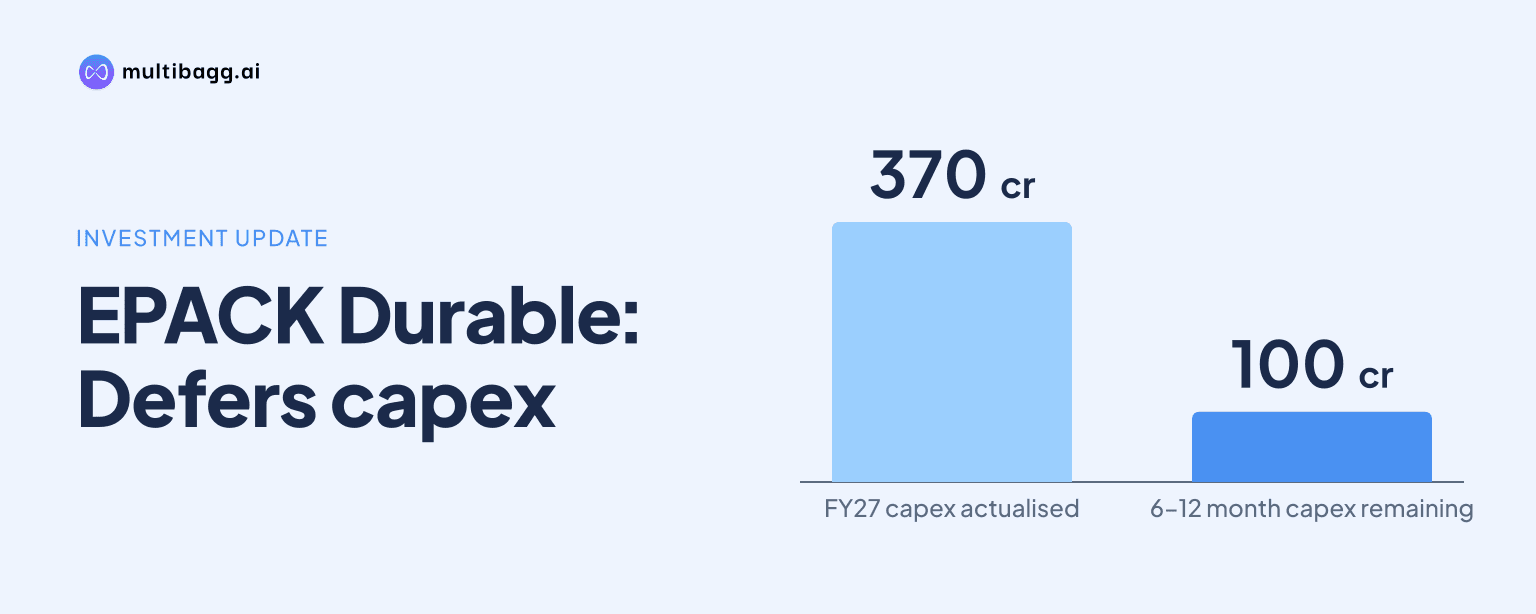
EPACK Durable will stagger Rs 100 crore of planned capital expenditure over six to 12 months after actualising Rs 370 crore of its roughly Rs 470 crore expansion plan by the end of September, shifting its priority to using new capacity in washing machines, room air conditioners and small appliances.
Know Epack Durable inside out
Results, valuation, peers and who's buying, in one view.
Why has EPACK Durable deferred its remaining capex?
EPACK Durable has deferred the final Rs 100 crore because most of the roughly Rs 470 crore programme announced about 18 months earlier is already operational, management said during the second-quarter financial year 2027 earnings call. Of the plan, Rs 370 crore had been actualised by the end of September, with plants largely completed and equipment mostly put to use. Management said future spending will depend on visible growth in the categories it intends to expand.
The remaining outlay will be staggered over six to 12 months rather than deployed immediately. Management identified washing machines and newer room-air-conditioner models as areas for the residual investment, while saying there were no significant investment plans in the medium term. This follows EPACK Durable's decision to focus capital and management attention on its core entity after transferring its stake in Epavo Electricals and winding up two inactive subsidiaries.
How much new capacity is EPACK Durable trying to utilise?
EPACK Durable is seeking to raise utilisation across recently built facilities rather than add large new plants. Management said the completed investments cover products including washing machines and air conditioners, while the company is deepening captive component integration in heat exchangers, copper tubing, printed circuit boards, cross-flow fans and moulded parts. Its installed room-air-conditioner capacity was about 2.3 million sets at the time of the call.
The planned ramp is supported by a broader product mix. Non-room-air-conditioner business contributed 63% of second-quarter FY27 revenue, while small and large domestic appliances rose 57% year on year, led by washing machines and air fryers. In the first half of FY27, small and large domestic appliances grew 62%, while room-air-conditioner business rose 58%, supported by share gains with existing customers and contributions from new customers.
What does the Hisense programme add to EPACK Durable's plan?
EPACK Durable said its investment for Hisense is largely complete, with front-load washing-machine pilot production scheduled to finish by the end of November 2026 and mass production expected from December 2026. The work is being undertaken through EPACK Durable's wholly owned Sri City subsidiary and would move the facility from a single product category to multiple product categories.
Hisense sourced about 18,000 air conditioners from EPACK Durable through September in its first year as a mass player, and management put sales from the association in the first half of FY27 at approximately Rs 90 crore. The next manufacturing step is front-load washing machines, a segment management described as premium and growing. EPACK Durable is therefore directing deferred spending toward a ramp in products already connected to customer programmes rather than announcing a separate expansion initiative.
Got a follow-up? Ask IRIS
What financial results frame EPACK Durable's capital decision?
EPACK Durable reported revenue from operations of Rs 439 crore in the second quarter of FY27, up more than 106% from Rs 213 crore in the second quarter of FY26. Earnings before interest, tax, depreciation and amortisation (EBITDA) rose to Rs 7.1 crore from Rs 0.5 crore. First-half FY27 revenue reached Rs 1,325 crore, up 51.3% year on year, providing the volume base management expects to use to absorb fixed costs at new facilities.
Reported profitability still reflects the cost of capacity built ahead of utilisation. Management cited depreciation and interest on new capacity, a lag in commodity-cost pass-through, the absence of production-linked incentive (PLI) income and seasonal factors. Second-quarter FY27 EBITDA margin was 1.62%, versus 0.23% a year earlier, but second-quarter FY26 included Rs 8 crore of PLI income. Excluding that income, management said comparable EBITDA improved by about Rs 14.6 crore year on year.
How will EPACK Durable fund its remaining investment?
EPACK Durable said it does not plan to raise significant new capital for the remaining Rs 100 crore investment, and management expects its medium-term debt position to remain similar as capacity is used. Gross debt was about Rs 770 crore to Rs 775 crore, or about 0.8 times equity, according to management. During the second quarter of FY27, EPACK Durable reduced inventory by about Rs 125 crore, paid suppliers about Rs 225 crore and capitalised about Rs 100 crore of investment.
Management also said finance cost had remained almost unchanged in absolute terms despite revenue doubling in value from the previous year. It expects working-capital requirements to stay within current limits as sales of small and large domestic appliances rise, because those categories have better payment terms than the seasonal room-air-conditioner business. That expectation is management's view and depends on the planned sales mix and capacity ramp occurring as described.
Conclusion
EPACK Durable's decision to stagger Rs 100 crore does not cancel its roughly Rs 470 crore expansion programme; it changes the pace of its final phase after Rs 370 crore had been actualised by the end of September. The company is pairing that capital discipline with a product-mix shift, as non-room-air-conditioner operations supplied 63% of second-quarter FY27 revenue and washing machines, air fryers and component integration are intended to absorb facilities already built.
The next disclosed operational marker is completion of Hisense front-load washing-machine pilot production by the end of November 2026, followed by expected mass production from December 2026. The subsequent six-to-12-month capex schedule, commodity-cost pass-through and management's expectation that debt and working-capital requirements remain within current limits will indicate how quickly the installed capacity is being used.