










EPACK Durable plans Hisense washers after Rs 90 crore H1 sales
Key highlights
- EPACK Durable said Hisense generated approximately Rs 90 crore of H1 revenue.
- EPACK Durable plans to start Hisense front-load washer mass production in December after November pilot completion.
- Hisense sourced close to 18,000 air conditioners from EPACK Durable through September.
- EPACK Durable had actualised approximately Rs 370 crore of a close to Rs 470 crore capital-expenditure plan by September-end.
powered by IRIS
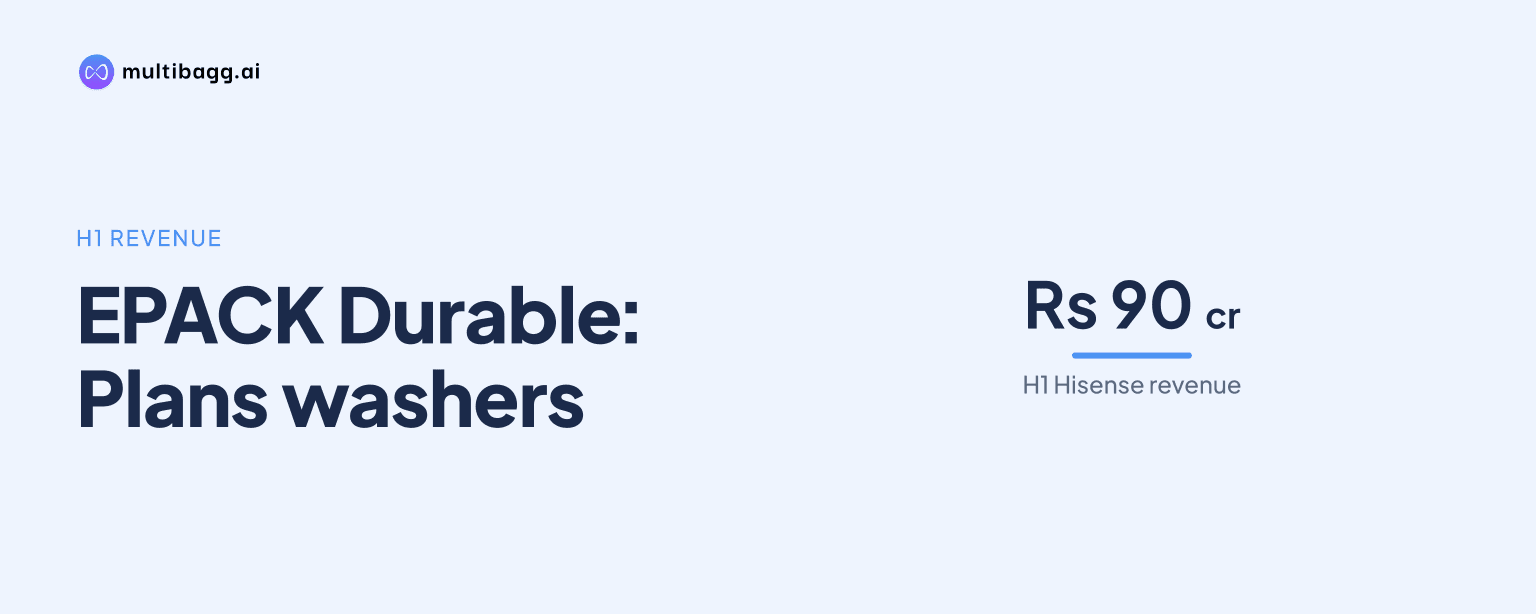
EPACK Durable reported approximately Rs 90 crore of H1 revenue from Hisense and plans to begin mass production of Hisense front-load washing machines in December, after completing pilot production by the end of November. Hisense had also sourced close to 18,000 air conditioners from EPACK Durable through September.
Know Epack Durable inside out
Results, valuation, peers and who's buying, in one view.
When will EPACK Durable begin making Hisense washing machines?
EPACK Durable expects to start mass production of Hisense front-load washing machines from December. Management said pilot production was under way and would be completed by the end of November, allowing commercial-scale production to begin in the following month.
The front-load washing-machine programme uses technology transferred from Hisense, according to management. It expands a relationship that had initially focused on room air conditioners, or RACs, and places Hisense within EPACK Durable's push into small and large domestic appliances alongside air fryers and induction cooktops.
Hisense sourced close to 18,000 air conditioners from EPACK Durable through September in the current year. Management described this as Hisense's first year as a mass player in Indian air conditioners and said the addition of washing machines and other products should strengthen the association.
How much revenue has Hisense generated for EPACK Durable?
Hisense generated approximately Rs 90 crore of revenue for EPACK Durable in H1, management said. The company did not disclose a separate H1 unit figure for Hisense air conditioners or split the Rs 90 crore between air conditioners and other products.
Management said Hisense had already gained significant market share in India's television market, though it did not provide a market-share percentage. It said the television business was helping create the Hisense brand, while the 18,000 air conditioners sourced through September provided confidence in the partnership's channels and product expansion.
The December launch is therefore a new production milestone rather than revenue already included in the Rs 90 crore H1 contribution. Management gave no washing-machine volume target, revenue target, customer allocation or timetable for scaling output after the December start.
What spending remains for Hisense and appliance capacity?
EPACK Durable said investment for Hisense was largely complete, while approximately Rs 100 crore remains from its wider capital-expenditure plan. Management expects to stagger this balance over the next 6 to 12 months for capacity additions in products including washing machines and newer air-conditioner models.
The company had announced capital expenditure of close to Rs 470 crore about 18 months earlier. By the end of September, it had actualised around Rs 370 crore, and management said most of the facilities had been put to use and the plants were largely complete.
Management said it had extended the timing of the remaining Rs 100 crore rather than committing it immediately. The company intends to invest as it sees growth in selected categories and said it had no significant medium-term investment plans beyond this staged spending.
EPACK Durable is also withdrawing from certain joint ventures, including Epavo, as part of what management called capital discipline. Epavo recorded losses of approximately Rs 12 crore over two years, reducing its equity from about Rs 22 crore to about Rs 10 crore, according to management.
Got a follow-up? Ask IRIS
How is EPACK Durable changing its sales mix and margins?
EPACK Durable said non-RAC business rose from 45% to nearly 50% of sales on a year-on-year basis. Management linked that shift to growth in small and large domestic appliances and components, which it expects to use capacity outside the seasonal RAC cycle.
In the current quarter, RAC revenue increased 160% year on year to almost Rs 161 crore from about Rs 61 crore. Revenue from small and large domestic appliances rose 57% to almost Rs 168 crore from about Rs 107 crore, while component revenue increased 45% to about Rs 47 crore from about Rs 32 crore.
Management said total revenue increased 106% in the current quarter, although it did not state the total quarterly revenue figure in the supplied discussion. The domestic-appliance and component increases compare with the 160% RAC increase, while the mix shift toward non-RAC categories was described separately as a year-on-year movement from 45% to nearly 50%.
On a like-for-like basis excluding production-linked incentive, or PLI, income, gross margin rose to 12.8% in the current H1 from approximately 12.4% in prior-year H1. Management said commodity-cost pass-through normally occurs in subsequent quarters, creating a timing lag, and that a foreign-exchange loss of approximately Rs 10 crore reduced the margin reported in the period.
What are EPACK Durable's funding and capacity plans?
EPACK Durable expects its debt level to remain broadly similar in the medium term while the remaining Rs 100 crore of planned capital expenditure is deployed over 6 to 12 months. Management said the company was not looking to raise significant new capital and expects utilisation of installed capacity to improve as newer product lines ramp up.
Gross debt was approximately Rs 775 crore, according to management, or about 0.8 times equity. During the quarter, the company reduced inventory by approximately Rs 125 crore, made about Rs 225 crore of supplier payments related to inventory carried, and capitalised approximately Rs 100 crore of investment.
Management said finance cost had remained almost unchanged in absolute terms from the previous year even though revenue had doubled in value. It attributed its expectation that working-capital needs would stay within current limits partly to higher sales of small domestic appliances and large domestic appliances, where it said payment terms are better than in RACs.
The planned Hisense washer start also sits within management's broader effort to raise capacity use beyond the RAC season. EPACK Durable said its installed RAC capacity was approximately 2.3 million sets, covering window and split air conditioners, but it did not disclose installed washing-machine capacity or the portion designated for Hisense.
Conclusion
EPACK Durable's Hisense relationship has produced approximately Rs 90 crore of H1 revenue and close to 18,000 air conditioners sourced through September. The planned December production of front-load washing machines extends that relationship into a domestic-appliance category as non-RAC business moves from 45% to nearly 50% of sales.
The next disclosed operating milestone is completion of the washer pilot run by the end of November, followed by planned mass production in December. Management's other stated watchpoint is the staged deployment of the remaining Rs 100 crore of its Rs 470 crore capital-expenditure plan over the next 6 to 12 months, alongside commodity pass-through and potential PLI discount normalisation.