










EPACK PREFAB cash flow turns negative as cycle hits 60 days
Key highlights
- EPACK PREFAB reported negative operating cash flow of Rs 106.9 crore in H1 FY27.
- EPACK PREFAB’s annualised working-capital cycle increased to 60 days in H1 FY27 from 32 days in FY26.
- Revenue from operations rose 18.9% year on year to Rs 867 crore in H1 FY27.
- Pending Prefab orders stood at Rs 1,462.5 crore on 30 September 2026.
powered by IRIS
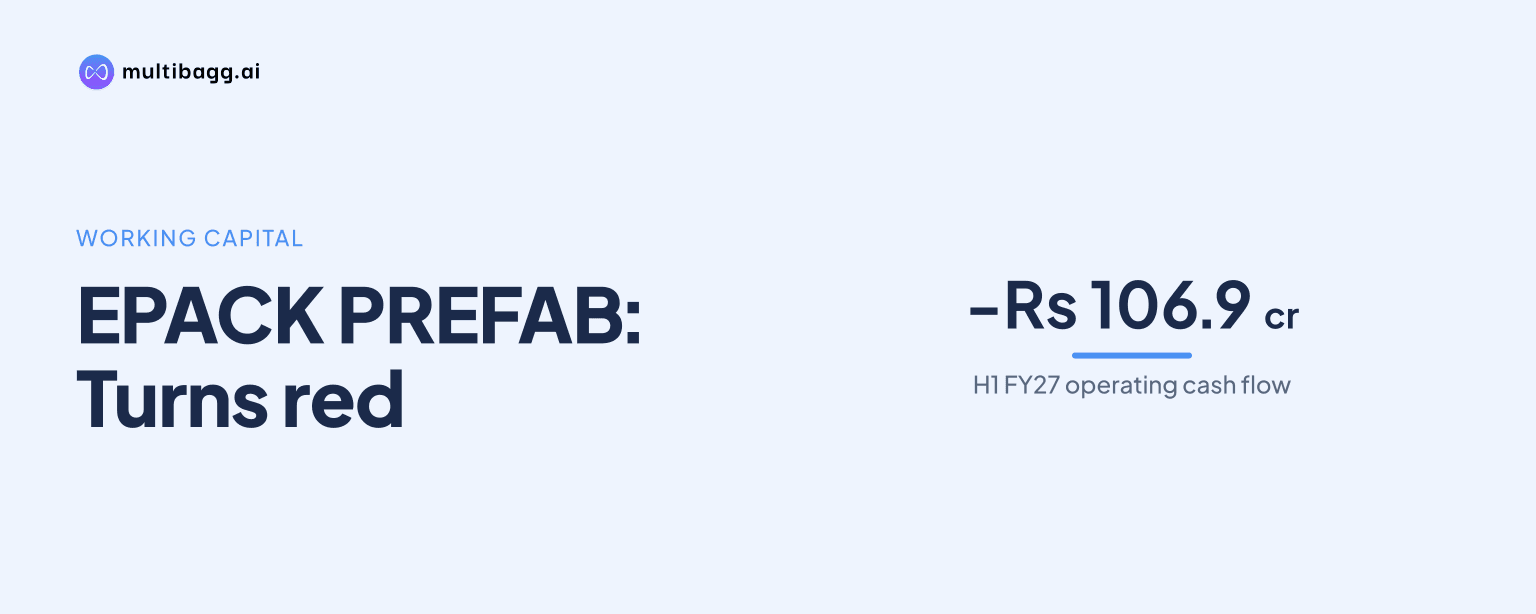
In the first half of financial year 2027 (H1 FY27), EPACK PREFAB reported negative operating cash flow of Rs 106.9 crore as its annualised working-capital cycle rose to 60 days from 32 days in FY26. The company attributed the stretch to milestone-based realisations on large renewable projects and a strategic inventory build-up.
Know EPack Prefab Technologies inside out
Results, valuation, peers and who's buying, in one view.
Why did EPACK PREFAB’s working-capital cycle rise to 60 days?
EPACK PREFAB said its working-capital cycle reached 60 days in H1 FY27 because it executed large renewable industrial projects whose contractual-milestone realisations are expected in the third quarter of FY27 (Q3 FY27). The annualised figure was 28 days above the 32-day cycle reported in FY26, following 35 days in FY25 and 24 days in FY24.
The company also attributed the increase to a strategic inventory build-up intended to minimise disruption from raw-material volatility. Cost of materials consumed and changes in work-in-progress and finished-goods inventories rose 23.2% year on year to Rs 589.9 crore in H1 FY27, compared with an 18.9% rise in revenue from operations to Rs 867 crore.
What happened to EPACK PREFAB’s operating cash flow in H1 FY27?
EPACK PREFAB’s operating cash flow turned negative by Rs 106.9 crore in H1 FY27 while its annualised working-capital cycle widened to 60 days. The presentation specifies that cash flow from operations is measured for the six-month period, whereas working-capital days, return ratios and net debt to earnings before interest, tax, depreciation and amortisation (EBITDA) are annualised for H1 FY27.
The negative operating cash flow occurred during a period of higher project execution and inventory investment. EPACK PREFAB received orders worth Rs 1,124.3 crore and executed orders worth Rs 774.5 crore in H1 FY27, increasing pending Prefab orders to Rs 1,462.5 crore on 30 September 2026 from Rs 1,112.7 crore on 31 March 2026.
How does EPACK PREFAB’s 60-day cycle compare with prior years?
EPACK PREFAB’s 60-day H1 FY27 cycle was the highest level shown from FY22 through H1 FY27. The cycle increased from 22 days in FY22 to 32 days in FY23, declined to 24 days in FY24, rose to 35 days in FY25, and eased to 32 days in FY26 before the H1 FY27 increase.
The 28-day increase from FY26 exceeded the 13-day increase between FY24 and FY25. EPACK PREFAB’s explanation for the H1 FY27 movement is tied to renewable-project milestones expected in Q3 FY27 and inventory held to address potential raw-material disruption.
Got a follow-up? Ask IRIS
Did EPACK PREFAB’s revenue and profit grow despite the cash outflow?
EPACK PREFAB’s revenue and profit grew in H1 FY27 despite the negative operating cash flow, although margins declined. Revenue from operations rose 18.9% year on year to Rs 867 crore, EBITDA increased 5.1% to Rs 85.1 crore, and profit after tax rose 5.0% to Rs 47.8 crore.
Prefab revenue increased to Rs 774.5 crore in H1 FY27 from Rs 651.6 crore in H1 FY26. Total revenue increased by Rs 137.7 crore over the same period, while the Prefab business contributed Rs 122.9 crore of that increase.
Margins moved in the opposite direction to revenue. EBITDA margin declined by 128 basis points to 9.8% in H1 FY27 from 11.1% in H1 FY26, while profit-after-tax margin fell to 5.5% from 6.2%. EPACK PREFAB attributed the 238-basis-point reduction in gross margin, to 32.0%, to a temporary rise in raw-material prices amid geopolitical conditions.
What do costs and order execution show about EPACK PREFAB’s cash requirements?
EPACK PREFAB’s materials cost was the main area of pressure in H1 FY27, reaching 68.0% of revenue from operations versus 65.7% in H1 FY26. Employee-benefit expense declined to 10.0% of revenue from 10.2%, while other expenses declined to 12.1% from 13.1%.
The pending Prefab order book of Rs 1,462.5 crore on 30 September 2026 represented an increase of Rs 349.8 crore from 31 March 2026. EPACK PREFAB said the order book provided visibility for about 11 months, while also noting that some orders received during the year may be cancelled.
Southern India accounted for 41.7% of the value of 285 disclosed orders, ahead of West at 26.4% and North at 25.5%. In the Prefab sales mix, South represented 43% in H1 FY27, compared with 37% in FY26, while North and Central represented 29%, down from 40%.
Conclusion
EPACK PREFAB’s H1 FY27 figures show that revenue growth and a larger order book coincided with negative operating cash flow of Rs 106.9 crore and a 60-day annualised working-capital cycle. The company links the movement to large renewable-project execution, contractual timing of collections and inventory stocking, while materials costs rose faster than revenue and EBITDA margin declined to 9.8%.
The next disclosed point to watch is Q3 FY27, when EPACK PREFAB expects contractual-milestone realisations from the renewable industrial projects. Management also expects price revisions on new orders and long-term sourcing arrangements to restore margins over coming quarters, while the Ghiloth facility’s completion timeline has been extended to March 2027.