










ESAF GNPA falls to 2.8% as legacy MFI stress clears
Key highlights
- ESAF’s GNPA declined to 2.8% in Q2 FY27 from 8.5% in Q2 FY26.
- Q2 FY27 slippages fell to Rs 87 crore from Rs 342 crore a year earlier.
- ESAF made Rs 626 crore of technical write-offs, which management called probably the final legacy NPA lot.
- Management raised its full-year FY27 ROA guidance to 2% from a prior year-end quarterly target.
powered by IRIS
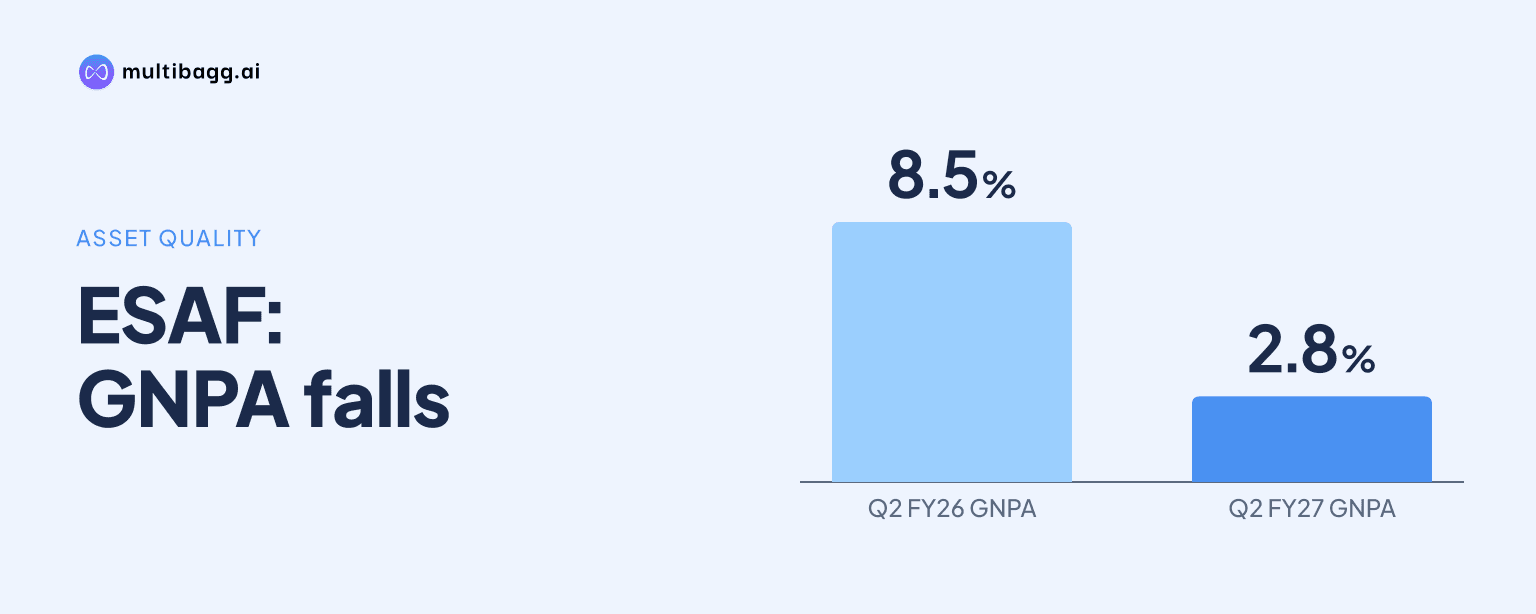
ESAF Small Finance Bank reported gross non-performing assets, or GNPA, of 2.8% in Q2 FY27, down from 8.5% a year earlier, after Rs 626 crore of technical write-offs and lower fresh slippages. Management subsequently raised its guidance to a 2% return on assets, or ROA, for full-year FY27.
Know ESAF Small Finance Bank inside out
Results, valuation, peers and who's buying, in one view.
Why did ESAF’s GNPA fall to 2.8%?
ESAF’s GNPA fell because legacy microfinance institution, or MFI, stress was normalised, fresh slippages reduced and the portfolio mix moved toward secured loans. GNPA declined to 2.8% in Q2 FY27 from 8.5% in Q2 FY26, while net NPA fell to 0.3% from 3.8%. The bank made Rs 626 crore of technical write-offs during Q2 FY27, which its chief financial officer said was probably the last lot from the legacy NPA pool.
The technical write-off did not generate an interest-income release, according to management. The chief financial officer said it represented principal against provisions for which the profit-and-loss impact had already been taken. Q2 FY27 net interest income, or NII, rose 73% year on year to Rs 643 crore partly because lower NPAs allowed interest income to be recognised on more of the loan book.
New loan stress also declined sharply. Slippages were Rs 87 crore in Q2 FY27, compared with Rs 342 crore in Q2 FY26, and the annualised gross slippage ratio was 1.6%. Annualised credit cost was 2.6% in Q2 FY27, while management estimated about 2% for FY27 as a whole, citing controlled slippages and completed backlog provisioning.
How is ESAF changing its loan book to reduce volatility?
ESAF is expanding secured lending and its Emerging Household segment while reducing dependence on unsecured group microfinance. Gross advances increased 25% year on year to Rs 23,934 crore in Q2 FY27. Secured advances rose 32% to Rs 15,377 crore, compared with 15% growth in unsecured advances to Rs 8,557 crore, leaving secured loans at 64% of gross advances.
The MARG portfolio, comprising micro, agriculture, retail and gold lending, reached Rs 13,938 crore in Q2 FY27, up 38% year on year and equal to 58% of total advances. Gold loans within MARG reached Rs 10,456 crore, and management reported GNPA of 0.1% for that portfolio. Agriculture, gold, mortgage and retail lending grew 66%, 39%, 39% and 34%, respectively, year on year.
Emerging Household loans grew 134% year on year and 5% quarter on quarter, contributing 32% of gross advances. Management said the segment includes individuals and small entrepreneurs progressing beyond traditional microfinance. By contrast, group-loan microfinance declined 65% year on year as ESAF took a calibrated approach and sought to move eligible borrowers into individual or secured lending relationships.
Did gold-loan stress create a new asset-quality risk for ESAF?
ESAF reported a temporary rise in gold-loan special mention account, or SMA, balances after gold-price volatility in September and early October 2026. Management said about Rs 990 crore of gold loans were in SMA-0 and Rs 200 crore in SMA-1. These balances were part of a Rs 10,456 crore gold-loan portfolio in Q2 FY27.
Management attributed the SMA increase to customers needing more time to roll over mostly bullet-repayment loans after price fluctuations. It said the average loan-to-value ratio, or LTV, on the gold book was 76% and did not expect material slippages once gold prices stabilised. Management also said ESAF does not generally provide top-up loans on gold, distinguishing its underwriting approach from lenders that do.
The disclosed gold-loan issue differs from the legacy MFI cleanup that drove Q2 FY27 technical write-offs. Management said backlog provisioning had already been completed and expected recovery from any gold-related slippage. The Rs 87 crore of Q2 FY27 slippages included a Rs 7 crore corporate account, while management described the remaining level as normalised.
Got a follow-up? Ask IRIS
How did lower credit stress affect ESAF’s earnings and returns?
ESAF’s Q2 FY27 profit recovery reflected lower provisioning pressure, higher NII and operating efficiency rather than balance-sheet growth alone. Profit after tax, or PAT, doubled sequentially to Rs 160 crore from Rs 80 crore in Q1 FY27. Pre-provisioning operating profit, or PPOP, rose 289% year on year to Rs 362 crore, while total interest income reached Rs 1,175 crore.
Operating metrics also improved from Q2 FY26. The cost-to-income ratio fell to 58% from 82%, while net interest margin, or NIM, was 8.2% in Q2 FY27. Operating expenses rose 2% quarter on quarter, with other operating expenses up 4% and employee expenses flat, and management expects the cost-to-income ratio to be about 60% for FY27.
Annualised ROA and return on equity, or ROE, stood at 1.5% and 26.5%, respectively, in Q2 FY27. Management changed its earlier objective of reaching a 2% quarterly ROA by FY27 year-end to guidance of 2% ROA for the full year. It said steady PPOP, controlled slippages and lower provisioning needs should offset StratoNeXt-related expenses in the second half.
Capital-to-risk weighted assets ratio, or CRAR, improved by 20 basis points to 24.1% as of September 2026. Management said the bank had considered a capital infusion of about Rs 1,000 crore, but had made no concrete decision and saw no urgent need to raise capital at a 24% capital adequacy ratio.
What could affect ESAF’s FY27 asset-quality and return outlook?
ESAF’s FY27 outlook depends on slippages remaining contained and the legacy provisioning cleanup holding. Management said the remaining legacy NPA balance was Rs 80 crore and expects the 1.6% annualised gross slippage ratio reported in Q2 FY27 to maintain its direction through the rest of the year. It also estimated that FY28 credit cost could be around 1.5%, while stating that estimate was based on conditions at the time.
Management identified drought conditions in Maharashtra and Karnataka as a regional matter to monitor. Those states represent about 15% to 16% of the portfolio, and management said collections had not been materially affected as of the call. It added that a drought lasting through the year could affect collections, although it described the Maharashtra portfolio as performing well.
Technology costs and funding costs are the other disclosed variables. ESAF went live with the StratoNeXt programme and Oracle FLEXCUBE core banking system on October 26, 2026, and expects related capitalisation and expenses in H2 FY27. Management said further policy-rate increases could lift interest expense and affect the 8.2% NIM, even as the platform is intended to support automation, controls and secured-loan growth.
Conclusion
ESAF’s fall in GNPA from 8.5% in Q2 FY26 to 2.8% in Q2 FY27 was linked to Rs 626 crore of technical write-offs, lower slippages of Rs 87 crore and a faster-growing secured portfolio. The reduction in legacy stress supported PAT of Rs 160 crore, lower expected credit cost and management’s revised 2% ROA guidance for FY27.
The next measures to watch are whether the 1.6% annualised gross slippage ratio and management’s 2% FY27 credit-cost estimate hold through H2 FY27. Management is also due to give FY28 ROA guidance next quarter, while the effect of StratoNeXt costs, drought conditions in Maharashtra and Karnataka, and gold-loan SMA recovery remains unresolved.