










ESAF Small Finance Bank shifts 64% of advances into secured loans
Key highlights
- Secured loans accounted for 64% of ESAF's Rs 23,934 crore gross advances on September 30, 2026.
- ESAF's Emerging Household segment grew 134% year on year and represented 32% of gross advances in Q2 FY27.
- ESAF's group microfinance portfolio declined 65% year on year under its calibrated lending strategy.
- ESAF's MARG portfolio reached Rs 13,938 crore, up 38% year on year, and gold loans reached Rs 10,456 crore.
powered by IRIS
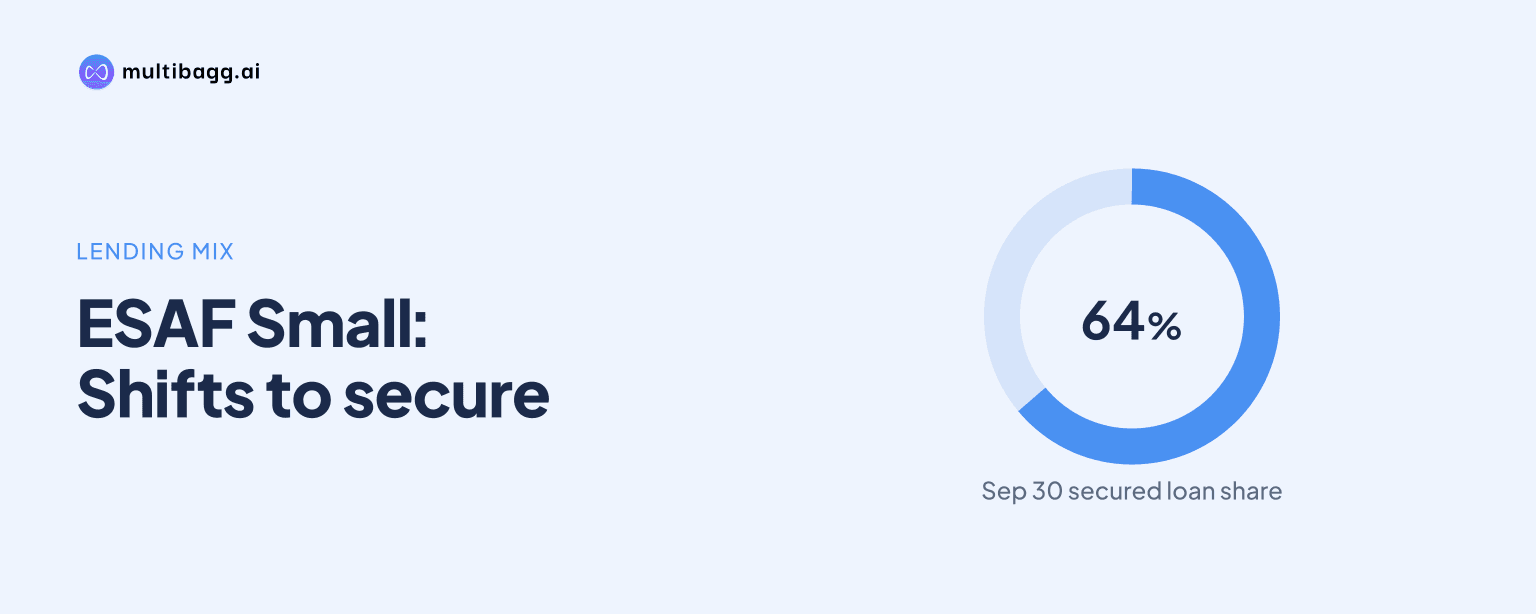
ESAF Small Finance Bank had 64% of its Rs 23,934 crore gross advances in secured loans at September 30, 2026, as its Emerging Household segment grew 134% year on year and group microfinance loans declined 65%. Management said the shift is intended to move eligible borrowers beyond traditional group lending while diversifying the loan book.
Know ESAF Small Finance Bank inside out
Results, valuation, peers and who's buying, in one view.
How has ESAF changed its loan mix?
ESAF shifted its loan mix toward secured lending, which accounted for Rs 15,377 crore, or 64%, of gross advances in Q2 FY27, the second quarter of fiscal 2027. Total gross advances rose 25% year on year to Rs 23,934 crore from Rs 19,137 crore, while the unsecured portfolio stood at Rs 8,557 crore.
The secured book grew faster than the unsecured book, although the call included two secured-growth figures. Management initially said secured loans grew 35% year on year, while the chief financial officer later described 32% growth; both statements showed growth above the 15% rate reported for unsecured loans.
The mix shift coincided with lower reported stress in the loan book. Gross non-performing assets, or GNPA, declined to 2.8% in Q2 FY27 from 8.5% a year earlier, while net non-performing assets fell to 0.3% from 3.8%. Management attributed the improvement to a change in portfolio mix, improved collection efficiency and moderation in slippages.
What products are driving ESAF's secured lending?
ESAF is using its MARG portfolio as the main vehicle for expanding secured retail lending. MARG stood at Rs 13,938 crore in Q2 FY27, grew 38% year on year and represented 58% of the total portfolio, according to management.
Gold loans were the largest disclosed MARG component, reaching Rs 10,456 crore after crossing Rs 10,000 crore in gross advances during Q2 FY27. Management reported a 0.1% GNPA ratio for the gold-loan portfolio. It also reported year-on-year growth of 66% in agri lending, 39% in gold loans, 39% in mortgage loans and 34% in retail lending.
The difference between the Rs 13,938 crore MARG balance and the Rs 10,456 crore gold-loan balance indicates that products other than gold formed a material part of MARG. ESAF said its distribution footprint reached 831 banking outlets, 722 automated teller machines, 1,060 customer service centres and 31 institutional business correspondents across 24 states and two Union Territories after adding 10 banking outlets in the quarter.
Got a follow-up? Ask IRIS
Why is ESAF expanding Emerging Household loans?
ESAF is expanding Emerging Household loans to serve individuals and small entrepreneurs moving beyond traditional microfinance with established repayment histories. The segment grew 134% year on year and 5% quarter on quarter in Q2 FY27, and management said it contributed 32% of total gross advances.
Management classified Emerging Household lending into Individual, Enterprise and Farmers Interest Group portfolios. The Farmers Interest Group portfolio remained stable, while Individual and Enterprise loans grew both sequentially and year on year. ESAF did not disclose a rupee balance for Emerging Household lending or for any of those three subcategories.
The bank said eligible group-loan customers can be progressed into individual and secured relationships under this segment rather than being lost as their borrowing needs change. Management said borrowers in Emerging Household lending generally have repayment histories and growing incomes, but it did not provide a separate delinquency ratio for this portfolio.
How is ESAF managing group microfinance and execution?
ESAF deliberately reduced its group microfinance loan portfolio by 65% year on year in Q2 FY27 as part of a calibrated strategy. Management said it was comfortable with the current group-loan portfolio size and aimed to preserve yield and reduce volatility rather than pursue growth in that product.
That decline occurred while the overall unsecured portfolio increased 15% year on year to Rs 8,557 crore. The transcript did not reconcile the group-loan contraction with growth in total unsecured lending or disclose the group-loan balance. It did distinguish group loans from customers transitioned into individual and secured Emerging Household relationships.
Slippages, meaning loans newly classified as non-performing during the period, fell to Rs 87 crore in Q2 FY27 from Rs 342 crore in Q2 FY26. ESAF also reported Rs 626 crore of technical write-offs during the quarter, which the chief financial officer described as probably the last lot from legacy non-performing assets and said had no income-reversal component.
ESAF went live with its StratoNeXt technology programme on October 26, 2026, including migration to Oracle FLEXCUBE as its core banking system. Management said the platform is designed to support portfolio diversification, secured-lending expansion, automation and operating controls, while immediate priorities are transaction accuracy, system performance and customer support as operations stabilise.
Conclusion
ESAF's Q2 FY27 results show a lending strategy centred on replacing a larger reliance on group microfinance with secured MARG products and Emerging Household relationships. Gross advances rose 25% to Rs 23,934 crore, secured loans reached 64% of the book, and the reported GNPA ratio declined by 5.7 percentage points to 2.8% from 8.5% a year earlier.
Next, management plans to further strengthen MARG and grow Emerging Household lending during the second half of FY27 while maintaining a balance between growth and asset quality. It aims for a cost-to-income ratio of around 60% for the year after reporting 58% in Q2 FY27, and said StratoNeXt benefits should emerge progressively as the platform and processes are optimised.