










Eureka Forbes Q2 margin reaches 13.6% as revenue grows 15%
Key highlights
- Eureka Forbes revenue increased 15.0% year on year to Rs 889.6 crore in Q2 FY27.
- Adjusted EBITDA rose 18.8% to Rs 120.7 crore, lifting the margin to 13.6% from 13.1%.
- Operating expenses fell to 41.6% of revenue from 43.4%, offsetting a gross-margin decline to 55.1%.
- Net surplus was Rs 304 crore at the end of Q2 FY27, down from Rs 425 crore in Q1 FY27 but above Rs 228 crore a year earlier.
powered by IRIS
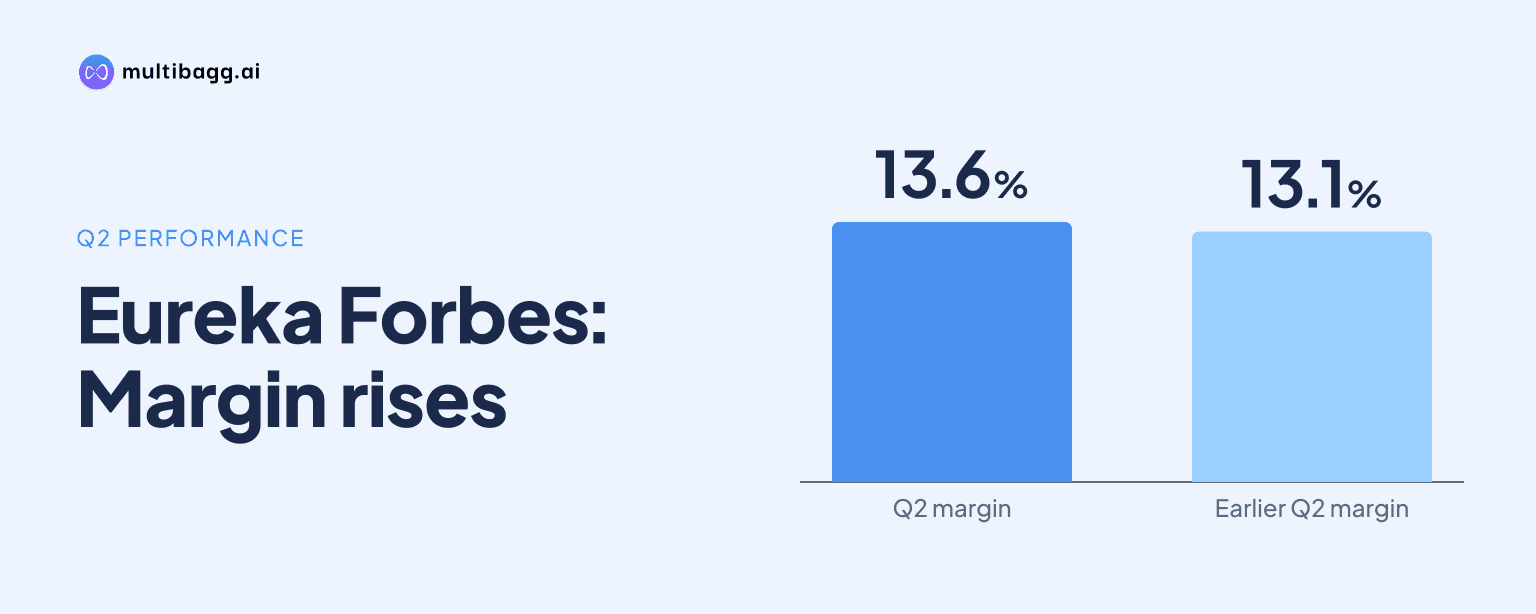
Eureka Forbes lifted adjusted EBITDA margin to 13.6% in Q2 FY27 from 13.1% a year earlier as revenue increased 15.0% to Rs 889.6 crore. The presentation attributes the result to a 181-basis-point decline in operating expenses as a share of revenue, exceeding a 138-basis-point gross-margin decline tied primarily to commodity costs.
Know Eureka Forbes inside out
Results, valuation, peers and who's buying, in one view.
How did EFL perform in Q2 FY27?
EFL reported Q2 FY27 revenue of Rs 889.6 crore, up 15.0% from Rs 773.4 crore in Q2 FY26, while adjusted earnings before interest, tax, depreciation and amortisation, or adjusted EBITDA, increased 18.8% to Rs 120.7 crore. The faster growth in adjusted EBITDA lifted the margin by 43 basis points to 13.6%.
EFL defines adjusted EBITDA as profit before tax before exceptional items, plus finance cost, depreciation, amortisation and employee stock-option-plan, or ESOP, charge, less other non-operating income. Adjusted profit before tax, which excludes exceptional items and ESOP charges, rose 17.8% to Rs 104.7 crore from Rs 88.9 crore.
Reported profit after tax rose 19.1% to Rs 73.3 crore in Q2 FY27 from Rs 61.6 crore a year earlier, and EFL reported a profit-after-tax margin of 8.2%. Depreciation increased 25.0% to Rs 11.2 crore and amortisation rose 19.1% to Rs 8.8 crore, while finance cost declined 6.4% to Rs 2.1 crore.
Why did EFL's adjusted EBITDA margin increase?
EFL's adjusted EBITDA margin increased because the reduction in its operating-expense ratio exceeded the decline in gross margin. Total expenses were 41.6% of Q2 FY27 revenue, down 181 basis points from 43.4% in Q2 FY26, while gross margin declined 138 basis points to 55.1%, primarily because of a significant increase in commodity costs.
The main expense lines increased more slowly than Q2 revenue. Employee benefit expenses increased 13.7% to Rs 91.0 crore, service charges rose 12.8% to Rs 95.6 crore, and other expenses increased 7.3% to Rs 183.1 crore; combined total expenses rose 10.2% to Rs 369.7 crore against 15.0% revenue growth.
EFL said growth spending increased year on year through a scaled-up in-store presence and new marketing campaigns. The presentation does not disclose the amount spent on either initiative, but it identifies lower operating-expense intensity as the mechanism that offset commodity-cost pressure and increased growth spending.
The Q2 FY27 margin was higher than each of the four preceding quarterly margins shown in the presentation: 13.1% in Q2 FY26, 11.3% in Q3 FY26, 13.2% in Q4 FY26 and 10.5% in Q1 FY27. Sequentially, adjusted EBITDA rose 63.3% from Rs 73.9 crore in Q1 FY27, while revenue rose 26.9% from Rs 700.8 crore.
Got a follow-up? Ask IRIS
Which businesses supported EFL's Q2 FY27 revenue growth?
EFL said its products business grew in the high teens year on year in Q2 FY27, supported by strength across categories. Water purifiers also grew in the high teens, led by volume growth and market-share gains, although the presentation gives no category revenue, volume or market-share figures.
Emerging categories continued to scale up across robotics, water softeners and air purifiers. EFL attributed robotics growth to premiumisation, while new product launches drove growth in water softeners and air purifiers; the presentation does not specify growth rates for those individual categories.
Service revenue remained largely in line with the trajectory of the past few quarters, while filter-business growth accelerated. This differs from the stated high-teens growth in products and water purifiers, supporting EFL's statement that products led the company's 15.0% revenue increase.
The Q2 FY27 performance continued a period of mostly double-digit revenue growth, following 14.9% in Q2 FY26, 8.0% in Q3 FY26, 11.6% in Q4 FY26 and 15.3% in Q1 FY27. The 15.0% Q2 FY27 rate was 0.3 percentage points below Q1 FY27 but 0.1 percentage points above the comparable quarter's growth rate.
How did EFL's Q2 profit and cash position compare with Q1 FY27?
EFL reported profit after tax of Rs 73.3 crore in Q2 FY27, compared with Rs 55.4 crore in Q1 FY27, but the reported sequential comparison includes a Q1 exceptional item. Q1 FY27 included a one-time pre-tax gain of Rs 19.5 crore from reversal of gratuity expense, while Q2 FY27 had no exceptional items.
On a pre-exceptional basis, Q1 FY27 profit after tax was Rs 40.9 crore, compared with Rs 73.3 crore in Q2 FY27. Adjusted profit before tax increased 70.4% sequentially to Rs 104.7 crore from Rs 61.5 crore, while reported profit before tax rose to Rs 98.1 crore from Rs 74.4 crore.
EFL's net surplus was Rs 304 crore at Q2 FY27, down from Rs 425 crore at Q1 FY27 and Rs 443 crore at Q4 FY26, but above Rs 228 crore at Q2 FY26. Net surplus after lease liability was Rs 270 crore, compared with Rs 396 crore in Q1 FY27 and Rs 199 crore a year earlier.
The presentation also noted that Crisil upgraded EFL's rating to Crisil AA/Stable from Crisil AA-/Positive. The rating update accompanied the Q2 FY27 cash disclosure, which showed a Rs 121 crore sequential reduction in net surplus from the Q1 FY27 level.
Conclusion
EFL's Q2 FY27 results combined 15.0% revenue growth with faster growth in adjusted EBITDA and reported profit after tax, at 18.8% and 19.1%, respectively. A 181-basis-point reduction in operating expenses as a share of revenue more than offset the 138-basis-point gross-margin decline associated primarily with higher commodity costs.
Next, EFL's disclosed plan is to grow water penetration and premiumisation, expand convenient-cleaning and air categories, improve service-led customer experience and lifetime value, and build its direct-to-consumer platform. Commodity costs, pricing conditions, competitive intensity and input costs remain disclosed uncertainties for the execution of that strategy.