










Evans Electric reports Rs 35.60 lakh operating cash outflow
Key highlights
- Evans Electric used Rs 35.60 lakh in operating activities in the half year ended September 30, 2026.
- Inventories rose to Rs 2.45 crore at September 30, 2026 from Rs 49.73 lakh at March 31, 2026.
- Cash and cash equivalents fell by Rs 2.55 crore to Rs 3.89 crore during the half year.
- Evans Electric reported Rs 43.11 lakh net profit on Rs 6.18 crore of revenue from operations.
powered by IRIS
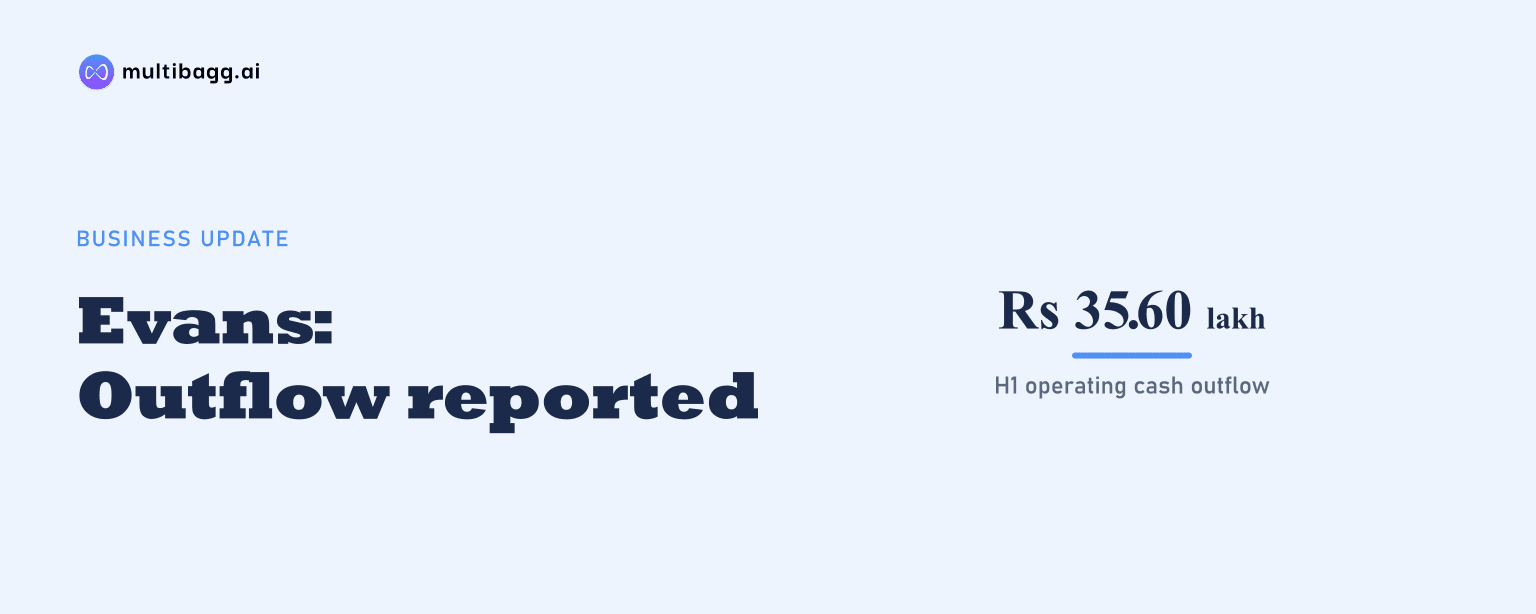
Evans Electric Limited recorded an operating cash outflow of Rs 35.60 lakh in the half year ended September 30, 2026, although it made Rs 43.11 lakh net profit, because a Rs 1.95 crore inventory-related cash use and tax payments outweighed working-capital inflows; cash and cash equivalents fell Rs 2.55 crore.
Know Evans Electric inside out
Results, valuation, peers and who's buying, in one view.
Why did Evans Electric report negative operating cash flow?
Evans Electric reported net cash used in operating activities of Rs 35.60 lakh for the half year ended September 30, 2026. The cash-flow statement began with profit before tax of Rs 54.84 lakh, recorded net adjustments of Rs 11.72 lakh, and then showed a Rs 77.69 lakh cash outflow from working-capital changes. Income tax paid of Rs 24.47 lakh moved operating cash flow below zero.
The result contrasts with the year ended March 31, 2026, when Evans Electric reported Rs 4.22 crore of net cash generated from operating activities. The earlier period included a Rs 5.49 crore positive working-capital movement, compared with the Rs 77.69 lakh outflow in the September 2026 half year. The periods differ in duration, but the disclosed direction of working-capital cash flow changed.
Evans Electric made net profit of Rs 43.11 lakh in the September 2026 half year, compared with a Rs 75.13 lakh loss in the half year ended March 31, 2026 and a Rs 32.07 lakh profit in the half year ended September 30, 2025. Exceptional items were nil in all three half-year columns. The filing uses the indirect cash-flow method, which adjusts pre-tax profit for non-cash items and movements in operating assets and liabilities.
What caused Evans Electric's working-capital outflow?
Evans Electric's largest disclosed working-capital cash use was a Rs 1.95 crore increase in inventories during the half year ended September 30, 2026. Inventories stood at Rs 2.45 crore at September 30, up from Rs 49.73 lakh at March 31, 2026. The balance-sheet increase is broadly reflected in the cash-flow statement's Rs 1.95 crore inventory outflow.
The inventory movement differed from the year ended March 31, 2026, when inventories provided Rs 25.53 lakh of cash according to the cash-flow statement. Evans Electric values materials and components at the lower of cost or market value, while work in progress is carried at estimated cost. The filing does not split the September 2026 inventory balance between those categories, so it does not identify the stock type behind the increase.
Trade receivables and trade payables partly offset the inventory cash use. Receivables generated Rs 31.40 lakh of cash-flow movement and declined to Rs 3.32 crore at September 30 from Rs 3.65 crore at March 31. Trade payables generated Rs 72.20 lakh in cash-flow terms, while dues to creditors other than micro and small enterprises rose to Rs 1.20 crore from Rs 44.85 lakh.
Other current liabilities provided Rs 26.54 lakh of cash-flow movement, while other current assets used Rs 21.18 lakh. On the balance sheet, other current liabilities rose to Rs 57.34 lakh from Rs 30.80 lakh, and other current assets increased to Rs 1.50 crore from Rs 93.18 lakh. These movements did not fully offset the Rs 1.95 crore cash use associated with inventory.
Got a follow-up? Ask IRIS
Why did Evans Electric's cash balance decline?
Evans Electric's cash and cash equivalents decreased by Rs 2.55 crore in the half year ended September 30, 2026, ending at Rs 3.89 crore compared with Rs 6.45 crore at the beginning of the period. The decline combined the Rs 35.60 lakh operating outflow with Rs 2.35 crore used in investing activities, partly offset by Rs 15.35 lakh generated through financing activities.
Investing activities used Rs 2.35 crore after Evans Electric invested Rs 3.02 crore in term deposits and spent Rs 64.88 lakh on fixed assets. Maturity of term deposits generated Rs 1.23 crore and interest income added Rs 8.57 lakh. The company defines cash and cash equivalents as cash in hand, bank demand deposits and short-term highly liquid investments with original maturities of three months or less.
Financing activities generated Rs 15.35 lakh in the half year. Evans Electric received Rs 13.33 lakh from long-term borrowings and Rs 15.28 lakh from short-term borrowings, repaid Rs 8.27 lakh of long-term borrowings, and paid Rs 4.99 lakh in interest. At September 30, long-term borrowings were Rs 65.67 lakh and short-term borrowings were Rs 31.81 lakh, compared with Rs 60.61 lakh and Rs 16.53 lakh at March 31.
How did Evans Electric's profit and balance sheet change?
Evans Electric reported Rs 43.11 lakh net profit on revenue from operations of Rs 6.18 crore for the half year ended September 30, 2026. Revenue rose from Rs 4.77 crore in the half year ended March 31, 2026, but remained below Rs 6.87 crore in the half year ended September 30, 2025. Total income from operations was Rs 6.21 crore in the latest half year.
Cost of materials consumed rose to Rs 2.44 crore from Rs 56.81 lakh in the preceding half year, while employee-benefit expense declined to Rs 2.55 crore from Rs 2.65 crore. Other expenses increased to Rs 2.45 crore from Rs 1.24 crore. Finance costs fell to Rs 4.99 lakh from Rs 30.88 lakh, while other income declined to Rs 8.57 lakh from Rs 52.41 lakh.
Total assets increased to Rs 29.97 crore at September 30, 2026 from Rs 28.25 crore at March 31, 2026. Non-current assets rose to Rs 17.66 crore from Rs 15.06 crore, including property, plant and equipment of Rs 3.74 crore and other non-current assets of Rs 2.67 crore. Current assets fell to Rs 12.31 crore from Rs 13.19 crore as the lower cash balance outweighed the rise in inventories.
Shareholders' funds were Rs 25.43 crore at September 30, compared with Rs 25.00 crore at March 31, while current liabilities increased to Rs 3.30 crore from Rs 2.21 crore. Non-current liabilities rose to Rs 1.24 crore from Rs 1.05 crore. Evans Electric operates in one reportable business segment, repair contracts, so the filing provides no segment-level working-capital or cash-flow disclosure.
Conclusion
Evans Electric's September 2026 half-year profit did not convert into operating cash generation. The Rs 1.95 crore inventory-related cash use was the largest stated driver of the Rs 35.60 lakh operating outflow, while term-deposit investment and fixed-asset spending contributed to the Rs 2.55 crore reduction in cash and cash equivalents.
The next financial update will indicate whether the Rs 2.45 crore inventory balance converts into revenue or remains elevated, and whether operating cash flow changes from its negative half-year position. The filing also says actuarial valuation for gratuity and leave encashment will be carried out at year-end, making employee-benefit provisions between the September and March half years not comparable to that extent.