










Eveready Alkaline Revenue Rises 36.5%, Battery Mix Is 11%
Key highlights
- Eveready’s alkaline battery revenue rose 36.5% year on year to Rs 29.5 crore in Q2 FY27 from Rs 21.6 crore.
- Alkaline batteries accounted for 11% of Eveready’s Q2 FY27 battery revenue by value, while carbon-zinc and other products made up 89%.
- Eveready’s consolidated Q2 FY27 revenue increased 10.7% to Rs 428.2 crore, while EBITDA rose to Rs 53.8 crore from Rs 49.4 crore.
- Emerging channels, led by quick commerce and e-commerce, grew 17% in Q2 FY27, while carbon-zinc volumes remained steady.
powered by IRIS
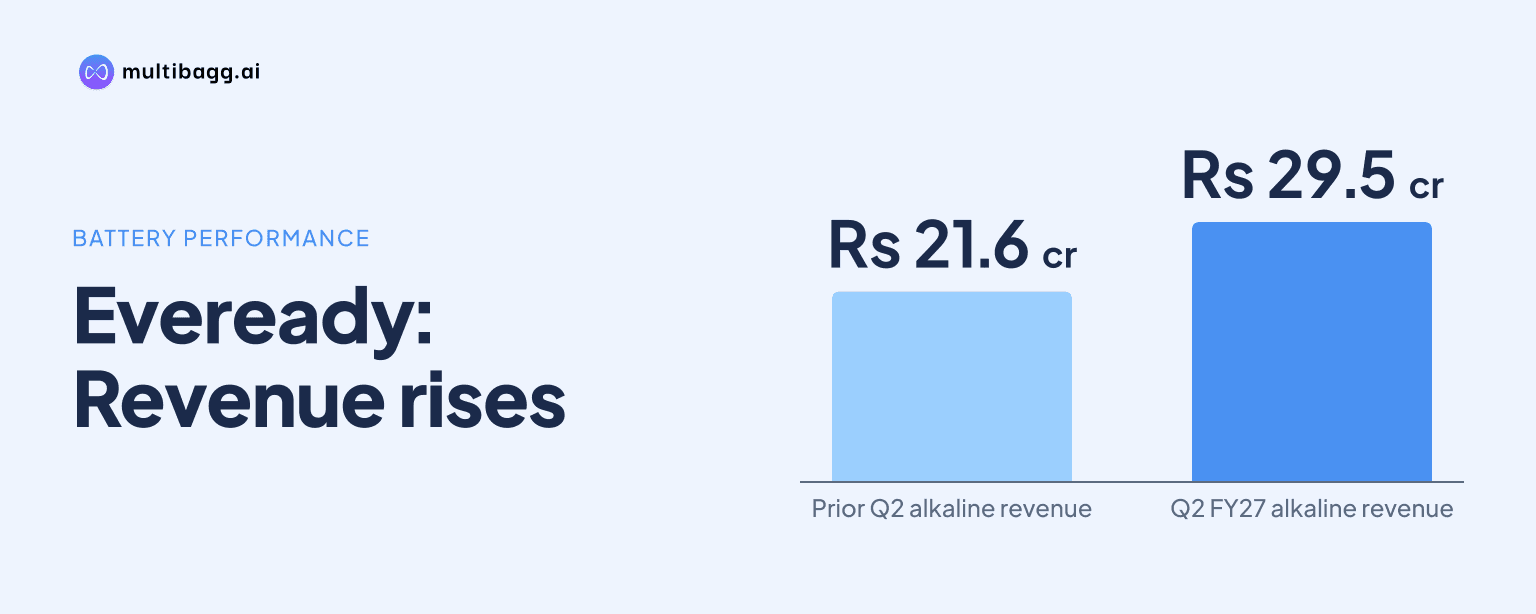
Eveready reported Rs 29.5 crore of alkaline battery revenue in Q2 FY27, a 36.5% increase from Rs 21.6 crore in Q2 FY26. The growth exceeded Eveready’s 10.7% consolidated revenue growth, but alkaline batteries accounted for only 11% of battery revenue by value, leaving carbon-zinc and other products as the larger base.
Know Eveready Industries India inside out
Results, valuation, peers and who's buying, in one view.
How fast did Eveready’s alkaline battery revenue grow?
Eveready’s alkaline battery revenue grew 36.5% year on year in Q2 FY27, rising Rs 7.9 crore to Rs 29.5 crore from Rs 21.6 crore in Q2 FY26. Eveready also said alkaline volumes increased by about 30% and market share was growing, although it did not disclose either the current or prior-period alkaline market-share percentage.
The alkaline growth rate was higher than Eveready’s 10.7% consolidated revenue increase in Q2 FY27. Consolidated revenue rose to Rs 428.2 crore from Rs 386.8 crore, and the presentation identified batteries as the lead contributor to growth across all business segments.
Eveready recorded its eighth consecutive quarter of year-on-year revenue growth in Q2 FY27. However, the presentation gives alkaline revenue only for the second quarter, rather than for H1 FY27, so it does not establish whether the 36.5% rate was maintained through the full first half.
What share of Eveready’s battery revenue is alkaline?
Alkaline batteries represented 11% of Eveready’s Q2 FY27 battery revenue by value, compared with 89% for carbon-zinc and other battery products. The category is therefore expanding from a smaller part of the battery portfolio rather than replacing the established carbon-zinc franchise at the disclosed scale.
Eveready’s broader portfolio presentation divides the remaining mix into 82% carbon-zinc batteries, 6% accessories and others, and 1% rechargeable and coin batteries. Those categories total 89%, matching the carbon-zinc and others grouping in the Q2 FY27 segment split and showing that carbon-zinc remains the largest individual category.
Eveready sells more than 1.3 billion dry-cell batteries annually, according to the presentation. It did not provide battery-segment revenue, average selling prices, alkaline unit sales or battery-segment profit, so the 11% figure shows revenue mix by value but not alkaline’s contribution to sales volume or profit.
Got a follow-up? Ask IRIS
What is driving Eveready’s alkaline battery expansion?
Eveready attributes alkaline momentum to about 30% volume growth, rising market share and its high-performance alkaline offering. Its portfolio materials feature Eveready Ultima with a stated 10-year shelf life and Eveready Ultima Pro, indicating that product specifications and branded ranges form part of the alkaline proposition.
Eveready reported 17% growth in emerging channels in Q2 FY27, led by quick commerce and e-commerce. The presentation does not state how much of that channel growth came from alkaline batteries, but it identifies these channels as part of the distribution backdrop for the battery range.
Eveready also said its Jammu facility is operational, adding manufacturing scale and supporting operational performance. The presentation does not disclose the facility’s capacity, investment, output, or the share of production allocated to alkaline batteries, so its direct contribution to alkaline revenue cannot be quantified.
How is Eveready’s larger carbon-zinc business performing?
Eveready said carbon-zinc volumes were steady in Q2 FY27, while disciplined price increases helped sustain profitability. Eveready placed its carbon-zinc market share at about 57% and said growth in the legacy portfolio was supported by scale and distribution strength.
The 57% figure is a stated market share in carbon-zinc, whereas the 11% alkaline figure is the internal share of Eveready’s battery revenue by value. Eveready did not disclose a comparable numerical market-share figure for alkaline batteries, saying only that its market share was growing.
At the consolidated level, earnings before interest, tax, depreciation and amortisation, or EBITDA, rose to Rs 53.8 crore in Q2 FY27 from Rs 49.4 crore in Q2 FY26. EBITDA margin moved to 12.6% from 12.8%, and the presentation does not establish whether alkaline growth changed battery-segment profitability or the overall margin mix.
Eveready’s H1 FY27 revenue increased 9.9% to Rs 836.0 crore from Rs 760.9 crore, while EBITDA rose to Rs 115.2 crore from Rs 105.5 crore. The H1 EBITDA margin was 13.8%, compared with 13.9% in H1 FY26; Eveready did not provide carbon-zinc revenue, alkaline revenue, or margin data for the half year.
Conclusion
Eveready’s Q2 FY27 results show that alkaline battery revenue grew faster than consolidated revenue, rising 36.5% to Rs 29.5 crore against a 10.7% increase in group revenue. Yet alkaline accounted for 11% of battery revenue by value, while carbon-zinc and other products accounted for 89%, with the carbon-zinc business retaining steady volumes and a stated market share of about 57%.
The next disclosed developments to watch are Eveready’s effort to scale high-performance alkaline products, the operating contribution from the Jammu facility, and growth in quick-commerce and e-commerce channels. Eveready has reported those initiatives and a 17% increase in emerging-channel revenue, but has not disclosed alkaline revenue targets, market-share targets, plant capacity or battery-category margins.