










Eveready launches portable rechargeable liquid vaporiser
Key highlights
- Eveready launched the patent-applied Ultima Portable Anti-Mosquito Liquid Vaporiser with Type-C operation and up to 3 hours of battery backup.
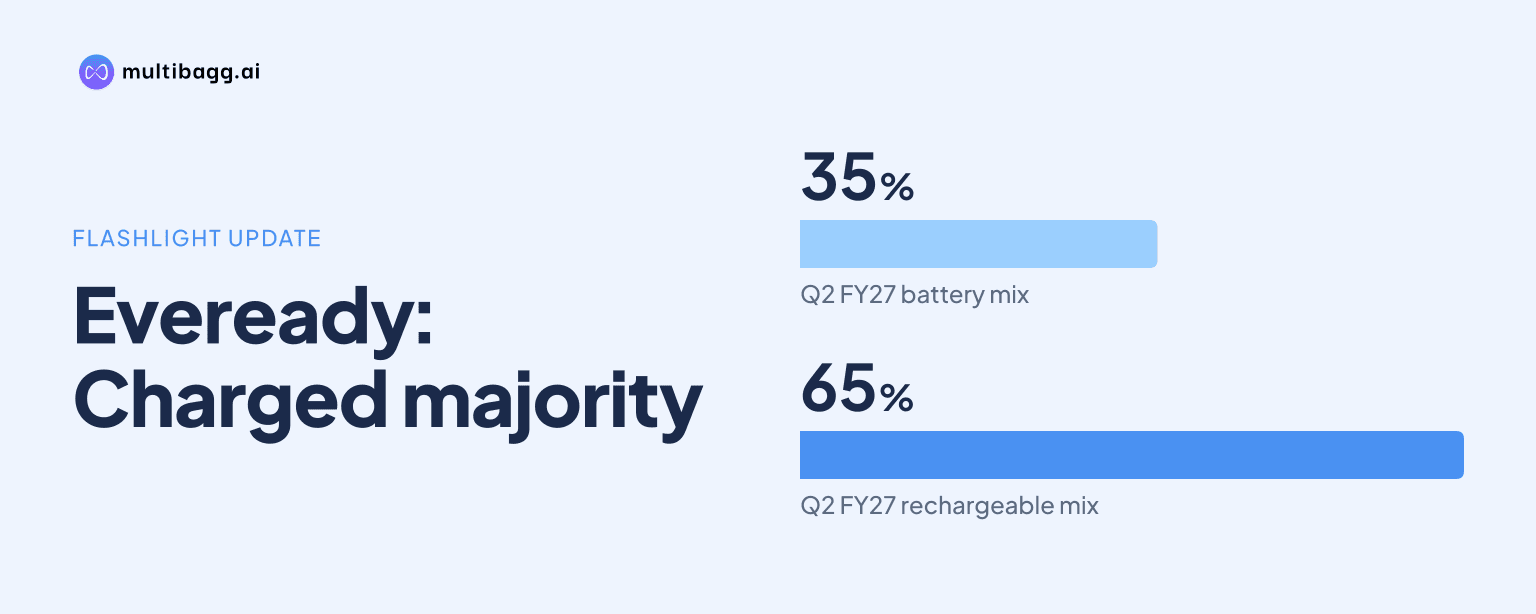
- Rechargeable flashlights accounted for 65% of Eveready’s flashlight revenue in Q2 FY27, compared with 35% for battery-operated flashlights.
- Eveready’s rechargeable flashlight revenue increased 33.2% to Rs 35.8 crore in Q2 FY27 from Rs 26.8 crore in Q2 FY26.
- Alkaline battery revenue rose 36.5% to Rs 29.5 crore in Q2 FY27 from Rs 21.6 crore in Q2 FY26.
powered by IRIS
Eveready has launched the Eveready Ultima Portable Anti-Mosquito Liquid Vaporiser, a patent-applied rechargeable device that can operate continuously through an included Type-C cable and provides up to three hours of battery backup. The product expands Eveready’s mosquito-protection range beyond racquets into portable liquid vaporisers.
Know Eveready Industries India inside out
Results, valuation, peers and who's buying, in one view.
What has Eveready launched in liquid vaporisers?
Eveready has introduced the Eveready Ultima Portable Anti-Mosquito Liquid Vaporiser, which it calls India’s first portable liquid vaporiser. The presentation describes the product as rechargeable and patent applied, positioning it as a liquid-vaporiser format intended for use beyond a fixed wall socket.
The product carries the Ultima name, which Eveready also uses in its alkaline battery portfolio. Eveready labels the vaporiser a “uni-plug” device that can be used anywhere, while its central product proposition is “mosquito protection that moves with you.” The source does not disclose a retail price, launch date, refill format or distribution plan for the vaporiser.
Eveready states in the product material that the vaporiser offers “100% protection from dengue, chikungunya & malaria.” The supplied presentation does not provide the conditions, test methodology or footnote details supporting that product claim. Its stated technical specifications are operation through a Type-C cable and battery backup of up to three hours.
How does the Eveready portable vaporiser operate?
Eveready says the vaporiser works continuously when plugged into the included Type-C cable and can provide up to three hours of battery backup when used on its rechargeable power source. This gives the product a corded operating mode and a temporary portable mode, rather than limiting use to a permanent electrical outlet.
The presentation does not disclose the battery capacity, charging time, charging-adapter specification or liquid-refill capacity. Its “uni-plug and use anywhere” wording identifies portability as the mechanism behind the new format, but the source provides no information on the locations or usage conditions for the stated three-hour battery-backup period.
Eveready already reports meaningful rechargeable participation in flashlights. Rechargeable flashlights accounted for 65% of flashlight revenue in Q2 FY27, compared with 35% for battery-operated flashlights, based on value performance. That comparison applies to flashlights rather than vaporisers, but it shows that rechargeable products form the larger reported part of that adjacent portable-electrical category.
How does the vaporiser fit Eveready’s portfolio?
Eveready presents the vaporiser under its objective of shaping a future portfolio for maximized value, alongside its established batteries and mosquito-protection products. Within the batteries portfolio, carbon-zinc batteries represent 82% of offerings, alkaline batteries 11%, accessories and others 6%, and rechargeable and coin batteries 1%.
The launch therefore adds a rechargeable consumer device outside Eveready’s listed dry-cell battery product split. In Q2 FY27, carbon-zinc and other products represented 89% of battery revenue by value, while alkaline batteries represented 11%. The source does not state whether the new vaporiser will be recorded in a batteries segment, an adjacent-products segment or another reporting line.
Eveready reported alkaline battery revenue of Rs 29.5 crore in Q2 FY27, up from Rs 21.6 crore in Q2 FY26, a 36.5% increase. It also reported about 30% volume growth in alkaline batteries, alongside growing market share. Carbon-zinc, by contrast, maintained steady volumes, with price increases helping sustain profitability, according to management.
Eveready said its carbon-zinc market share was about 57%, while its Jammu facility had become operational to add manufacturing scale and support operational performance. It also reported 17% emerging-channel growth, led by quick commerce and e-commerce. The presentation does not link the vaporiser specifically to the Jammu facility or to either emerging sales channel.
Got a follow-up? Ask IRIS
What other mosquito-protection products does Eveready offer?
Eveready presents the portable liquid vaporiser alongside mosquito racquets, describing the broader range as ready-to-use mosquito-protection solutions. One racquet has an auto mode in which blue light attracts and kills mosquitoes automatically when the product is placed on its stand in a dimly lit room and its switch is moved to the middle position.
That automatic racquet is described as addressing four household pests: mosquitoes, flies, cockroaches and moths. Its blue-light and electric-racquet mechanism differs from the new vaporiser’s liquid format, Type-C power connection and rechargeable battery. Eveready does not disclose sales, revenue or market share for either mosquito racquets or the liquid vaporiser.
Eveready also markets the Zap-On-The-Go Mosquito Racquet as ergonomic and travel friendly, with an ability to kill mosquitoes and flies instantly. The company states that this racquet has a 12-month warranty. Together with the vaporiser’s up-to-three-hour battery backup, the products address portable use, while the auto-mode racquet is designed for stand-based indoor operation.
What does Eveready’s rechargeable performance show?
Eveready’s rechargeable flashlight revenue rose 33.2% to Rs 35.8 crore in Q2 FY27 from Rs 26.8 crore in Q2 FY26. Management attributed the growth to continuous product innovation and value-led pricing. This revenue performance relates to flashlights, not vaporisers, and the source provides no comparable sales figure for the new liquid-vaporiser product.
In lighting, Eveready reported that emergency light-emitting diode, or LED, revenue increased 26.3% year on year to Rs 22.8 crore in Q2 FY27 from Rs 18 crore in Q2 FY26. Emergency LED products represented 22% of lighting revenue in Q2 FY27, compared with 51% for other LED products and accessories, 16% for luminaires and 11% for professional luminaires.
Eveready says it sells more than 1.3 billion dry-cell batteries annually and more than 17 million flashlights annually. These figures indicate the scale of its existing battery and portable-electrical categories, but they do not quantify demand for mosquito-protection products. The presentation gives no market-size estimate, revenue forecast, sales target or market-share target for the portable liquid vaporiser.
Conclusion
Eveready’s portable liquid vaporiser extends its mosquito-protection range through a rechargeable, Type-C-enabled format with up to three hours of battery backup. The launch sits alongside auto-mode and travel-oriented racquets, while Eveready’s wider rechargeable activity includes 33.2% growth in rechargeable flashlight revenue to Rs 35.8 crore in Q2 FY27 and 26.3% growth in emergency LED revenue to Rs 22.8 crore.
The next development to watch is how Eveready’s stated plan to shape its future portfolio for maximized value translates into reported performance for mosquito-protection products. The presentation identifies the vaporiser as patent applied and portable, but leaves its sales contribution, price, distribution reach and category position unresolved.