










Eveready’s Jammu plant delivers 6%-7% alkaline cost edge
Key highlights
- Eveready said Jammu-made alkaline batteries currently have a 6%-7% cost advantage over imports.
- Management estimated a 12%-13% advantage under stable forex, commodity-price and MRP conditions.
- Jammu contributed no more than 10% of alkaline sales in the quarter ending September after billing began that month.
- Eveready said alkaline batteries last at least three times as long as zinc batteries but cost about twice as much.
powered by IRIS
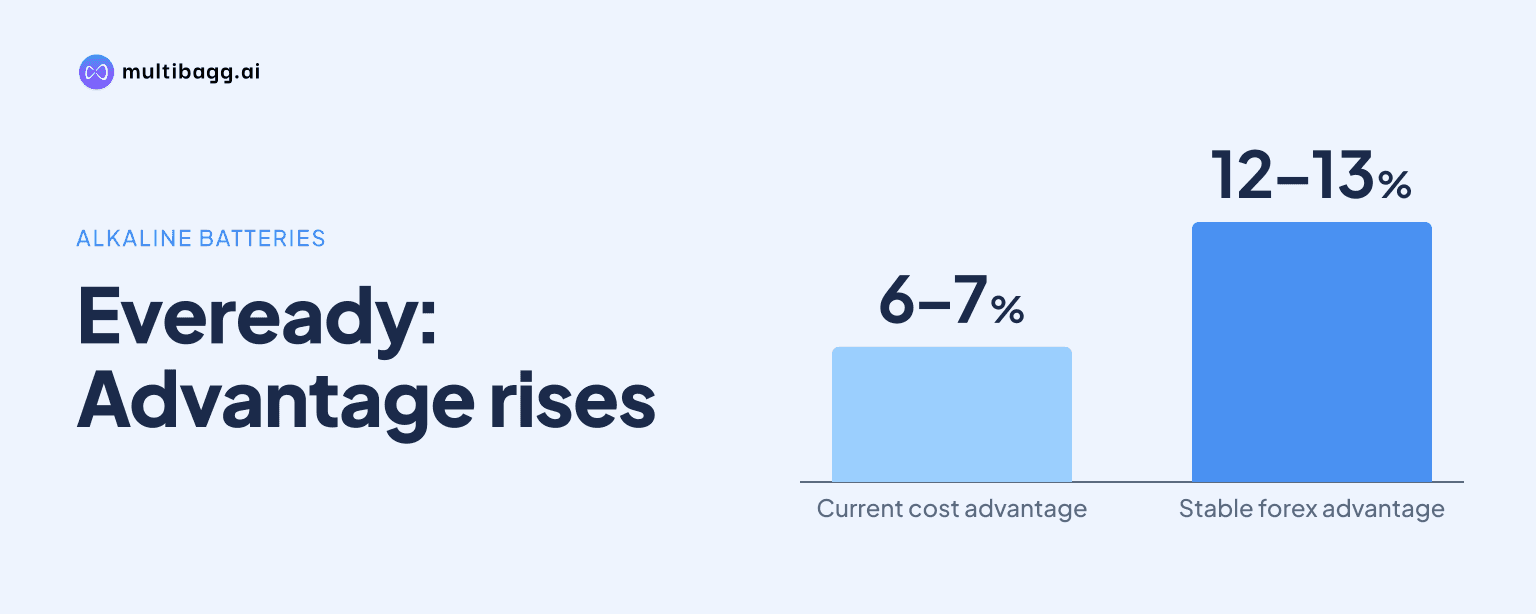
Eveready Industries India Limited said its Jammu-made alkaline batteries currently offer a 6%-7% cost advantage over imports, while management estimated a 12%-13% benefit under stable foreign-exchange, commodity-price and pricing conditions. Commercial production began in May, but billing started in September after battery ageing and the clearance of transition-period imported stock.
Know Eveready Industries India inside out
Results, valuation, peers and who's buying, in one view.
How much does Eveready save by making alkaline batteries in Jammu?
Eveready said Jammu-made alkaline batteries are currently at least 6%-7% better than imported batteries on a cost basis. Management described this as a broad estimate because war-related disruption, foreign-exchange movements, commodity inflation and changes in maximum retail prices, or MRP, can affect the difference between local production and imports.
Under stable conditions, Eveready estimated that local manufacturing would provide at least a 12%-13% accrual over imported prices. Management defined those conditions as stable foreign exchange and commodity prices, with MRP unchanged. The higher figure is therefore a conditional estimate rather than a reported current saving or a margin forecast.
Management did not disclose a rupee-per-battery saving, alkaline gross margin or timetable for achieving the 12%-13% estimate. The difference between the two ranges is 6 percentage points, showing the extent to which external costs and pricing conditions influence the reported economics.
When will Jammu-made batteries replace Eveready’s alkaline imports?
Eveready said Jammu output represented no more than 10% of alkaline-battery sales in the quarter ending September, when imports still supplied most of the category. Management said the current quarter would be largely supplied by the Jammu plant, and confirmed that alkaline sales of Rs 30 crore would be totally indigenous from Jammu going forward.
The plant began commercial production in May, but billing started only in September because batteries require 28 to 42 days of ageing, depending on the product. Eveready also had imported inventory for the transition period. The gap between May production and September billing explains why Jammu had contributed no more than 10% of alkaline sales in the September quarter.
What needs to happen for Eveready to reach a 12%-13% benefit?
Eveready said the move from a current 6%-7% advantage towards a potential 12%-13% benefit depends on higher plant utilisation, vendor localisation and backward integration. Management described this as a process that would continue over the next one year, as the company develops a domestic ecosystem for alkaline-battery manufacturing.
Management distinguished the immediate benefit from replacing imports with Jammu production from later operating improvements. It said alkaline batteries remain a smaller share of the total dry-battery mix than it desires, although their salience is accelerating during the current year and the next year. A larger alkaline mix could make improved unit economics more material to earnings before interest, tax, depreciation and amortisation, or EBITDA, according to management.
Got a follow-up? Ask IRIS
Why is Eveready prioritising alkaline batteries over zinc batteries?
Eveready said alkaline batteries last at least three times as long as zinc batteries in broad consumer terms but cost about twice as much. Management cited medical devices, smart remotes and remote-controlled toys as high-drain applications where alkaline batteries can be adopted, while saying a three-times price point would not initially support consumer adoption.
Management said about 95% of India’s dry-cell market was zinc roughly two and a half years ago, while global dry-cell markets have largely shifted to alkaline products. It said dry-cell volumes can look flat because longer-lasting alkaline cells substitute for zinc cells, but category value continues to grow as consumers trade up. Eveready put category penetration at about 85%-90%, framing the opportunity as household premiumisation rather than broad penetration growth.
What other routes could expand Eveready’s Jammu alkaline output?
Eveready said it has started scouting for alkaline white-label opportunities, but management placed the process on a one-to-two-year path. The Jammu facility is preparing for certifications, compliance requirements and buyer audits that may be needed before it can qualify for global tenders or supply arrangements.
Eveready already supplies private-label batteries in India’s business-to-business, or B2B, channel and said such business avoids advertising and promotion expenditure. Management said roughly 10% of total revenue comes from battery supplies to original equipment manufacturers and institutions, and that private-label business can earn middle-double-digit margins. It did not disclose a margin specifically for Jammu-made alkaline private-label batteries, while noting that pricing changes with inflation and zinc costs.
Conclusion
Eveready has quantified a current 6%-7% economic advantage from Jammu-made alkaline batteries against imports, with a management estimate of 12%-13% under stable forex, commodity and pricing conditions. The September quarter captured only an early part of that shift because Jammu accounted for no more than 10% of alkaline sales after billing began in September.
The next indicators are whether the current quarter is largely supplied from Jammu, as management indicated, and whether utilisation and vendor localisation progress over the next one year. Management also expects white-label development to take one to two years and said it would be better placed around February or March to provide a broader outlook on batteries, non-battery categories and growth direction.