










Evonile Pharma warns separation may disrupt operations
Key highlights
- Evonile Pharma’s control changed on July 29, 2026 after 17,450,680 shares, or 70.68% of share capital, were sold.
- Purchases from the erstwhile promoter were Rs 111.8 crore, or 53.1% of stock-in-trade purchases, in Fiscal 2026.
- Third-party manufactured products accounted for Rs 350.32 crore, or 98.87%, of Fiscal 2026 revenue from operations.
- Evonile Pharma received a fresh certificate of incorporation under its new name on October 1, 2026.
powered by IRIS
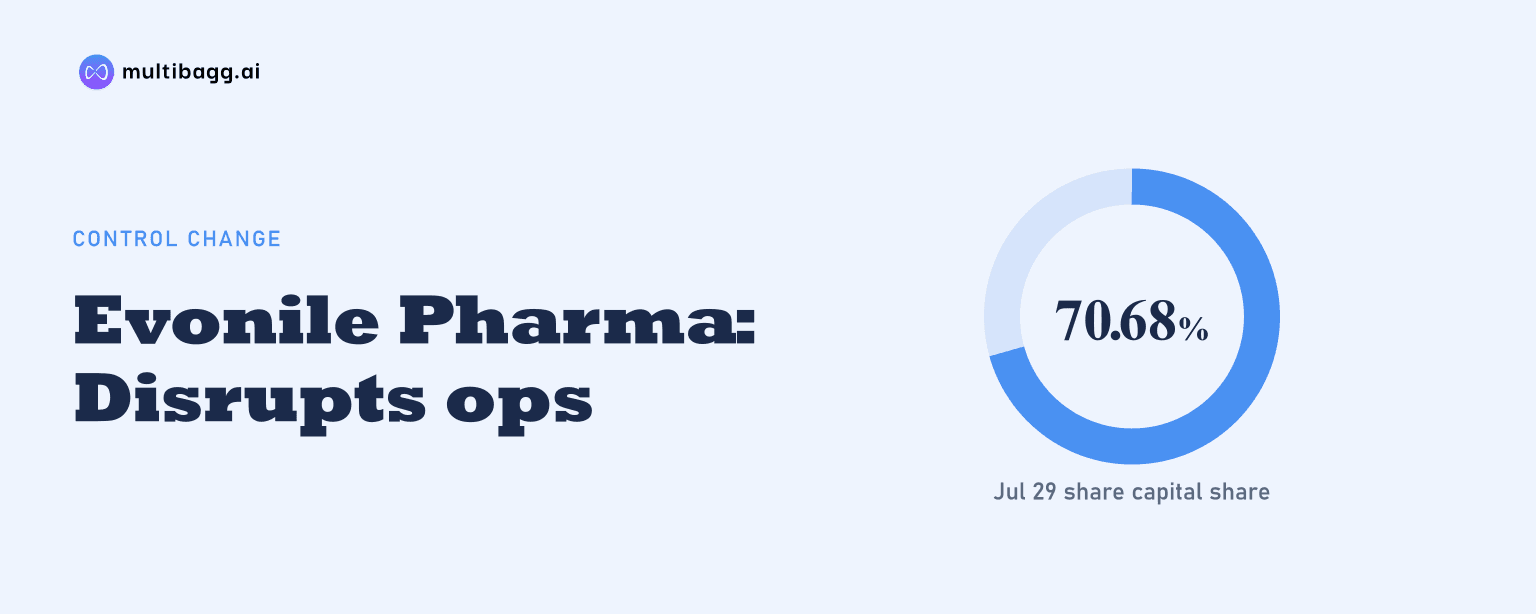
Evonile Pharma Limited says its separation from its erstwhile promoter could disrupt operations, supply arrangements and customer relationships after control changed on July 29, 2026, following the sale of 70.68% of its share capital. The company must rebuild systems, commercial arrangements and leadership continuity previously supported by the former promoter structure.
Know Evonile Pharma inside out
Results, valuation, peers and who's buying, in one view.
What changed in Evonile Pharma’s ownership and leadership?
Evonile Pharma changed control on July 29, 2026 after its erstwhile promoter sold 17,450,680 equity shares, representing 70.68% of share capital, under a February 19, 2026 share purchase agreement. WaveRise Investments Limited and ChrysCapital Fund X became the new promoters, while Two Infinity Partners became part of the promoter group. The acquirers and persons acting in concert also made an open offer for up to 6,419,608 shares, representing 26% of voting share capital.
The company says its new promoters had overseen operations for only a limited period when the Letter of Offer was issued. It cautions that historical financial performance until July 29, 2026 reflects periods before the control change and may not indicate future performance under the new promoters. This is a stated transition risk rather than a reported decline in financial performance.
Evonile Pharma also replaced its previous board, key managerial personnel and senior management after the control change. The new directors, key managerial personnel and senior management were appointed with effect from July 29, 2026. The company says the departure of personnel with institutional knowledge and long-standing customer and supplier relationships could affect operations, internal controls and continuity of strategic direction.
The company adopted its current name after shareholders approved the change on September 24, 2026, and received a fresh certificate of incorporation on October 1, 2026. Evonile Pharma says it must establish its identity with customers, distributors, suppliers and regulators while its new board and management build systems and processes for a standalone business.
Which former arrangements must Evonile Pharma rebuild?
Evonile Pharma says it was historically significantly dependent on its erstwhile promoter for trademarks and brand usage, supply arrangements, information-technology systems, and corporate and management expertise. Following the July 29, 2026 control change, it must replace, renegotiate or rebuild these arrangements, potentially requiring fresh approvals, registrations and permits. The company says this could involve higher costs, operational disruption and the loss of key personnel.
Supply is a material part of the separation because Evonile Pharma historically bought a substantial share of stock-in-trade from the erstwhile promoter. Such purchases were Rs 111.8 crore in Fiscal 2026, or 53.1% of total stock-in-trade purchases of Rs 210.58 crore, compared with Rs 82.24 crore, or 41.3% of Rs 199.07 crore, in Fiscal 2025. The purchase value rose by Rs 29.56 crore and the share of total purchases increased by 11.8 percentage points.
The previous arrangements with the erstwhile promoter ended when the share purchase agreement transactions were completed. Evonile Pharma now sources products from new third parties, including Novartis Pharma Services AG under a distribution arrangement granting exclusive rights to import, distribute and sell certain pharmaceutical products in India for specified periods. The company says these agreements contain conditions, restrictions and termination rights, and that loss of exclusivity or non-renewal could affect its market position.
Evonile Pharma does not own manufacturing facilities and relies on third parties in India and Switzerland for finished goods. Revenue from products made under third-party manufacturing arrangements was Rs 350.32 crore in Fiscal 2026, representing 98.87% of revenue from operations, versus Rs 355.3 crore and 99.73% in Fiscal 2025. Revenue from these products fell by Rs 4.98 crore, while their share of revenue declined by 0.86 percentage points.
Got a follow-up? Ask IRIS
How could separation affect Evonile Pharma’s customers and brands?
Evonile Pharma says it may not retain distributors, vendors and customers on the same terms, or at all, after leaving the former promoter structure. The company identifies possible effects on its customer base, sales volumes and pricing power if it cannot complete integration into the new ownership and governance framework without material disruption. These risks arise while the new promoters build operating experience with the business after July 29, 2026.
The October 1, 2026 name change adds a separate brand-transition task. Evonile Pharma says it may need to rebrand products, packaging, labels, marketing materials and regulatory records, potentially requiring approvals or intimations to the Central Drugs Standard Control Organization and state drug authorities. It warns that customer or distributor confusion could result in lower prescriptions or orders, weaker product placement, loss of goodwill and pressure on pricing.
Customer concentration raises the significance of maintaining commercial relationships. In Fiscal 2026, the largest customer contributed Rs 146.17 crore, or 41.2% of revenue from operations, compared with Rs 162.69 crore, or 45.6%, in Fiscal 2025. The top 10 customers accounted for 60.8% of revenue in Fiscal 2026 and 63.7% in Fiscal 2025, showing that concentration reduced but remained material.
Evonile Pharma also says customer transactions are generally driven by individual purchase orders rather than firm volume commitments. Pricing, delivery schedules and quantities are ordinarily determined by each order, so past order frequency or value does not assure future demand. That structure could make relationship disruption more consequential during the branding, leadership and distribution transition that began in July 2026.
What is Evonile Pharma’s plan after the control change?
Evonile Pharma says its new promoters and reconstituted management are pursuing portfolio expansion through in-licensing or acquisitions, new therapy areas, new geographies and changes to its distribution model. The company is building a therapy-aligned, divisionalised field force across metro cities and tier-2 and tier-3 markets instead of relying on a partner-led distribution model. It is also building presence in chronic segments including cardio-metabolic therapy.
The strategy includes acquiring larger chronic-therapy brands and complementary brands in orthopedics, gynecology and neurology, as well as launches within existing therapy areas. On September 7, 2026, the board approved the acquisition of the Indian trademarks Minipress and Minipres and related intellectual-property rights from a pharmaceutical company. On September 8, 2026, Evonile Pharma signed an exclusive promotion and distribution agreement with Novartis Healthcare Private Limited for Accentrix, or ranibizumab, and Pagenax, or brolucizumab, in India.
Management cautions that executing the plan can require upfront spending to recruit and retain skilled personnel, establish partnerships and enter competitive therapies. It also says acquisitions and brand agreements may fail to deliver anticipated benefits, require significant management attention, and be funded through debt or equity. The filing does not quantify the cost of the strategy or give a timetable for completing the separation work.
The company says its ability to grow will depend on independently sourcing products after the former arrangements ended. It states that this may require significant capital expenditure and management attention, and may not produce expected returns. Evonile Pharma also warns that customers, suppliers, distributors and other stakeholders may view it differently after it ceased to be part of the erstwhile promoter group.
Conclusion
Evonile Pharma’s filing presents the control change as an operational transition involving linked supply, technology, personnel, regulatory and commercial risks. The company has moved from purchases from the erstwhile promoter equal to 53.1% of Fiscal 2026 stock-in-trade purchases to new third-party arrangements, while changing its name and replacing leadership from July 29, 2026.
The next point to watch is execution of the stated standalone strategy: building a divisionalised field force, securing supply under new arrangements and integrating the Minipress and Minipres trademarks approved on September 7, 2026. Evonile Pharma also needs to complete regulatory updates related to its October 1, 2026 name change and gain acceptance of its new corporate identity among distributors, customers and suppliers.