










Evonile relies on third parties for 98.87% revenue
Key highlights
- Evonile generated Rs 350.32 crore, or 98.87% of Fiscal 2026 revenue from operations, through third-party manufacturing.
- Purchases from the Erstwhile Promoter were Rs 111.80 crore, or 53.1% of Fiscal 2026 stock-in-trade purchases.
- Evonile's largest customer contributed Rs 146.17 crore, or 41.2% of Fiscal 2026 revenue from operations.
- Evonile had Rs 29.68 crore of unhedged foreign-currency payables as of March 31, 2026.
powered by IRIS
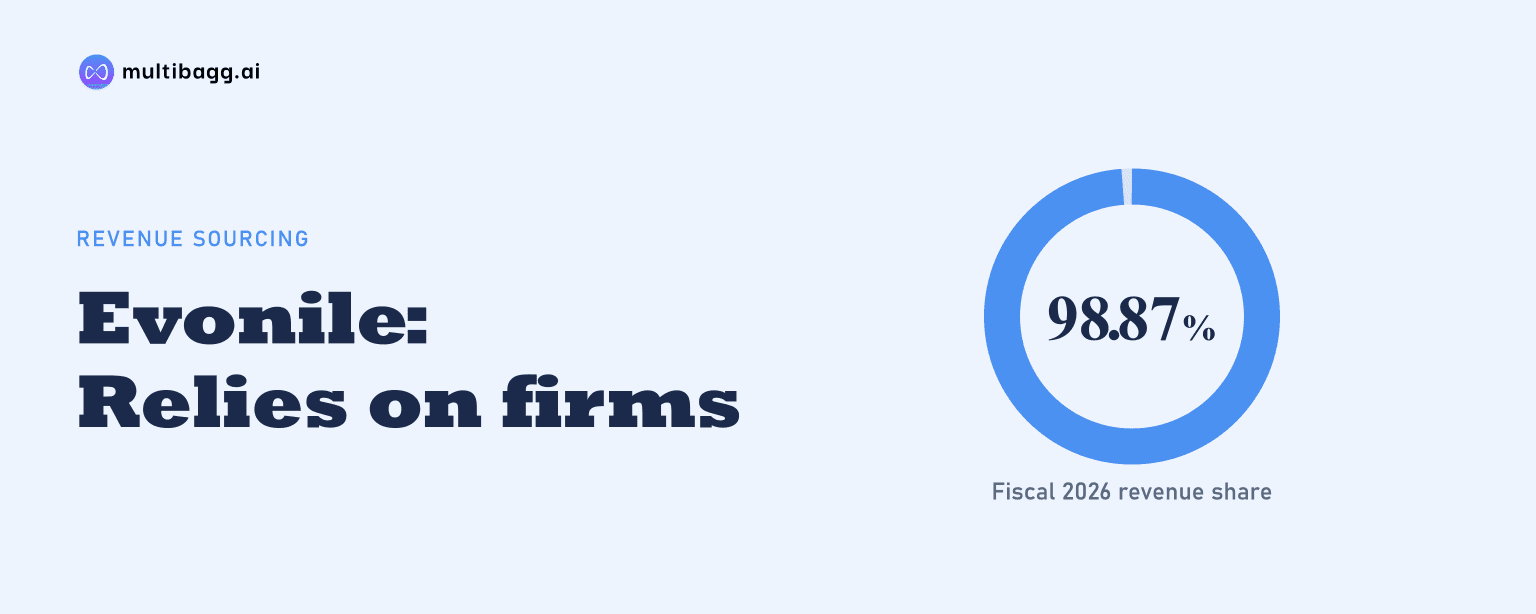
Evonile Pharma Limited generated Rs 350.32 crore, or 98.87% of revenue from operations in Fiscal 2026, from products made through third-party manufacturing arrangements. Evonile does not own manufacturing facilities, while its largest customer contributed Rs 146.17 crore, or 41.2% of Fiscal 2026 revenue from operations.
Know Evonile Pharma inside out
Results, valuation, peers and who's buying, in one view.
How dependent is Evonile on third-party manufacturers?
Evonile depends on third parties for all finished pharmaceutical products and does not own or operate manufacturing facilities. Revenue from products made through those arrangements was Rs 350.32 crore in Fiscal 2026, representing 98.87% of revenue from operations, compared with Rs 355.30 crore, or 99.73%, in Fiscal 2025.
The revenue generated through third-party manufacturing fell by Rs 4.98 crore between Fiscal 2025 and Fiscal 2026, while its share of revenue declined by 0.86 percentage points. Despite that movement, virtually all revenue in both years remained linked to externally made products across pain management, calcium supplementation, gynecology, neurosciences and transplant immunology.
Evonile's manufacturers operate in Maharashtra, Goa, Karnataka, Daman, Sikkim and Uttarakhand, as well as Switzerland. The company says production disruptions, quality issues, regulatory actions, contractual disputes, raw-material availability, transport delays and pricing changes could affect the timely or cost-effective supply of its finished goods.
The company also says it may not be able to exercise adequate oversight of the quality, storage or distribution practices of manufacturers and their suppliers. Products were recalled in Fiscal 2026 after tests by Karnataka Health Authorities found that they did not meet certain standards, although the disclosure does not identify the product involved or quantify the financial effect.
How concentrated was Evonile's supplier base before the ownership transition?
Evonile purchased Rs 111.80 crore of stock-in-trade from the Erstwhile Promoter in Fiscal 2026, equal to 53.1% of total purchases. This compared with Rs 82.24 crore, or 41.3% of total purchases, in Fiscal 2025.
Purchases from the Erstwhile Promoter increased by Rs 29.56 crore in Fiscal 2026, while total stock-in-trade purchases rose by Rs 11.51 crore. As a result, the former promoter group's share of stock-in-trade purchases rose by 11.8 percentage points, from 41.3% to 53.1%.
Evonile says it previously sourced a majority of its pharmaceutical products from a single third party that was a member of the erstwhile promoter group. The arrangements with the Erstwhile Promoter ended after completion of the transactions under the share purchase agreement, requiring Evonile to source key products from new third parties.
The company now identifies Novartis Pharma Services AG among new third parties supplying products under a distribution arrangement that gives Evonile exclusive rights to import, distribute and sell specified pharmaceutical products in India for specified periods. Evonile says its arrangements in India and Switzerland include conditions, restrictions and termination rights, and that a loss of exclusivity, termination or non-renewal could affect market access for relevant products.
What import and contract risks does Evonile face?
Evonile had Rs 29.68 crore of foreign-currency payables as of March 31, 2026 and does not hedge them. The company says rupee depreciation would increase the cost of imported goods, alongside its exposure to import-related customs duties and pricing restrictions.
Imports amounted to Rs 111.80 crore in Fiscal 2026 and Rs 82.24 crore in Fiscal 2025, representing 53.1% and 41.3%, respectively, of stock-in-trade purchases in those years. The increase of Rs 29.56 crore in imports coincided with the increase in purchases reported from the Erstwhile Promoter, although the disclosure does not separately provide a broader imported-product cost breakdown.
Evonile also says some supplier arrangements have no monetary cap or time limit on its indemnification obligations. It may have to bear costs where products are determined to be defective because of incorrect specifications it provided or a breach by the company, creating the possibility of claims without the contractual limits it describes.
The company remains responsible for regulatory compliance even where third parties provide services. For products requiring controlled storage, cold-chain handling and traceability, failures by carrying and forwarding agents, manufacturers or suppliers could result in spoilage, write-offs, recalls or regulatory action, according to the disclosure.
Got a follow-up? Ask IRIS
How concentrated is Evonile's customer revenue after the distribution termination?
Evonile's largest customer generated Rs 146.17 crore, or 41.2% of Fiscal 2026 revenue from operations, down from Rs 162.69 crore, or 45.6%, in Fiscal 2025. Its top 10 customers accounted for 60.8% of revenue in Fiscal 2026, compared with 63.7% a year earlier.
The revenue contribution from the largest customer declined by Rs 16.52 crore, while its share of revenue fell by 4.4 percentage points. The top 10 customers' combined share also declined by 2.9 percentage points, but the filing still identifies a substantial reliance on a limited number of customers.
Evonile says the recent termination of a distribution and promotion agreement with a major distributor has significantly reduced dependency on certain key customers and the associated concentration risk. It does not disclose a post-termination customer-concentration percentage, and says it will need to re-acquire and secure market access for products for which that distributor held promotional, distribution and sales rights.
Customers generally include distributors and stockists, as well as institutional and government customers. Evonile says quantities are usually set through individual purchase orders rather than firm long-term volume commitments, meaning pricing, delivery schedules and order volumes can vary from one order to another.
What is Evonile doing to change its commercial model?
Evonile is building a therapy-aligned, divisionalised field force to strengthen distribution across metro, tier-2 and tier-3 markets instead of relying on a partner-led distribution model. The plan follows the July 29, 2026 change in control, when WaveRise and ChrysCapital became the new promoters.
Management's disclosed strategy includes portfolio expansion through in-licensing or acquisitions, entry into new therapeutic areas and geographies, and distribution-model changes. Evonile says it is building a presence in cardio-metabolic therapy and pursuing launches in existing therapy areas, as well as complementary brands in orthopedics, gynecology and neurology.
The board approved the acquisition of the Minipress and Minipres trademarks registered in India, with certain related intellectual property rights, on September 7, 2026. On September 8, 2026, Evonile entered an exclusive distribution and promotion agreement with Novartis Healthcare Private Limited for Accentrix, containing ranibizumab, and Pagenax, containing brolucizumab, in India.
Evonile cautions that the strategy may require upfront costs for recruiting and retaining skilled personnel, entering partnerships and investing in competitive therapies. The company also says that its board, key managerial personnel and senior management were appointed from July 29, 2026, and that the new leadership's ability to establish systems and execute the strategy will affect the transition.
Conclusion
Evonile's Fiscal 2026 disclosure shows that third-party manufacturing remained the basis of 98.87% of revenue from operations, while supplier concentration rose before arrangements with the Erstwhile Promoter ended. Customer concentration declined from Fiscal 2025 levels, but the largest customer still represented 41.2% of Fiscal 2026 revenue, and the end of a major distributor arrangement requires Evonile to restore market access for affected products.
The next issue to watch is execution of Evonile's planned shift toward a divisionalised field force and a broader portfolio of in-licensed or acquired brands. The September 2026 Minipress and Minipres approval and the ophthalmology distribution agreement are disclosed steps in that plan, while the company has not quantified post-termination customer concentration or the outcome of its market-access rebuilding effort.