










Exicom approves Tritium sale plan at USD 85m enterprise value
Key highlights
- Exicom approved a non-binding Tritium divestment term sheet at an indicative USD 85 million enterprise value.
- Consolidated Q2 FY27 revenue was Rs 388.3 crore, up from Rs 331.1 crore in Q1 FY27.
- Standalone Q2 FY27 EBITDA rose to Rs 25.6 crore from Rs 15.2 crore in Q2 FY26.
- Exicom's EV charging revenue exceeded Rs 100 crore for the first time in Q2 FY27.
powered by IRIS
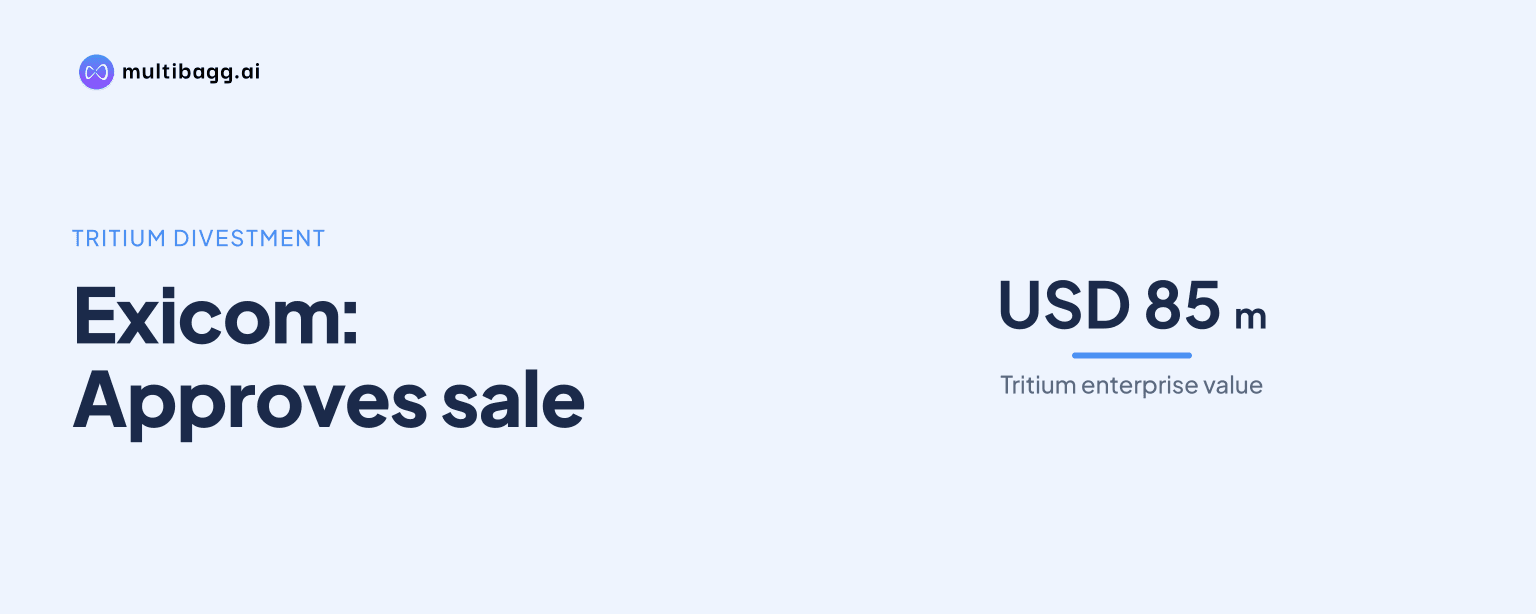
Exicom Tele-Systems Limited approved a non-binding term sheet to divest Tritium at an indicative USD 85 million enterprise value on November 4, 2026, subject to due diligence, closing adjustments and definitive documents. The decision follows Q2 FY27 consolidated revenue of Rs 388.3 crore and redirects capital towards Indian and export opportunities.
Know Exicom Tele-Systems inside out
Results, valuation, peers and who's buying, in one view.
What did Exicom approve for Tritium?
Exicom approved a non-binding term sheet with a prospective acquirer for the divestment of its Tritium business at an indicative enterprise value of USD 85 million. The proposed valuation is on a cash-free and debt-free basis, and the November 4, 2026 announcement says the transaction remains subject to confirmatory due diligence, customary closing adjustments and mutual agreement on definitive transaction documents.
The approval is not a completed disposal or a disclosed cash receipt for Exicom. The release does not identify the prospective buyer, provide a timetable for signing or closing, or quantify sale proceeds available after adjustments. It says Exicom will retain a perpetual licence to TRI-FLEX technology, while management said Tritium's liquid-cooled power modules are already manufactured at Exicom's Hyderabad plant.
Why is Exicom divesting Tritium now?
Exicom is divesting Tritium because it sees capital-allocation opportunities in its Indian business and export markets while describing Tritium as capital intensive. Tritium was acquired to access global electric-vehicle charging technology and international markets; Exicom said the business has commercialised new products, entered new markets and reached its highest order book since the acquisition, with what it described as a clear path to profitability.
Management's stated rationale is to retain the technology and market gains from the acquisition while reallocating financial resources. Anant Nahata, Exicom's chief executive officer and managing director, said the company would retain access to global markets and power-electronics capabilities through the technology licence and Hyderabad production. Exicom said the proposed divestment “re-opens” a path to becoming debt-free in the very near future, rather than saying that this outcome is assured by the USD 85 million enterprise value.
How did Exicom's Q2 FY27 financials change?
Exicom's consolidated performance improved sequentially in Q2 FY27, with revenue rising to Rs 388.3 crore from Rs 331.1 crore in Q1 FY27 and earnings before interest, tax, depreciation and amortisation (EBITDA) turning positive at Rs 1.8 crore from a loss of Rs 21.9 crore. Against Q2 FY26, consolidated revenue increased from Rs 281.7 crore and EBITDA improved from a loss of Rs 32.7 crore.
The standalone business provided the larger positive contribution in the quarter ended September 30, 2026. Standalone revenue increased 21.3% year on year to Rs 277.0 crore, while EBITDA rose 69% to Rs 25.6 crore and its EBITDA margin reached 9.2%, compared with 6.6% in Q2 FY26. Consolidated profit after tax remained a loss of Rs 57.8 crore, but narrowed from losses of Rs 73.6 crore in Q1 FY27 and Rs 68.8 crore in Q2 FY26.
Got a follow-up? Ask IRIS
Which India and export opportunities will Exicom fund?
Exicom's priority is electric-vehicle charging in India, where standalone EV charging-equipment revenue exceeded Rs 100 crore for the first time in Q2 FY27. The company said it produced 2.5 times as many alternating-current chargers and twice as many direct-current chargers during the quarter, supported by new customer wins. Exicom estimates annual Indian demand could rise to as many as 130,000 AC chargers, 25,000 DC chargers and nearly 6,000 high-power DC chargers for electric buses and trucks.
The company also reported international expansion from FY26 market trials, entering 10 new countries and appointing 10 new distribution partners in Q2 FY27. Its charging customer base includes 7 of India's top 10 EV makers, 17 of the top 20 charging operators and 9 of 18 electric-bus and truck makers, according to Exicom. On software, it extended artificial-intelligence-based remote monitoring to Spin Air AC chargers and introduced an AI-enabled service agent.
Beyond charging, Exicom cited a Q2 order for about 5,000 DC power systems from a tier-1 telecom operator in its Critical Power segment. It also said it holds about 50% share in hybrid power and battery solutions for BharatNet's mid-mile network, added Critical Power customers in Africa and the Middle East, and signed long-term energy-storage distributor agreements. The company cited projected commercial and industrial energy-storage installations growing from under 1 gigawatt-hour in 2025 to as much as 31 gigawatt-hours by 2032.
Conclusion
The proposed Tritium divestment combines a withdrawal from owning the global DC fast-charging arm with retention of a perpetual TRI-FLEX technology licence. Q2 FY27 also showed a difference between standalone EBITDA of Rs 25.6 crore and consolidated EBITDA of Rs 1.8 crore, explaining Exicom's stated focus on its India-led operating business and selected export expansion.
The next matters to watch are confirmatory due diligence, agreement on definitive transaction documents and closing adjustments to the USD 85 million indicative enterprise value. Exicom enters the second half of FY27 with its first Rs 100 crore EV-revenue quarter, 10 newly entered export countries and the disclosed 5,000-system telecom order as measurable milestones for its refocused plan.