










Exicom seeks approval for USD 85 million Tritium divestment
Key highlights
- Exicom approved a proposed Tritium divestment on November 4, 2026 at an indicative USD 85 million enterprise valuation.
- Exicom B.V. reported FY 2025-26 turnover of Rs 204.3471 crore and a loss of Rs 291.6284 crore.
- Exicom's consolidated half-year revenue rose to Rs 719.4152 crore for the period ended September 30, 2026 from Rs 487.0424 crore a year earlier.
- The proposed sale requires a shareholder special resolution, buyer due diligence, definitive agreements and closing approvals.
powered by IRIS
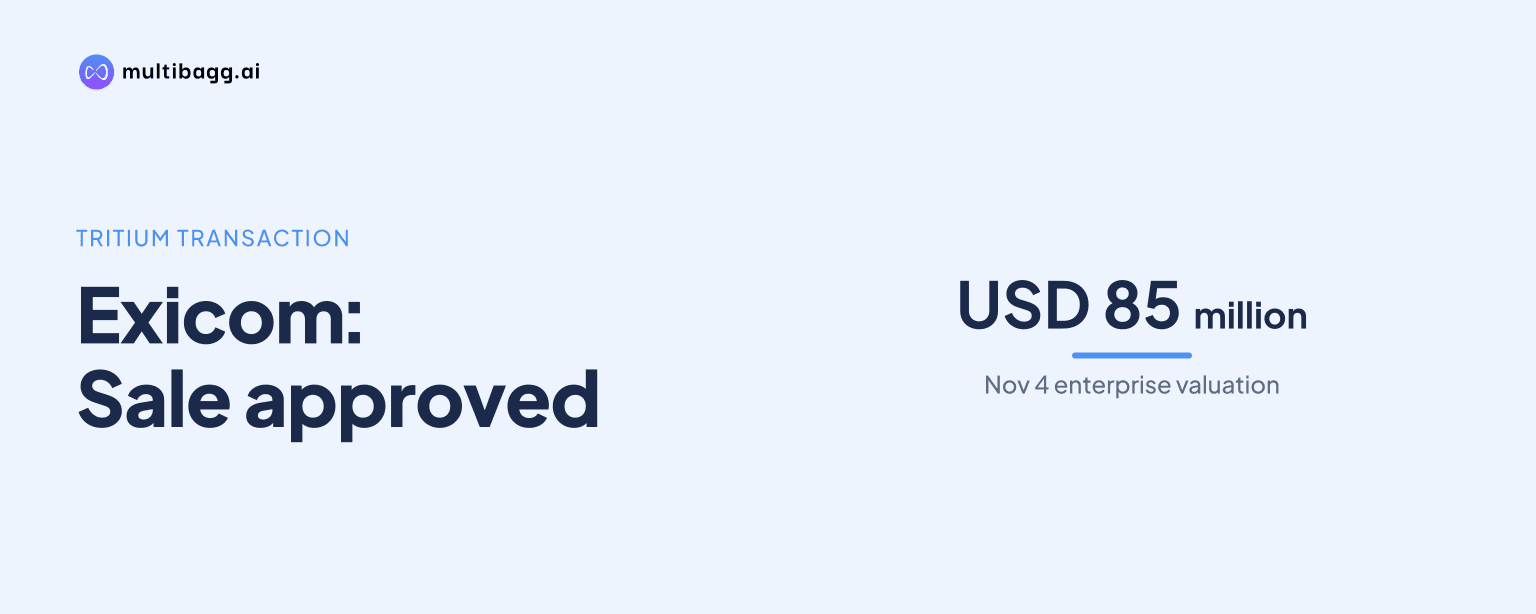
Exicom Tele-Systems Limited is seeking shareholder approval to divest its Tritium business at an indicative enterprise valuation of USD 85 million, after Exicom B.V. reported a Rs 291.6284 crore loss in FY 2025-26. The November 4, 2026 proposal remains conditional on buyer due diligence, definitive agreements and closing approvals.
Know Exicom Tele-Systems inside out
Results, valuation, peers and who's buying, in one view.
What is Exicom proposing to sell?
Exicom is proposing to sell the Tritium business through either a sale of its entire shareholding in Exicom Power Solutions B.V., Netherlands, or a sale by Exicom B.V. of all four Tritium subsidiaries. The entities are Tritium Power Solutions Inc. in the United States, Tritium NexGen Solutions B.V. in the Netherlands, Tritium Power Solutions Pty Ltd in Australia and Tritium Power Solutions Limited in the United Kingdom.
The transaction perimeter may also include the relevant business and intellectual property held by those Tritium entities, as specified in final transaction documents. Exicom's board approved both possible structures on November 4, 2026, while Exicom B.V. had ceased to be a wholly owned subsidiary on April 22, 2026.
What does the USD 85 million Tritium valuation mean?
The USD 85 million amount is an indicative enterprise valuation for the Tritium business on a cash-free and debt-free basis, rather than a final cash payment to Exicom. The final transaction value and consideration due to Exicom or Exicom B.V. will depend on the selected legal structure, due diligence, customary closing adjustments and negotiated commercial terms.
No consideration had been received as of November 4, 2026, and Exicom had not disclosed the prospective buyer's identity. The term sheet is non-binding on the proposed sale, although its clauses on exclusivity, expense reimbursement, confidentiality, announcements, governing law and dispute resolution are binding under its terms.
Why does Exicom need shareholder approval for the sale?
Exicom will seek shareholder approval by special resolution for the proposed disposal under Section 180(1)(a) of the Companies Act, 2013, and Regulations 24(5), 24(6) and 37A of the Securities and Exchange Board of India Listing Regulations. The board approved the draft postal-ballot notice on November 4, 2026, with dispatch to shareholders planned in due course.
Shareholder approval would not itself complete the transaction because no definitive agreement had been executed as of November 4, 2026. Exicom said completion requires satisfactory buyer due diligence, mutually acceptable definitive documents, fulfilment of conditions precedent, and applicable statutory, regulatory, contractual and other approvals; it expects completion within the current financial year only if these steps are met.
Got a follow-up? Ask IRIS
How material was Exicom B.V. to Exicom's results?
Exicom B.V. contributed turnover of Rs 204.3471 crore in FY 2025-26, equal to 17.74% of Exicom's consolidated turnover of Rs 1,151.7253 crore. It also recorded a Rs 291.6284 crore loss and had net worth of Rs 168.857 crore, which the disposal disclosure says represented 25.93% of Exicom's consolidated net worth.
The Exicom B.V. loss exceeded Exicom's consolidated FY 2025-26 loss of Rs 274.1266 crore, indicating that other group operations and consolidation effects partly offset the subsidiary's result. The filing describes Exicom B.V. as a material subsidiary and says the proposed divestment supports Exicom's stated focus on EV Charging and Critical Power in India and international markets.
What do Exicom's latest financial results show?
Exicom reported consolidated revenue from operations of Rs 719.4152 crore for the half year ended September 30, 2026, compared with Rs 487.0424 crore in the corresponding prior-year half year. Its consolidated net loss narrowed to Rs 130.3545 crore from Rs 151.9479 crore over the same comparison.
The EV Charger segment generated Rs 367.5505 crore of consolidated half-year revenue, above Critical Power's Rs 351.8647 crore, but its segment result before interest and tax was a loss of Rs 23.882 crore. Critical Power reported a segment result of Rs 20.2553 crore for the six-month period, compared with the EV Charger's loss.
What could change if the Tritium transaction closes?
A sale of Exicom's entire holding in Exicom B.V. would remove that subsidiary and its Tritium operations from Exicom's group structure, while a sale of the Tritium subsidiaries by Exicom B.V. would leave a different structure. The filing does not quantify a disposal gain or loss, tax impact, debt settlement, final cash proceeds or post-sale balance-sheet effect.
At September 30, 2026, Exicom had consolidated total assets of Rs 1,883.7676 crore and consolidated equity of Rs 596.2497 crore, down from Rs 651.2937 crore at March 31, 2026. Consolidated cash and cash equivalents were Rs 30.8263 crore at September 30, 2026, versus Rs 35.3903 crore at March 31, 2026, but these group-level figures do not establish the ultimate cash proceeds from a sale.
Conclusion
Exicom's proposed Tritium divestment carries an indicative USD 85 million enterprise value for a business housed in a material subsidiary that recorded a Rs 291.6284 crore FY 2025-26 loss. The proposal is consistent with management's stated plan to optimise capital allocation and concentrate on EV Charging and Critical Power, but the final consideration and accounting effect have not been disclosed.
The next events to watch are dispatch of the postal-ballot notice, the shareholder vote, completion of buyer due diligence and execution of definitive documents. Exicom expects completion within the current financial year only after conditions precedent, closing adjustments and required approvals are satisfied, while the buyer identity and final transaction structure remain unresolved.