










Fastway plan approved; DoT claim revision and licence consent
Key highlights
- Fastway’s plan was approved after receiving 100% financial-creditor voting support.
- The tribunal rejected DoT’s Rs 416.33 crore escrow request for a contingent claim.
- DoT sought to raise Category 1 LF and SUC dues from Rs 270.02 crore to Rs 271.45 crore.
- ISP licence transfer requires DoT approval, but Fastway’s plan proceeds even without the licence.
powered by IRIS
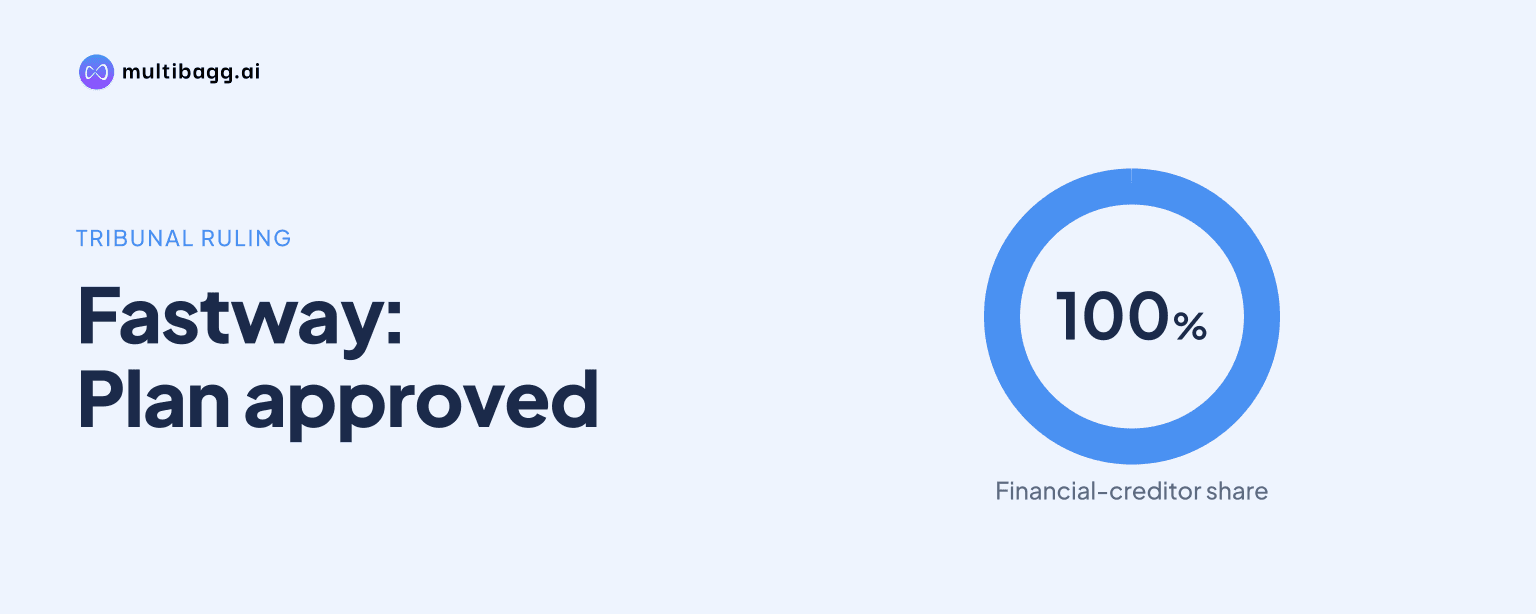
Fastway Transmissions Private Limited’s resolution plan was approved after the tribunal rejected the Department of Telecommunications’ request for a Rs 416.33 crore escrow, directed recalculation of its admitted claim and held that any Internet Service Provider licence transfer needs Department of Telecommunications approval. Fastway’s plan remains unconditional even if the ISP licence is not granted.
Know Quadrant Televentures inside out
Results, valuation, peers and who's buying, in one view.
Why did the tribunal approve Fastway’s resolution plan?
The tribunal approved Fastway’s resolution plan because it found compliance with Section 30(2) of the Insolvency and Bankruptcy Code, 2016, and the applicable Corporate Insolvency Resolution Process, or CIRP, Regulations. Financial creditors approved the plan with 100% of their voting share, and the resolution professional filed a Form H compliance certificate supporting the plan’s conformity with the Code and regulations.
The plan provides for CIRP costs to be paid before other debts and for operational creditors to receive the treatment required under the Code. The resolution professional also certified Fastway’s eligibility under Section 29A. The plan includes Rs 50 lakh for contingencies and claims arising before its effective date, including reasonable litigation costs incurred after approval in proceedings concerning implementation or court directions.
The tribunal had reserved the plan application for final orders on 22 September 2026 after hearing that the corporate debtor had a pan-India ISP licence but held no spectrum. That distinction shaped its treatment of the Supreme Court’s 2026 decision in State Bank of India v Union of India, which concerned telecom licence and spectrum transfers rather than an ISP licence without any spectrum allocation.
What happened to DoT’s admitted claim against Fastway?
The tribunal directed the resolution professional to recompute interest and admit the Department of Telecommunications, or DoT, claim accordingly under Clause 20.7 of the licence agreement. DoT sought to increase Category 1 licence-fee and spectrum-usage-charge, or LF and SUC, adjusted gross revenue dues from Rs 270.02 crore to Rs 271.45 crore by counting September 2025 as a full month for interest.
Clause 20.7 provides for delayed-payment interest at 2% above State Bank of India’s Prime Lending Rate, or PLR, prevailing at the start of the relevant financial year. It requires monthly compounding and explicitly treats part of a calendar month as a full month. The tribunal said the clause was clear and required no interpretation, making recalculation of the interest component necessary.
DoT also submitted a revised Rs 878.24 crore claim on 21 August 2026, citing the Supreme Court’s 1 September 2020 judgment. The tribunal said Regulation 14(2) requires the resolution professional to revise admitted claims when further information justifies it. It directed the professional to account for the effect of the 2020 judgment on matters it decided, if that impact had not already been included.
Why did the tribunal reject DoT’s Rs 416.33 crore escrow request?
The tribunal rejected DoT’s request for a Rs 416.33 crore escrow or contingent provision because the claim had not crystallised on the insolvency commencement date. The resolution professional had admitted the amount at a notional Rs 1 as a contingent claim in an email dated 12 June 2026, pending the outcome of Civil Appeal No. 220 of 2021 before the Supreme Court.
The order says a CIRP cannot be held up while disputed claims are determined elsewhere. It relied on the National Company Law Appellate Tribunal’s 2025 decision in U.P. Jal Vidyut Nigam Ltd. v Ashish Chhawchharia, which upheld notional admission of a disputed contingent claim where the underlying liability remained uncertain. On that reasoning, the tribunal did not fault the Rs 1 notional admission.
DoT’s related application, IA (IBC) 4314 of 2026, was disposed of on these terms. That application had also sought disclosure of the corporate debtor’s liquidation value and the potential Section 53(1) payment in liquidation. The tribunal recorded that the liquidation value was conveyed to DoT’s counsel on 21 October 2026, when the application was reserved for orders.
Got a follow-up? Ask IRIS
Can Fastway transfer the ISP licence without DoT approval?
No, Fastway can transfer the ISP licence only with DoT approval and subject to DoT’s conditions and directions. The successful resolution applicant stated that transfer would be subject to those requirements, and the tribunal held that any transfer must occur strictly in accordance with the approval DoT grants.
The tribunal nevertheless held that pre-plan liabilities directly attributable to telecom and ISP licences, including licence fees, adjusted gross revenue, penalties, interest and regulatory dues, would be settled under the approved plan. It said the absence of spectrum made the facts different from the 2026 Supreme Court case, while the clean-slate treatment under the plan addressed historic liabilities of the corporate debtor.
Fastway made a binding offer for two outcomes: licence transfer with DoT approval, or implementation without an ISP licence if approval is not granted. The tribunal accepted that the plan is unconditional in the latter scenario. The order therefore separates DoT’s authority over a future licence transfer from Fastway’s ability to implement the approved resolution plan.
What other conditions apply after Fastway’s plan approval?
Fastway must meet securities-law requirements if extinguished or unsettled debt is converted into equity and the related capital is reduced. The order specifically makes such steps subject to Securities and Exchange Board of India requirements on fresh-share allotment and cancellation, as well as the minimum 5% public-shareholding requirement under Securities Contracts Regulation Act regulations.
The order also leaves tax and accounting questions to the relevant authorities and laws. The Income Tax Department may examine accounting treatment under Sections 2(24), 28 and 56 of the Income Tax Act, 1961, or corresponding provisions of the Income Tax Act, 2025, including General Anti-Avoidance Rules. Tax authorities may similarly examine the carry-forward of losses, unabsorbed depreciation and indirect-tax input credit.
For permissions other than the ISP licence, renewal or continuation cannot be refused solely because past dues were extinguished under the Code or because of the corporate debtor’s earlier insolvency. Fastway may seek renewal through the prescribed process and fees. Statutory appointments must be completed within 12 months, unless the resolution plan provides a longer period.
Conclusion
The order gives Fastway an approved route to implement its resolution plan, supported by 100% financial-creditor voting, without setting aside Rs 416.33 crore for DoT’s unresolved contingent claim. It also requires the DoT claim to be corrected under the licence agreement’s interest provisions and preserves DoT’s control over the separate question of ISP licence transfer.
The next matters to watch are the resolution professional’s interest recalculation, any claim revision reflecting the Supreme Court’s 1 September 2020 judgment, and DoT’s decision on licence-transfer approval. Fastway’s plan is structured to proceed even without that licence, while statutory appointments are due within 12 months or any longer period specified in the plan.