








Felix Oman targets 60 TPD after securing Rs 100 crore contracts
Max Plan at ₹4,999/yr₹8,999

Find your next multibaggerBe a Pro Investor
Research stocks and track your picks on the go. Download the app.
Key highlights
- Felix holds 76.5% of Felix Oman, acquired in July 2023.
- Felix Oman targets waste-oil recycling capacity of 60 TPD by April 2027E, up from 40 TPD.
- OQ8 Duqm and Oman LNG have disclosed contract values totalling Rs 100 crore over five years.
- The OQ8 Duqm hazardous-waste agreement has a minimum disclosed value of Rs 60 crore over five years.
powered by IRIS
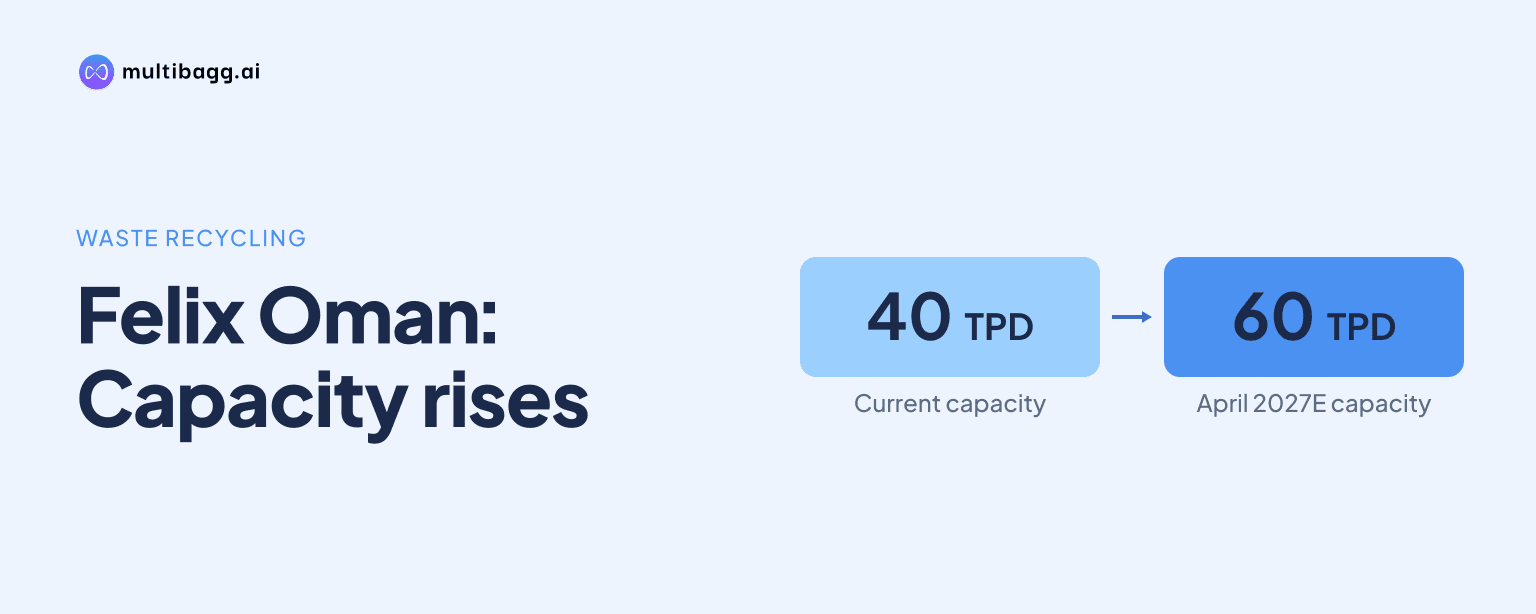
Felix Industries LLC - Oman, 76.5% held by Felix, targets waste-oil recycling capacity of 60 tonnes per day (TPD) by April 2027E, up 50% from 40 TPD, alongside disclosed five-year contracts worth Rs 100 crore with OQ8 Duqm and Oman LNG. The Oman business was acquired in July 2023 and serves as Felix’s Gulf operating platform.
Know Felix Industries inside out
Results, valuation, peers and who's buying, in one view.
What does Felix Oman do?
Felix Oman provides regulated environmental services across Oman and the wider Gulf Cooperation Council (GCC) region from the Sumair Industrial Area in Oman. Acquired in July 2023, the subsidiary collects, transports, treats, recycles and disposes of hazardous waste for oil and gas companies, government bodies and industrial customers.
Its waste-oil process covers used-oil collection and pre-treatment, followed by vacuum distillation and catalytic cracking. Listed outputs include re-refined base oils, blended fuels and recovered by-products. Felix Oman also identifies chemical-waste incineration, waste-to-energy, sewage treatment, environmental cleanup and single-use-plastic processing as operating activities alongside its 40 TPD oil-recycling plant.
Felix holds 76.5% of Felix Oman, compared with its 79.34% holding in Tierra Fertilizer Private Limited and 51% holding in Rivita Solutions Private Limited. Tierra operates a 4 TPD metals-recycling facility in Mehsana, Gujarat, while Rivita reports 8 active Oil and Natural Gas Corporation (ONGC) plants, placing the Oman unit within Felix’s wider environmental-services portfolio.
How large are Felix Oman’s disclosed customer contracts?
Felix Oman’s disclosed customer contracts have stated values of Rs 100 crore over five years, comprising a minimum Rs 60 crore agreement with OQ8 Duqm and a Rs 40 crore agreement with Oman LNG. The presentation describes the OQ8 Duqm agreement as a landmark hazardous-waste contract and dates it to May 2026.
The Rs 60 crore OQ8 Duqm figure is described as a minimum value. Therefore, the Rs 100 crore total reflects the values presented by Felix rather than a forecast of revenue recognition. The presentation does not provide an annual billing schedule, contract margin, Oman LNG start date or a split of OQ8 work between waste-oil recycling and other hazardous-waste services.
The contracts sit within a refinery-linked industrial setting in Oman. OQ8 Duqm is reported in the presentation as processing 255,000 barrels per day, above its 230,000-barrel-per-day nameplate capacity, while be'ah’s Al Duqm site received 32,400 tonnes of industrial waste in 2025. These figures describe the market environment cited by Felix, but they do not disclose Felix Oman’s expected waste volumes or contract utilisation.
How will Felix Oman increase waste-oil capacity to 60 TPD?
Felix Oman plans to increase waste-oil recycling capacity from 40 TPD to 60 TPD by April 2027E, adding 20 TPD or 50%. Felix categorises waste oil as an expanding vertical and says full utilisation of the existing 40 TPD oil-recycling plant is in sight before phase-two expansion.
Management’s disclosed sequence is to drive the existing Oman plant to full utilisation and then pursue phase-two expansion. The 60 TPD figure is therefore a target rather than current capacity. Felix does not state the capital cost, construction timetable, commissioning date, feedstock requirement or approval status for the additional 20 TPD.
Felix Oman’s process converts collected used oil through pre-treatment, vacuum distillation and catalytic cracking into re-refined base oils, blended fuels and recovered by-products. Felix does not disclose current throughput, utilisation percentage, base-oil yield or sales volumes. Progress from the installed 40 TPD base towards the April 2027E target cannot therefore be measured from the presentation alone.
Got a follow-up? Ask IRIS
How does Felix Oman fit Felix’s operating plan?
Felix positions Felix Oman as its international operating platform and says it will evaluate refinery opportunities in Saudi Arabia and the United Arab Emirates after the Oman plant reaches full utilisation. The presentation also says discussions are under way with Saudi and UAE refineries, but gives no contract values, sites, capacity targets or dates for either market.
The Oman capacity plan sits beside roadmaps in three other Felix verticals. Felix reports more than 17 million litres per day (MLD) of installed water and wastewater capacity, with recurring-revenue capacity expected to rise from 5.9 MLD to 9.1 MLD by April 2027, a 55% increase. Solid-waste capacity is shown as stable at 50 TPD through April 2027E, while metal recovery remains 4 TPD during commissioning.
Management says it intends to grow the share of build-own-operate (BOO), build-own-operate-transfer (BOOT) and operations-and-maintenance (O&M) contracts over the next four to five years. Felix Oman’s customer agreements have five-year terms, while Felix separately cites contracts of up to 10 years, including a Rs 140.08 crore, 10-year BOOT water order. The disclosed contract durations align with management’s plan to increase recurring operating income from assets and service arrangements.
What factors support Felix Oman’s waste-oil expansion?
Felix links the Oman platform to refinery-related hazardous-waste volumes and the country’s waste-diversion objectives. The presentation states that be'ah targets 60% landfill diversion by 2030 and 80% by 2040, while Felix Oman provides collection, treatment, recycling and disposal services beyond waste-oil processing.
The presentation also identifies used-oil re-refining as a regulation-led market in India, where the extended producer responsibility obligation rises from 5% in FY25 to 50% in FY31. That Indian requirement does not govern Felix Oman’s operations, but it illustrates the group’s broader focus on re-refining and recycling activities across its 40 TPD Oman waste-oil platform and its Indian environmental businesses.
Felix’s presentation does not quantify how much of the 60 TPD target will be supported by OQ8 Duqm, Oman LNG or other customers. It also does not disclose the source, price or quality of used-oil feedstock. These omissions leave the relationship between contracted hazardous-waste work and waste-oil capacity utilisation unresolved.
Conclusion
Felix Oman combines a 76.5% Felix holding, a current 40 TPD waste-oil recycling base and Rs 100 crore of disclosed five-year customer contracts. Reaching 60 TPD by April 2027E would add 20 TPD of capacity, while the OQ8 Duqm and Oman LNG agreements identify customers for a platform that also handles hazardous waste, treatment and recycling services.
The next disclosed milestones are full utilisation of the 40 TPD plant, phase-two expansion and the April 2027E 60 TPD target. Felix also plans to evaluate refinery opportunities in Saudi Arabia and the UAE, but its presentation does not yet disclose values, timing, capacity commitments or signed contracts for those potential opportunities.

