








Felix targets 9.1 MLD recurring capacity by April 2027
Max Plan at ₹4,999/yr₹8,999

Find your next multibaggerBe a Pro Investor
Research stocks and track your picks on the go. Download the app.
Key highlights
- Felix targets recurring water-treatment capacity of 9.1 MLD by April 2027, up from 5.9 MLD.
- Felix describes the 3.2 MLD increase in recurring water capacity as 55%.
- Felix’s Gujarat BOOT order is valued at Rs 140.08 crore and has a 10-year term.
- Felix’s CETP was about 65% complete, with commissioning targeted by March 2027.
powered by IRIS
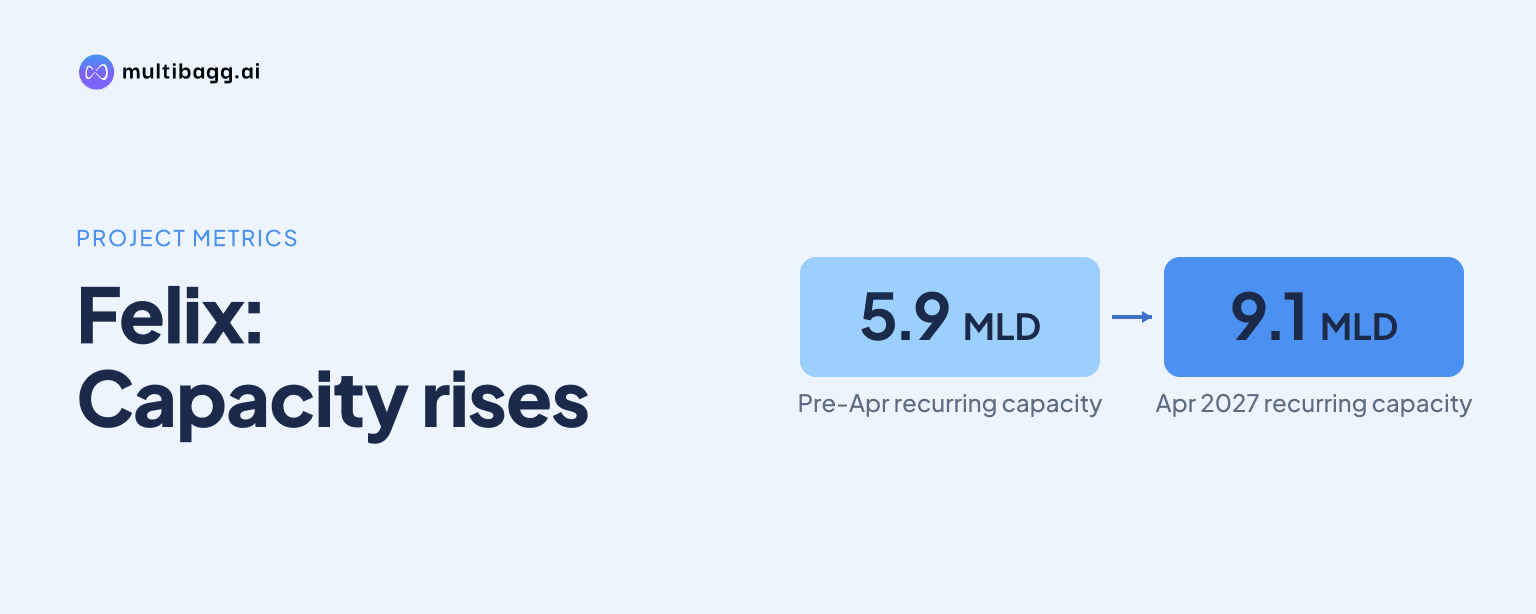
Felix expects water-treatment capacity generating recurring revenue to reach 9.1 million litres per day (MLD) by April 2027, a 55% increase from 5.9 MLD, alongside a Rs 140.08 crore, 10-year build-own-operate-transfer (BOOT) order in Gujarat. The target forms part of Felix’s stated shift toward long-tenure operating assets and operations-and-maintenance income.
Know Felix Industries inside out
Results, valuation, peers and who's buying, in one view.
What is Felix’s recurring water-capacity target?
Felix targets 9.1 MLD of water-treatment capacity generating recurring revenue by April 2027, compared with 5.9 MLD currently. The presentation describes the planned 3.2 MLD increase as 55%, while separately reporting total installed water and wastewater treatment capacity of more than 17 MLD.
The distinction between 5.9 MLD and more than 17 MLD is material. The 5.9 MLD figure is specifically identified as existing capacity generating recurring revenue, whereas the 17+ MLD figure refers to Felix’s total installed treatment capacity. The presentation does not state that all installed capacity produces recurring revenue, or provide an April 2027 target for total installed capacity.
Felix’s other capacity roadmaps use different operating measures. Oman waste-oil recycling capacity is expected to rise from 40 tonnes per day (TPD) to 60 TPD by April 2027, a 50% increase. Solid-waste capacity is shown as stable at 50 TPD and metal-recovery capacity as stable at 4 TPD, making water the largest percentage capacity increase in the roadmap.
How does the Rs 140.08 crore BOOT order support Felix’s plan?
Felix identifies its Rs 140.08 crore Gujarat BOOT order, with a 10-year tenure, as its largest-ever water order. The disclosed project scope includes 1,500 kilolitres per day (KLD) of treatment capacity, a 1,500 KLD water treatment plant (WTP), and a 120 KLD sewage treatment plant (STP).
The order is relevant to Felix’s objective of increasing activity under build-own-operate (BOO), BOOT and operations-and-maintenance (O&M) arrangements. Management says it aims to make recurring operations the core of the business over the next four to five years. The presentation gives the order’s value and duration, but does not disclose its annual revenue profile, operating margin, capital expenditure or commissioning date.
Felix also identifies a common effluent treatment plant (CETP) as a route from project execution to an operating income stream. The CETP was about 65% complete when the November 2026 presentation was issued, and commissioning was targeted by March 2027. Felix says it acts as both engineering, procurement and construction (EPC) contractor and project partner, with a long-term O&M stream expected after commissioning.
What regulations does Felix cite for water-reuse demand?
Felix cites draft treated-wastewater reuse requirements of 20% in FY28 and 50% in FY31 for bulk users consuming more than 5,000 litres a day. The presentation also cites Gujarat’s policy target of 100% wastewater reuse by 2030, which is relevant to the location of the Rs 140.08 crore BOOT project.
The company presents India’s sewage-treatment gap as a demand backdrop. India generates 72,368 MLD of sewage, according to the presentation, while 20,235 MLD, or 28%, is treated. Installed sewage treatment plant capacity is 31,841 MLD, or 44% of sewage generation, but operational capacity is lower at 26,869 MLD, or 37%.
Zero liquid discharge (ZLD) is another part of Felix’s water and wastewater positioning. The presentation estimates that India’s ZLD systems market could grow at a 9.5% compound annual growth rate from 2026 to 2032, from USD 1.46 billion to USD 2.52 billion. Felix lists mixed-salt separation as a proprietary ZLD salt-recovery technology through Enovation, in which it reports an 85% holding.
Got a follow-up? Ask IRIS
Which milestones could expand Felix’s operating-asset base?
Felix lists commissioning of an effluent treatment plant (ETP), a 175-kilowatt waste-to-energy facility and Rivita’s new ONGC plant as milestones that could add long-term O&M streams. These projects sit alongside the CETP commissioning target of March 2027 and the April 2027 water-capacity objective.
The presentation gives two different descriptions of Rivita’s ONGC plant base. Its strategic overview says Felix is a registered ONGC vendor through Rivita, with five active plants and a sixth under commissioning. Its water and wastewater positioning states that Rivita has eight active ONGC effluent O&M sites. Felix does not reconcile the two counts in the supplied presentation.
Felix’s Oman operation is another component of the broader operating-asset strategy, although it is not part of the 9.1 MLD water target. Felix reports a 76.50% stake in its Oman subsidiary, 40 TPD of oil-recycling capacity, and a minimum Rs 60 crore contract over five years with OQ8 Duqm. Management’s stated plan is to take the plant to full utilisation before considering phase-two expansion and refinery opportunities in Saudi Arabia and the United Arab Emirates.
How does the recurring-capacity target compare with Felix’s wider strategy?
Felix’s 55% planned increase in recurring water capacity is part of a strategy to convert selected environmental-infrastructure projects into longer-duration operating arrangements. The presentation identifies BOO, BOOT and O&M contracts with tenures of up to 10 years as mechanisms intended to strengthen the share of recurring operations.
The water target has a defined date and capacity measure, unlike several other strategic aims. For example, Felix plans to commercialise acid reclamation from pilot to commercial scale, but says land acquisition and Central Pollution Control Board approvals are still under way. It also plans to stabilise the 4 TPD Mehsana hazardous-metals recycling facility, where outputs include zinc sulphate, copper sulphate, ingots and chlorides.
The presentation’s capacity roadmap therefore provides a narrower measure than an overall earnings forecast. It establishes an April 2027 target of 9.1 MLD for recurring water capacity and identifies the Rs 140.08 crore Gujarat BOOT order and CETP as named operating-asset initiatives. It does not disclose how much revenue, profit or cash flow the additional 3.2 MLD is expected to generate.
Conclusion
Felix has set out a measurable expansion from 5.9 MLD to 9.1 MLD of water-treatment capacity generating recurring revenue by April 2027. The Rs 140.08 crore, 10-year Gujarat BOOT order, the CETP’s targeted March 2027 commissioning and management’s focus on BOO, BOOT and O&M structures show how Felix intends to increase its operating-asset base. Its 17+ MLD total installed capacity remains a separate metric from recurring-revenue capacity.
The next disclosed developments are progress on the CETP commissioning target in March 2027 and delivery of the 9.1 MLD recurring-capacity target in April 2027. Felix also plans to commission the ETP, 175-kilowatt waste-to-energy facility and Rivita’s new ONGC plant, while acid reclamation remains subject to land acquisition and Central Pollution Control Board approvals.

