










Fidel says AI conversion lags while automation cuts costs
Key highlights
- Fidel said Q2 AI demonstrations and proofs of concept converted into larger commercial engagements more slowly than expected.
- Fidel replaced a language-localisation ERP subscription costing approximately Rs 30 lakh annually with an internally developed solution using AI-assisted development.
- Fidel deployed a three-member Forward Deployed Engineering team for a client and began a Q3 asset-management software project using AI-assisted development.
- Fidel added two languages to its OTT and multilingual-services business and relocated IM Corporation Japan into Fidel’s Japan office in August 2026.
powered by IRIS
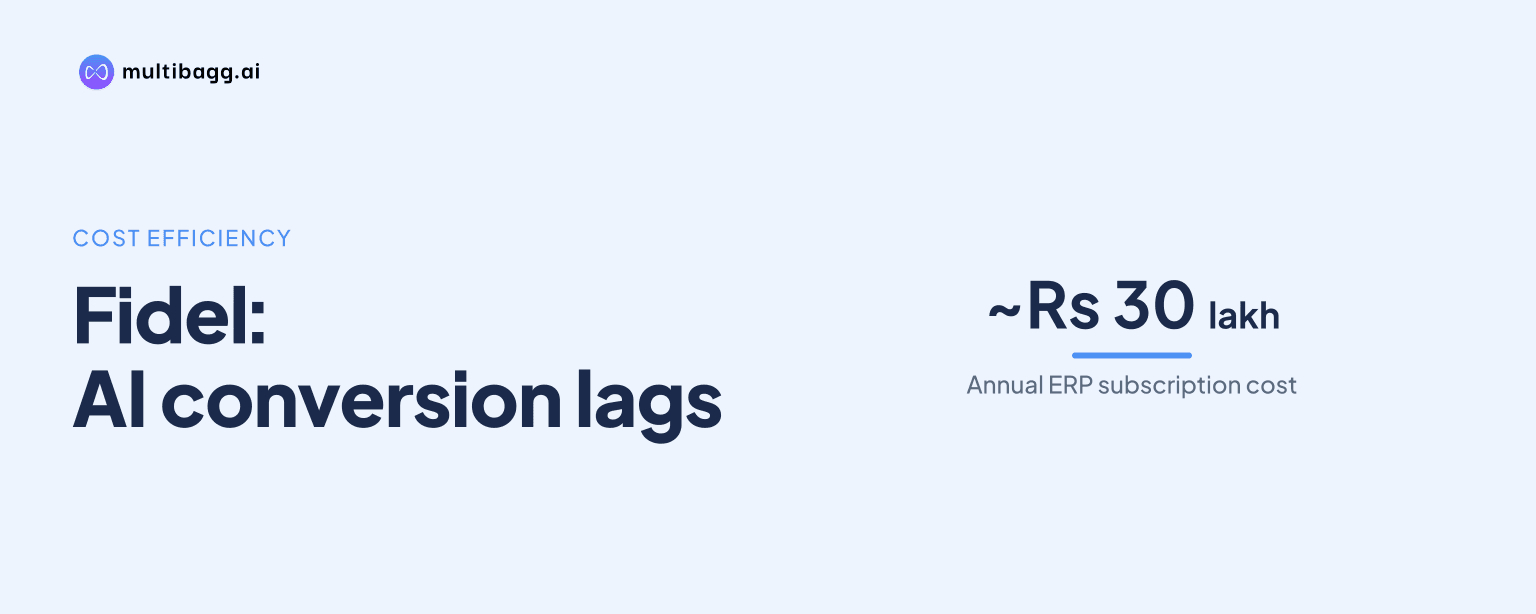
Fidel Softech says artificial intelligence, or AI, demonstrations and proofs of concept in Q2 have converted into larger commercial engagements more slowly than it anticipated. Yet Fidel has applied AI internally, replacing language-localisation project software that cost about Rs 30 lakh annually and automating multilingual-services workflows.
Know Fidel Softech inside out
Results, valuation, peers and who's buying, in one view.
Why is Fidel saying AI conversion is slower than expected?
Fidel says AI conversion is slower than expected because several Q2 demonstrations and proofs of concept, or POCs, for prospective customers have not yet become larger commercial engagements at the anticipated pace. The presentation does not disclose the number, value, customer sectors or expected closing dates of these opportunities, so the revenue impact cannot be quantified from the disclosed material.
The slower conversion contrasts with the range of demand themes Fidel reports in customer discussions, including AI, automation, low-code development, data analytics, managed services, digital transformation, multilingual data engineering and offshore delivery. This distinction is material: customer interest in AI and related services is recurring, but the company does not equate that interest with signed, large-scale AI contracts.
Fidel has nevertheless reported customer-facing AI activity beyond POCs. It deployed a three-member Forward Deployed Engineering, or FDE, team for a client, and it started execution in Q3 on an asset-management software platform for the India office of a global financial-services and capital-markets customer. That project includes domain-specific workflows and AI-assisted software development, although Fidel does not describe it as an AI-only mandate.
How is Fidel using AI to reduce operating costs?
Fidel is using AI-assisted development to replace a software-as-a-service, or SaaS, enterprise resource planning, or ERP, system that managed language-localisation projects. The third-party subscription cost approximately Rs 30 lakh a year, and Fidel says it discontinued the service after building an internal ERP solution, resulting in cost savings.
The ERP replacement is an internal operating application rather than proof of a large external AI sale. Fidel says AI-assisted development tools were used to create the system, while it has also increased automation of internal workflows in language services and operations. The presentation does not disclose the cost of developing the ERP, its maintenance cost, the implementation timetable or any change in employee numbers.
Fidel also says it automated much of the workflow in its over-the-top, or OTT, and multilingual-services business. That segment added two languages during the quarter, and management said automation improved productivity and turnaround times. No pre-automation turnaround measure, output volume or revenue figure was disclosed, but the use case links AI-enabled workflow changes to an expanding service line.
What integration savings is Fidel pursuing besides AI?
Fidel is pursuing office consolidation and staff utilisation measures alongside AI-enabled automation. IM Corporation Japan relocated to Fidel's Japan office in August 2026, and Fidel expects the combined office facilities to create annual savings. The company does not specify the start date of those savings or whether they are net of relocation and integration expenses.
Fidel also says it reduced the bench at IM Corporation through resource sharing and cross-selling between Fidel and IM accounts. A bench refers to employees not assigned to billable work. This mechanism differs from the Rs 30 lakh SaaS replacement: the ERP change removes a vendor subscription, whereas resource sharing seeks to raise the use of existing personnel in Japan.
Management characterises these as small initiatives that collectively demonstrate the scope for group integration, shared resources and wider technology use. Fidel says operational integration and cost optimisation will remain priorities in coming quarters. That focus accompanies subdued growth in Fidel's India standalone business, while Fidel sees more opportunities at Fidel Tech Japan and IM Corporation, where customers require local, onsite or combined onsite-offshore delivery.
Got a follow-up? Ask IRIS
What work could support Fidel's revenue from Q3 onward?
Fidel says several new engagements are expected to contribute from Q3 onward, although their financial contribution remains prospective rather than reported. The asset-management software project began in Q3 and uses AI-assisted development in a financial-services setting. Fidel says the engagement strengthens its fintech services and solutions presence, but gives no project duration, margin estimate or revenue-recognition schedule.
Multilingual data services are another stated opportunity. Fidel says it continues to see demand for voice and text datasets that complement its existing language services and newer AI-data capabilities. The two additional languages added in the OTT and multilingual-services business during the quarter expand its operating coverage, but the presentation does not disclose dataset volumes, client names or contract values.
Offshore delivery is also part of Fidel's plan to improve margins. During the quarter, Fidel initiated its first offshore project from Techvine USA's customer base, after Techvine had been largely focused on high-end consulting. Management says the transition took longer and believes further work could follow as customers gain confidence in the offshore-delivery and Centre of Excellence model; this is a management expectation, not a reported outcome.
How does AI fit into Fidel's wider operating model?
Fidel says its approach is to develop practical AI capabilities for both internal use and customer delivery. The Q2 record illustrates the two tracks: commercial conversion from POCs has been slower than anticipated, while the Rs 30 lakh annual software subscription has been removed through an internally developed solution. The three-member FDE deployment provides a separate example of AI-related customer delivery.
The company links AI-assisted automation to a broader margin-improvement plan that also includes improved resource utilisation, operational consolidation and a higher proportion of offshore delivery. Fidel describes the India standalone business as subdued, in contrast with the greater opportunities it identifies at Fidel Tech Japan and IM Corporation for local and combined onsite-offshore work. The presentation does not provide segment revenue or margin figures to measure the effect of this mix change.
Fidel's stated business outlook also includes a data-centre technology market-research engagement arising from Japan-India consulting and a Hi-Tech project to connect manufacturing machines to cloud-based dashboards. These are separate from the Q2 AI POCs, but they combine consulting, data, industrial digitalisation and implementation capabilities that Fidel says it intends to develop through its service model.
Conclusion
Fidel's disclosure shows that AI is currently producing clearer internal operating applications than large-scale commercial conversion. Replacing the Rs 30 lakh annual SaaS subscription, automating multilingual workflows and deploying a three-member FDE team demonstrate distinct uses, while the slower Q2 conversion of POCs shows that customer AI revenue has not yet developed at the pace management anticipated.
The next disclosed markers are Q3 contributions from new engagements, including the AI-assisted asset-management platform project, and potential follow-on offshore work from Techvine USA customers. Fidel also plans to continue AI-assisted automation, resource sharing and operational consolidation, while the August 2026 IM Corporation office move is expected to contribute facility savings.