










Fidel Softech says larger AI deals convert slower than expected
Key highlights
- Fidel Softech reported Q2 FY2026-27 revenue of Rs 37.97 crore and EBITDA of Rs 5.61 crore.
- Fidel Softech replaced project-management software costing about Rs 30 lakh annually with an internally developed, AI-assisted solution.
- Fidel Softech initiated its first offshore project from Techvine USA’s customer base during Q2 FY2026-27.
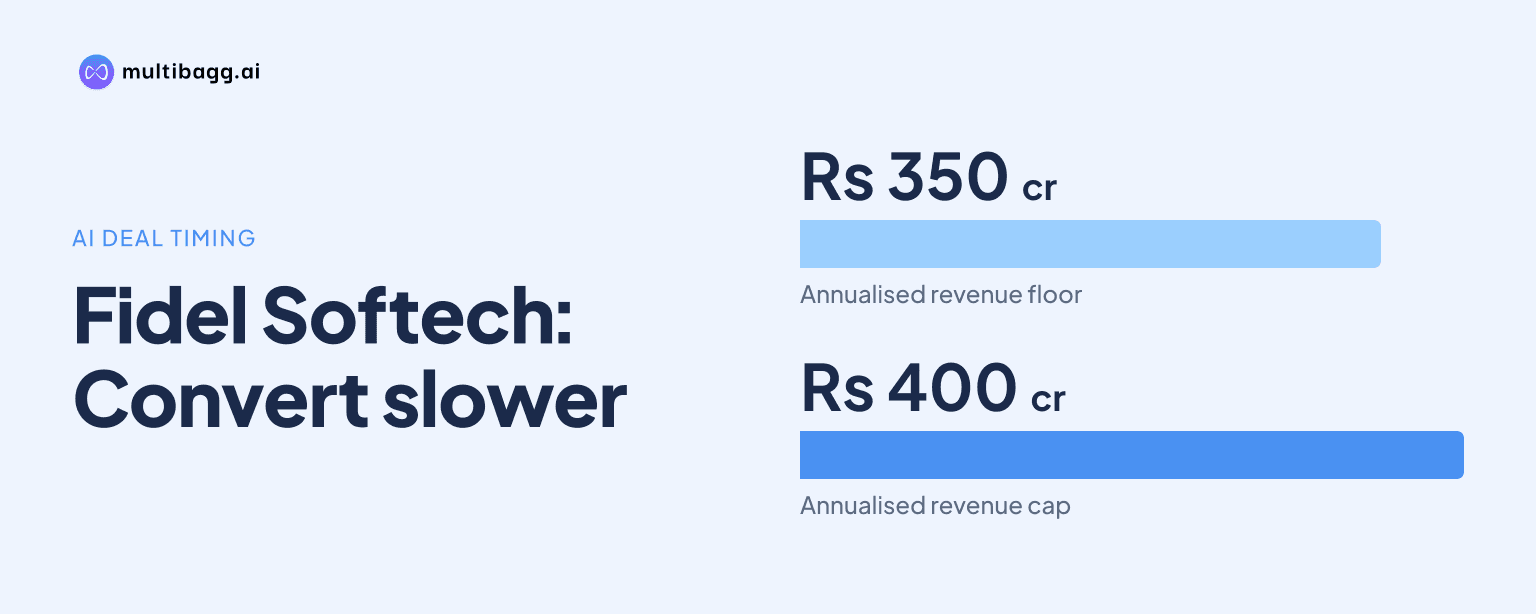
- Management expects the proposed Softenger acquisition to create an indicative annualised revenue base exceeding Rs 350 crore to Rs 400 crore.
powered by IRIS
Fidel Softech Limited (Fidel Softech) said in its October 30, 2026 CEO communication that larger artificial intelligence (AI) engagements were converting more slowly than anticipated, even as it used automation internally. Its clearest disclosed saving is replacement of third-party project-management software costing about Rs 30 lakh annually; Q2 FY2026-27 EBITDA was Rs 5.61 crore.
Know Fidel Softech inside out
Results, valuation, peers and who's buying, in one view.
What did Fidel Softech report in Q2 FY2026-27?
Fidel Softech reported revenue of Rs 37.97 crore, earnings before interest, tax, depreciation and amortisation (EBITDA) of Rs 5.61 crore, profit before tax of Rs 4.62 crore and profit after tax of Rs 3.60 crore for Q2 FY2026-27, covering July to September 2026. Earnings per share were Rs 2.44, and the company said it remained profitable in the quarter.
Fidel Softech said cash outflows and employee-related costs in the quarter included about Rs 3.10 crore of dividend distribution, annual salary revisions and a one-time employee appreciation incentive. The incentive followed the company reaching annual revenue of Rs 100 crore for the first time, while the salary appraisal cycle had been aligned to completion of Q1 three years earlier.
The company described FY2026-27 as a period of growth, integration and operational consolidation after recent acquisitions. Fidel Softech said some initiatives were taking longer than anticipated, but cited initial progress in cross-selling, offshore delivery and cost optimisation during the July-to-September 2026 quarter.
Why are Fidel Softech's larger AI engagements converting slowly?
Fidel Softech said it conducted several AI demonstrations, proofs of concept and small Forward Deployed Engineering (FDE) engagements in Q2 FY2026-27, but that conversion of these opportunities into larger commercial work had been slower than anticipated. It did not disclose the number, value or expected conversion date of the larger prospective engagements.
One disclosed customer deployment was a three-member FDE team assigned to a client during the quarter. Fidel Softech also cited AI-assisted software development and increased automation of internal workflows, particularly in language services and operations, showing that its AI work covered both customer delivery and internal processes.
Customer discussions covered AI, automation, low-code development, data analytics, managed information-technology operations, cybersecurity, digital transformation, multilingual data engineering and offshore delivery. That demand list is broader than AI alone, while the company specifically said larger AI commercial engagements had taken longer to materialise.
Fidel Softech said its approach was to develop practical AI capabilities for its own operations and customers. Management said this hands-on experience would help build AI-led service offerings over time, but gave no AI revenue target or timetable in the October 30, 2026 communication.
How is Fidel Softech using automation to cut costs?
Fidel Softech said it replaced a third-party software-as-a-service enterprise resource planning system used to manage language-localisation projects with an internally developed solution. The discontinued subscription cost about Rs 30 lakh annually, and the company said AI-assisted development enabled the replacement.
The company also said it automated much of the underlying workflow in its over-the-top and multilingual-services business during Q2 FY2026-27. Fidel Softech added two languages in that business during the quarter and said automation improved productivity and turnaround times, though it did not quantify either improvement.
The disclosed Rs 30 lakh recurring software cost provides a measurable internal outcome, unlike the larger external AI opportunities that remain in demonstration, proof-of-concept or small-engagement stages. Fidel Softech linked automation to its stated plan to improve margins through resource utilisation, operational consolidation and a higher proportion of offshore delivery.
That margin plan is a management objective rather than a reported outcome. Fidel Softech’s forward-looking disclaimer identified customer demand, employee costs, foreign-exchange movements, market conditions, competition, regulatory developments and acquisition risks among factors that could cause actual results to differ.
Got a follow-up? Ask IRIS
What integration and offshore-delivery changes has Fidel Softech made?
Fidel Softech said IM Corporation Japan relocated to its Japan office in August 2026, consolidating office facilities. The company expects the move to generate annual savings, although it did not provide a rupee-equivalent amount for that expectation in the communication.
Fidel Softech also said it reduced the employee bench at IM Corporation Japan through better resource sharing and cross-selling between Fidel Softech and IM Japan accounts. It did not disclose a headcount reduction or monetary saving, but identified shared staffing and cross-selling as the mechanisms behind better resource utilisation.
During Q2 FY2026-27, Fidel Softech initiated its first offshore project from Techvine USA’s customer base. Techvine had largely concentrated on high-end consulting, and Fidel Softech said the transition to offshore delivery had taken longer as customers became familiar with its offshore-delivery and Centre of Excellence model.
Fidel Softech said further offshore engagements could increase as customer comfort grows, potentially improving margins. Elsewhere, Hyderabad operations had a modest activity increase from seasonal projects, while the company added about six Japanese customers in India, principally Japanese manufacturing firms or global capability centres, through initially small consulting, language-service and support engagements.
What could affect Fidel Softech after Q2 FY2026-27?
Fidel Softech said several new engagements were expected to contribute from Q3 FY2026-27. They include an asset-management software development project for the India office of a global financial-services and capital-markets client, where execution began in Q3 and the work includes domain-specific workflows and AI-assisted development.
The company also identified a Japan-India data-centre technology research engagement involving an emerging Japanese optical-chip-based approach. Fidel Softech described the initial assignment as relatively small, while its hi-tech solutions team also secured a manufacturing project to connect industrial machines and display operating data through cloud-based dashboards.
Fidel Softech said growth in its India standalone business looked subdued, whereas Fidel Tech Japan and IM Corporation Japan were seeing more opportunities requiring local delivery, onsite support or a combination of onsite and offshore delivery. The disclosure did not provide separate revenue figures, but it indicates a different opportunity mix across the group’s operations.
The board has approved the proposed acquisition of Softenger Pvt Ltd, subject to regulatory requirements and customary completion conditions. Management said Softenger has annual revenue of about Rs 212 crore or more, and expects the combined group to have an indicative annualised revenue base exceeding Rs 350 crore to Rs 400 crore, based on current business run rates.
Conclusion
Fidel Softech’s disclosure shows AI activity at two different stages: larger customer engagements are taking longer to convert, while internal deployment has produced a stated saving through removal of a Rs 30 lakh annual software subscription. Q2 FY2026-27 EBITDA of Rs 5.61 crore was reported alongside integration measures, its first Techvine-linked offshore project and automation in multilingual operations.
The next disclosures to watch are contributions from projects expected from Q3 FY2026-27 and progress on the proposed Softenger acquisition. Management has also articulated an aspiration to reach Rs 500 crore in annual revenue by 2030-31, while identifying acquisition completion, integration, demand, employee costs and market conditions as factors that could affect that path.