










FIEM Q2FY27 automotive sales remain tied to two-wheelers
Key highlights
- FIEM derived 97.63% of Q2FY27 automotive revenue from two-wheelers and 2.37% from four-wheelers.
- Domestic OEMs contributed 94.15% of FIEM’s Q2FY27 automotive revenue, versus 1.39% from exports.
- Automotive operations represented 99.81% of FIEM’s standalone Q2FY27 sales.
- Automotive LED lighting accounted for 49.06% of FIEM’s Q2FY27 automotive revenue.
powered by IRIS
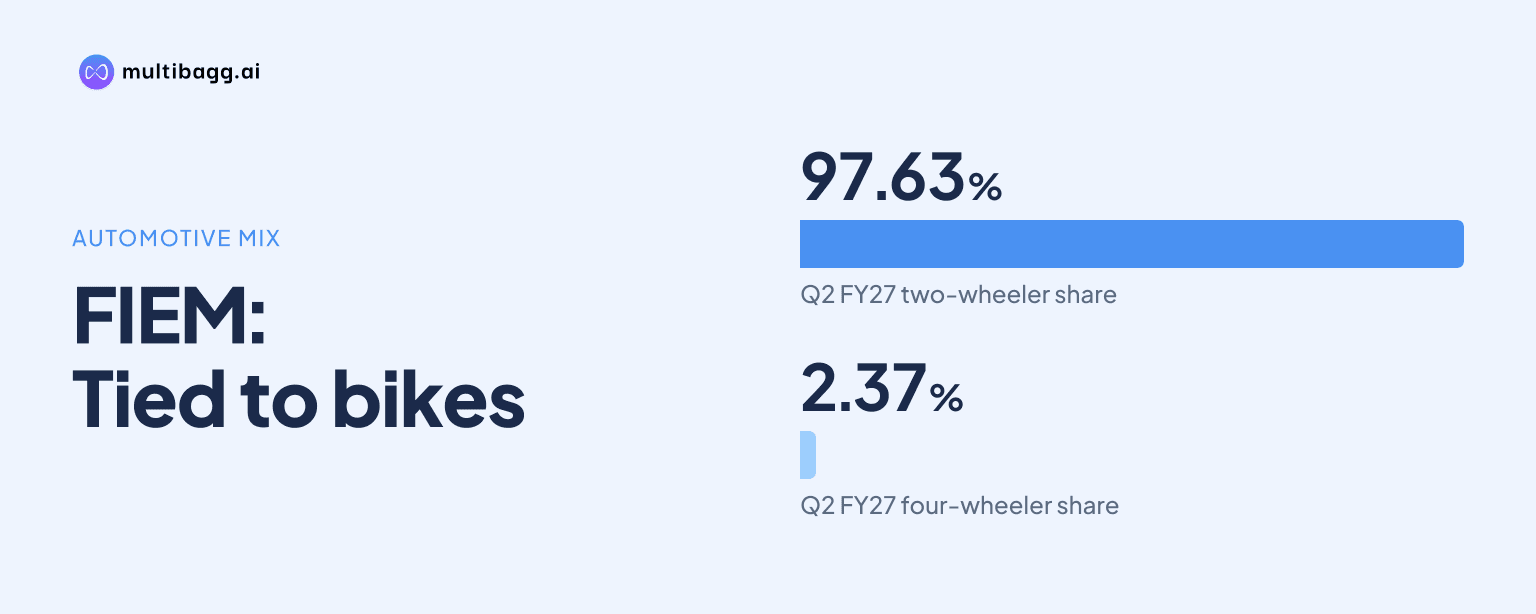
Fiem Industries Limited derived 97.63% of Q2FY27 automotive-segment revenue from two-wheelers and 94.15% from domestic original equipment manufacturers (OEMs). FIEM’s automotive segment accounted for 99.81% of standalone sales in Q2FY27, while integrated passenger information systems (IPIS) and LED luminaires accounted for 0.19%.
Know Fiem Industries inside out
Results, valuation, peers and who's buying, in one view.
How concentrated was FIEM’s Q2FY27 vehicle revenue?
FIEM’s Q2FY27 automotive revenue was concentrated in two-wheelers, which contributed 97.63%, compared with 2.37% from four-wheelers. The two-wheeler share was more than 41 times the four-wheeler share within the automotive segment, based on the revenue percentages disclosed. The presentation does not provide individual customer exposure or absolute quarterly revenue by vehicle type.
The Q2FY27 vehicle mix was nearly unchanged from H1FY27, when two-wheelers represented 97.66% and four-wheelers represented 2.34% of automotive revenue. The two-wheeler share was 0.03 percentage points lower in Q2FY27 than in H1FY27, while the four-wheeler share was 0.03 percentage points higher. FIEM describes the two-wheeler segment as the source of its major business.
FY26 provides the longer comparison: its 97.15% two-wheeler share was 0.48 percentage points below the Q2FY27 level of 97.63%. Four-wheelers accounted for 2.85% of automotive revenue in FY26, compared with 2.37% in Q2FY27. The disclosed mix therefore shows a modestly higher two-wheeler weighting in the latest quarter than in the preceding full year.
How dependent was FIEM on domestic OEM revenue in Q2FY27?
Domestic OEMs generated 94.15% of FIEM’s Q2FY27 automotive revenue, while the domestic replacement market contributed 4.46% and exports contributed 1.39%. Replacement-market and export sales together therefore made up 5.85% of automotive-segment revenue. The figures measure revenue mix rather than production volumes, pricing or customer order levels.
The domestic-OEM proportion rose by 0.06 percentage points from 94.09% in H1FY27 to 94.15% in Q2FY27. Over the same comparison, the domestic replacement-market share declined from 4.51% to 4.46%, and exports declined from 1.40% to 1.39%. These movements show limited change in FIEM’s market-channel mix during H1FY27 and Q2FY27.
Compared with FY26, domestic OEMs gained 0.98 percentage points in Q2FY27, while the replacement-market share fell 0.52 percentage points and exports fell 0.46 percentage points. The presentation lists TVS, Honda, Yamaha, Suzuki, Royal Enfield, Harley Davidson, Hero Motocorp and Piaggio among FIEM’s two-wheeler clients. It does not disclose the revenue contribution of any individual customer.
Got a follow-up? Ask IRIS
What portion of FIEM’s standalone sales came from automotive activities?
The automotive segment supplied 99.81% of FIEM’s standalone Q2FY27 sales, leaving IPIS and LED luminaires at 0.19%. The split was close to H1FY27, when automotive contributed 99.84% and IPIS and LED luminaires contributed 0.16%. Automotive’s share was therefore 0.03 percentage points lower in Q2FY27.
FY26 had the same 99.84% automotive share and 0.16% IPIS-and-LED-luminaires share reported for H1FY27. Relative to that FY26 mix, Q2FY27 increased the non-automotive share by 0.03 percentage points. The presentation does not state Q2FY27 segment revenue in rupees, so the disclosed information supports an assessment of revenue proportions rather than quarterly segment amounts.
FIEM reported standalone net sales of Rs 1,207.5 crore in FY21 and Rs 2,790.6 crore in FY26, representing a stated five-year compound annual growth rate of 18.24%. Earnings before interest, tax, depreciation and amortisation increased from Rs 133.8 crore in FY21 to Rs 393.3 crore in FY26, at a stated five-year compound annual growth rate of 24.07%. These annual figures provide scale but do not alter the Q2FY27 segment mix.
Which automotive products made up FIEM’s Q2FY27 sales?
Automotive LED lighting was FIEM’s largest Q2FY27 automotive product category at 49.06%, followed by automotive lighting at 27.41%, rear-view mirrors at 10.13%, plastic moulded parts at 8.28% and other products at 5.12%. Automotive LED lighting was 21.65 percentage points ahead of automotive lighting in the reported quarterly product mix.
Compared with H1FY27, automotive LED lighting increased from 48.68% to 49.06%, a gain of 0.38 percentage points. Automotive lighting declined from 28.03% to 27.41%, rear-view mirrors declined from 10.37% to 10.13%, and plastic moulded parts declined from 8.52% to 8.28%. Other products increased from 4.40% to 5.12%.
FIEM’s FY26 product mix placed automotive LED lighting at 47.51%, automotive lighting at 27.70%, rear-view mirrors at 10.68%, plastic moulded parts at 9.12% and other products at 4.99%. Q2FY27 therefore had a 1.55-percentage-point higher LED-lighting share than FY26 and a 0.84-percentage-point lower plastic-moulded-parts share. FIEM’s automotive range includes head lamps, tail lamps, signalling lamps, rear-view mirrors, sheet-metal parts and plastic-moulded parts.
Conclusion
FIEM’s Q2FY27 mix shows concentration across vehicle type, market channel and business segment. Two-wheelers supplied 97.63% of automotive revenue, domestic OEMs supplied 94.15%, and automotive operations supplied 99.81% of standalone sales. Within automotive products, LED lighting was the largest category at 49.06%.
The next disclosed event is FIEM’s Q2FY27 earnings call, scheduled for November 13, 2026 at 4.00 pm. Investors can watch for management’s discussion of whether the 1.39% export share, 2.37% four-wheeler share and 0.19% IPIS-and-LED-luminaires share are expected to change from the reported Q2FY27 levels.