










Foreign Institutional Investors Log ₹1.12 Lakh Crore Inflow
Key highlights
- FIIs bought ₹1,12,095.78 crore of Indian equities in November so far, according to cited NSDL and NSE data.
- The November buying reversed about ₹70,704 crore of FII selling in September and October combined.
- India received around $10 billion of foreign equity investments in November, while Taiwan saw nearly $21 billion of withdrawals.
- FIIs bought ₹94,230 crore through November 18 as DIIs sold ₹55,570 crore in the cited cash-market data.
powered by IRIS
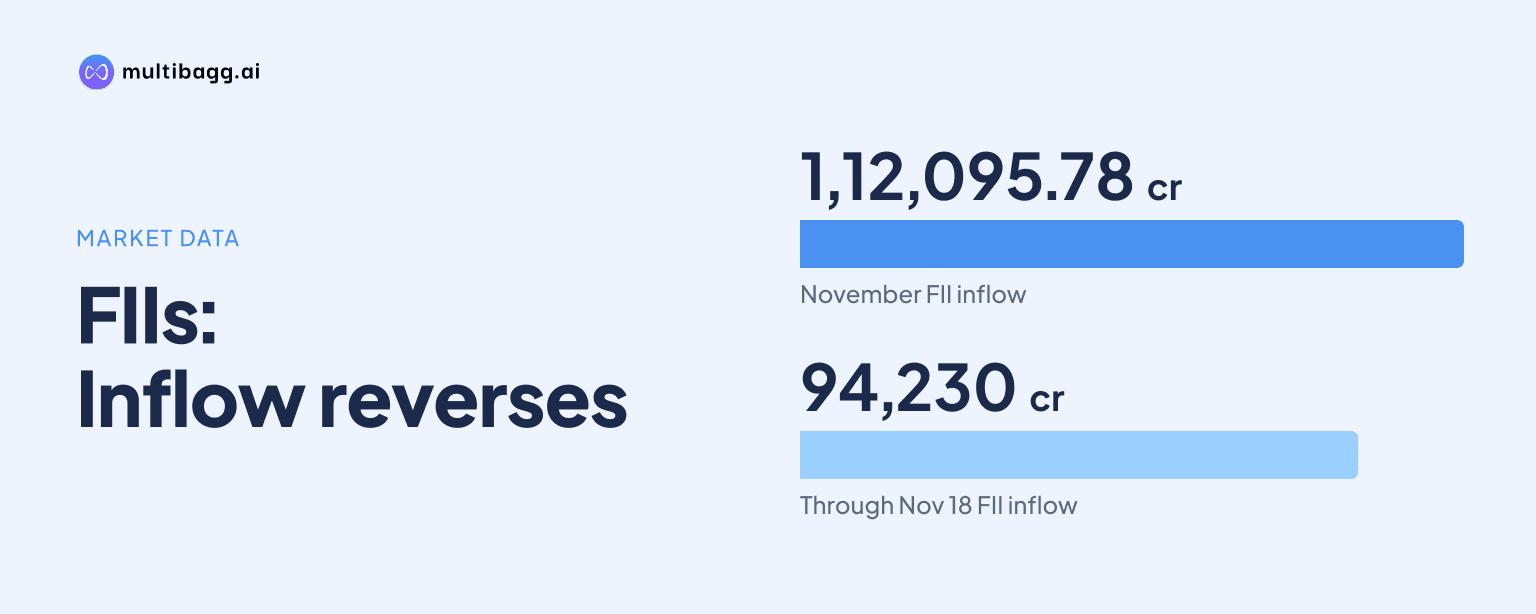
Foreign institutional investors (FIIs) bought ₹1.12 lakh crore of Indian equities in November 2026, the strongest monthly inflow on record in the cited updates, reversing six consecutive months of net selling and reducing their 2026 net outflow position from nearly ₹3 lakh crore to around ₹1.8 lakh crore.
Why did FIIs buy Indian equities in November?
FIIs returned to Indian equities as improving earnings prospects, lower crude prices, rupee resilience and changing global portfolio positions improved the case for India. The buying followed significant selling earlier in 2026, when concerns around crude oil, currency volatility and global interest-rate uncertainty had pressured Indian shares.
A reassessment of AI-linked exposure was also widely cited in the November discussion. Global investors had previously favoured South Korea, Taiwan and Japan for their greater connection to the AI investment cycle. As the AI trade slowed, some capital was reportedly rotated towards India, although the available information does not establish that every offshore outflow entered Indian equities.
How large was the November FII inflow?
FIIs recorded reported November net purchases ranging from about ₹99,158 crore to more than ₹1.08 lakh crore across updates, while the headline and NSDL-NSE figure stood at ₹1,12,095.78 crore. The differences reflect reporting dates and provisional data, but all cited estimates point to an unusually sharp reversal in overseas activity.
The pace remained strong through the month. Provisional data showed FIIs bought ₹32,646.67 crore in one week, including ₹10,308.42 crore on a Friday, their biggest daily purchase of that week. Another update put cumulative purchases at more than $14 billion over 15 trading sessions.
How did India compare with other Asian markets?
India emerged as the biggest recipient of foreign equity inflows among emerging markets during the reported November period. Bloomberg-based figures cited in the discussion showed India attracting around $10 billion, while South Korea recorded $9.3 billion of outflows and Taiwan saw withdrawals of nearly $21 billion.
Malaysia and the Philippines were the only other Asian markets said to have attracted some foreign buying in November. Taiwan had the steepest outflows, followed by South Korea. This pattern supports the view that cross-market allocation changes contributed to Indian demand, but it also means the flow picture could change if investor interest in AI-linked markets revives.
Got a follow-up? Ask IRIS
What did November buying reverse for FIIs?
FIIs more than offset the roughly ₹70,704 crore withdrawn in September and October through their November purchases. The cited monthly selling totals were ₹35,861 crore in September and ₹34,843 crore in October, before the reversal gained momentum in November.
The rebound has narrowed, rather than eliminated, the broader 2026 outflow. FIIs were still net sellers by roughly ₹2.1 lakh crore after the first two weeks of November, and later updates put the remaining year-to-date outflow near ₹1.8 lakh crore. From January through October, foreign investors had reportedly withdrawn about ₹2.95 lakh crore from the Indian market.
Are FII inflows replacing domestic institutional demand?
FIIs were the main institutional buyers in the November data cited, while domestic institutional investors (DIIs) were net sellers in one reported period. Through November 18, FIIs bought ₹94,230 crore and DIIs sold ₹55,570 crore, leaving combined institutional net flows of about ₹38,658 crore.
That contrasts with the earlier period of foreign selling. From July 2025 to October 2026, FIIs sold equities worth about ₹6.32 trillion while DIIs bought about ₹11.32 trillion. The change in November shows that foreign demand was driving the immediate reversal, but it does not negate the domestic buying that absorbed a substantial part of earlier FII supply.
Are the FII inflows likely to continue?
The durability of FII inflows remains linked to global allocation decisions as well as Indian fundamentals. The reported reasons for buying - earnings prospects, lower crude prices, a resilient rupee and weaker AI-trade momentum - can all change, particularly if money moves back into Taiwan or South Korea.
JPMorgan India CEO Pranav Chawda said the sustainability of flows would depend on directing index-linked and other long-term foreign capital into long-gestation domestic assets, making flows stickier. The available discussion therefore frames November as a major flow reversal, not confirmation that the earlier cycle of foreign selling has permanently ended.
Conclusion
November marked a material turn in Indian equity flows, with FIIs buying ₹1.12 lakh crore and reversing the combined September-October withdrawal. India also stood out against substantial reported foreign outflows from Taiwan and South Korea, while domestic institutions shifted to net selling in the November 18 cash-market data.
The next focus is whether lower crude prices, corporate earnings and rupee resilience continue to support overseas allocations. Investors will also watch global AI-linked markets, because a renewed preference for Taiwan or South Korea could test the persistence of the FII buying streak.