










Foreign institutional investors’ November buying tops ₹1 lakh crore
Key highlights
- FIIs bought about ₹1.12 lakh crore of Indian equities in November in the strongest reported monthly inflow.
- FIIs sold ₹45,162 crore in October before the November reversal in flows.
- Foreign investors bought about ₹32,600 crore during the latest five-session week.
- Financial services led reported FII buying, followed by telecom, auto and consumer services.
powered by IRIS
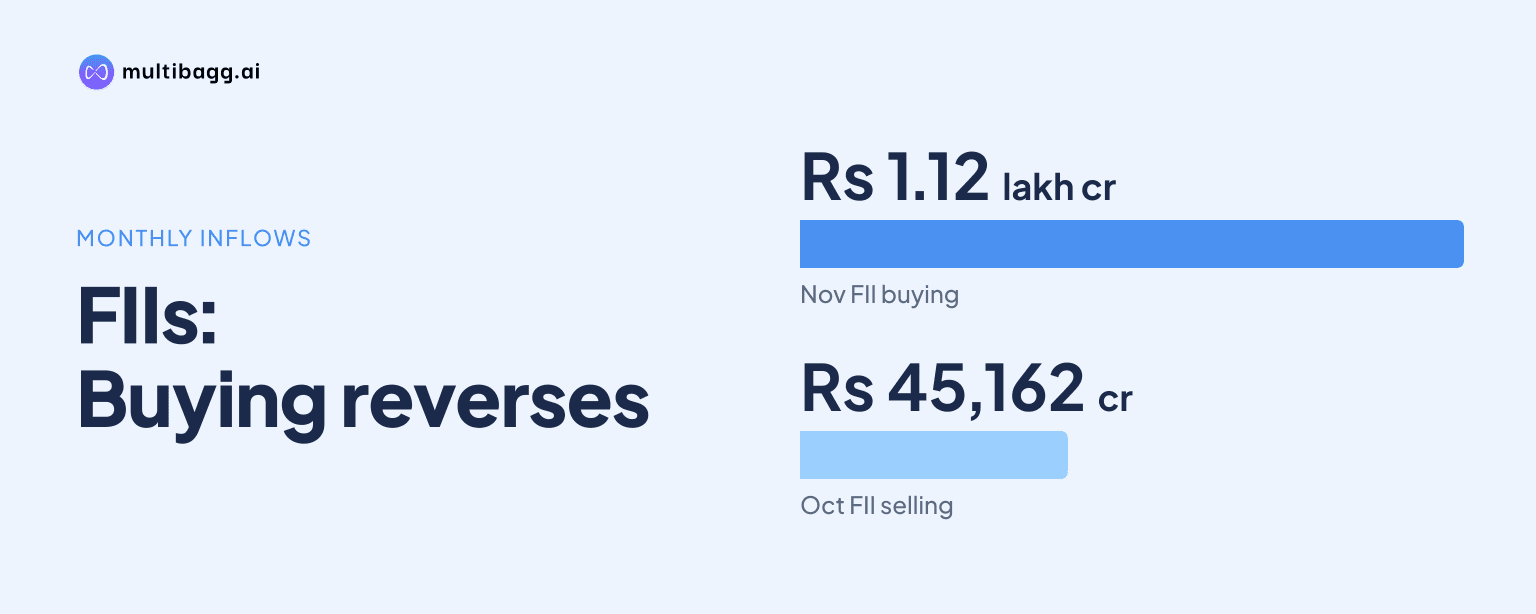
Foreign institutional investors (FIIs) bought about ₹1.12 lakh crore of Indian equities in November, the strongest reported monthly inflow, reversing the ₹45,162 crore sold in October and extending a four-week buying run. The reported inflow also came alongside a 13-session to 14-session stretch of net purchases.
How much did FIIs buy in Indian equities in November?
FIIs bought more than ₹1 lakh crore of Indian equities in November, with several reported data sets placing the total at roughly ₹1.01 lakh crore to ₹1.12 lakh crore by November 19 or 20. The Economic Times, citing NSDL and NSE data through November 19, reported net purchases of ₹1,12,095.78 crore and described it as the strongest month on record for FII inflows.
The variation in reported totals is important. NSDL custodial data and provisional exchange data do not necessarily match on every trading day, while some reports covered a different cut-off date. One report placed FPI cash-equity inflows at ₹1.01 lakh crore through November 19, while another estimate put exchange-based FII buying at ₹1,01,640.72 crore over 14 November sessions. The common point is that buying crossed ₹1 lakh crore during the month.
Why is the November FII inflow significant?
The November inflow is significant because it followed sustained foreign selling in the preceding months and was reported as the first time monthly FII buying crossed ₹1 lakh crore. FIIs had sold ₹45,162 crore in October and ₹44,013 crore in September, meaning the November purchases reversed a large part of those two months’ combined outflows.
The reported turnaround also reduced net FII selling for 2026 to around ₹1.8 lakh crore. This does not mean that prior outflows have been fully offset, but it shows that foreign participation changed sharply during November. Reports linked the shift partly to signs of a slowdown in the global AI trade, although the durability of that change remains uncertain.
Which sectors received the most FII buying?
Financial services received the bulk of the reported FII buying, followed by telecommunications, automobile and auto components, and consumer services. The sector pattern indicates that the November purchases were broad-based, but not evenly distributed across the market.
Financials mattered most because they accounted for the largest share of the reported inflows. The available context does not provide individual company-level purchases or sector-wise rupee allocations, so the data supports a sector-level reading rather than conclusions about specific stocks. Retail investors should therefore avoid treating the broad FII trend as confirmation for every company in these sectors.
Got a follow-up? Ask IRIS
How did FII buying affect Indian market indices?
FII buying coincided with stronger benchmark indices, with the Sensex crossing 83,000 and the Nifty moving above 25,500 during the reported period. One closing figure placed the Nifty at 25,514.30 as November foreign buying crossed ₹1 lakh crore.
The rise occurred even as domestic institutional investors were reported to be net sellers in part of the month. Through November 19, DIIs were net sellers of ₹56,927 crore in the cited cash-market data, while FIIs were buyers. On November 19 alone, provisional exchange data showed FIIs as net buyers of ₹7,411.41 crore and DIIs as net sellers of ₹1,356.57 crore.
What could determine whether FII buying continues?
The sustainability of FII buying will depend on global AI-related uncertainty, interest-rate risks and corporate earnings concerns highlighted in the reported discussion. A four-week buying streak and purchases across all five sessions of the latest week show strong near-term activity, but they do not establish a permanent shift in foreign investor positioning.
Daily flows should also be read carefully because provisional exchange figures may change and can differ from NSDL-based figures. The November 20 purchase of ₹10,308.42 crore was the largest purchase of that reported week, while the five-session total was about ₹32,600 crore. Continued purchases at that pace would support the current trend, whereas renewed global risk aversion could challenge it.
Conclusion
November’s FII buying marks a clear reversal from the September and October outflows, with reported purchases of more than ₹1 lakh crore lifting foreign participation and coinciding with firmer Indian benchmark indices. Financial services led the sectoral demand, while telecom, automobiles and consumer services also featured in the reported buying pattern.
The next focus is whether the four-week buying run extends as investors assess global AI-trade uncertainty, interest-rate risks and earnings concerns. Market participants will also watch subsequent daily and monthly flow releases, while noting that provisional exchange data and NSDL data can produce different running totals.