










Foreign institutional investors buy ₹1.12 lakh crore in November
Key highlights
- FIIs bought ₹1,12,095.78 crore of Indian equities in November so far, the strongest monthly inflow on record.
- The November buying reversed roughly ₹70,000 crore of FII selling in September and October combined.
- The Nifty gained more than 10% and the Sensex rose about 11% over the past month.
- FII net selling for 2026 declined from nearly ₹3 lakh crore to around ₹1.8 lakh crore.
powered by IRIS
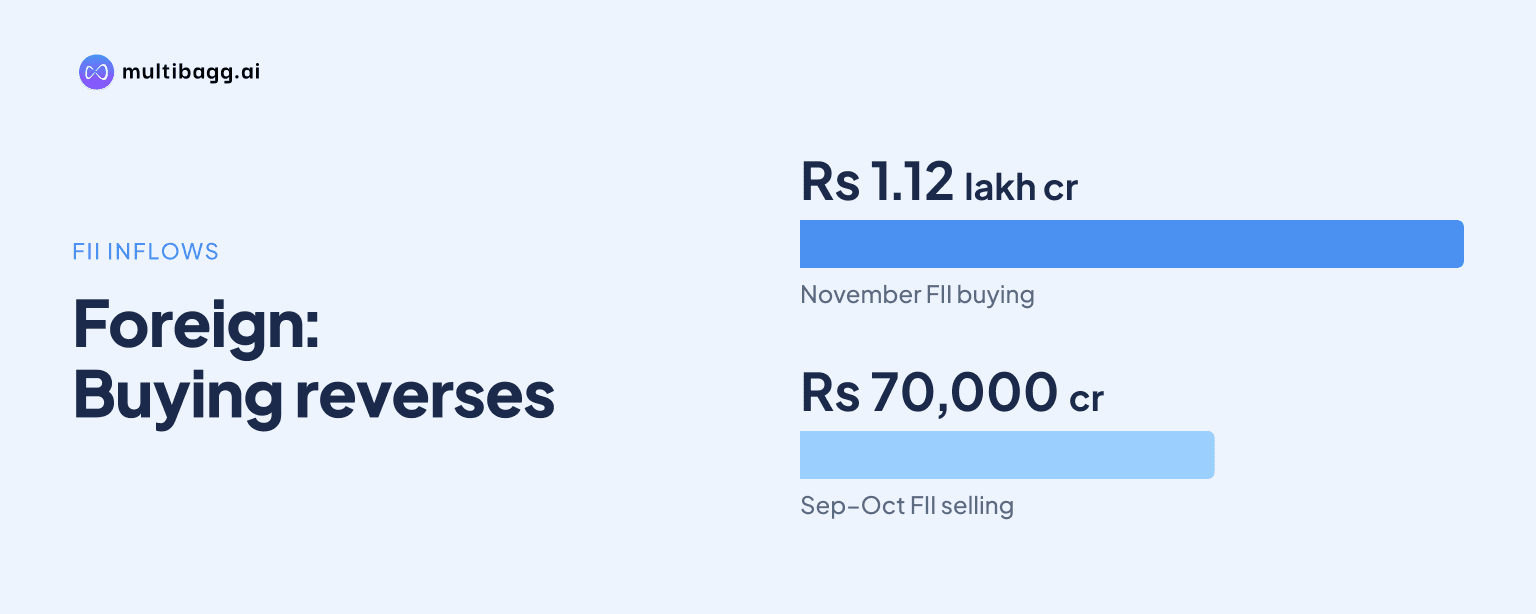
Foreign institutional investors (FIIs) bought ₹1.12 lakh crore of Indian equities in November so far, the strongest monthly inflow on record, reversing roughly ₹70,000 crore of selling in September and October and coinciding with the Nifty moving above 25,500. Data cited from NSDL and NSE placed the November inflow at ₹1,12,095.78 crore.
Why are FIIs buying Indian equities in November?
FIIs are buying Indian equities amid improving corporate earnings, lower crude oil prices, a stronger rupee and changes in global portfolio positioning. The reported flow marks a sharp change after six consecutive months of selling from May through October, when overseas investors had been a persistent source of pressure on domestic stocks.
A slowing global AI trade has also been cited as a factor behind the rotation towards India. Social-media discussions around the flow have focused on whether capital moving away from East Asian markets has supported Indian equities. That shift may have helped India outperform global peers during November, but it also leaves the market exposed if AI-linked flows return to Taiwan or South Korea.
How large is the November FII buying reversal?
FIIs bought ₹1,12,095.78 crore in November so far, exceeding ₹1 lakh crore and making the month the strongest on record for foreign equity inflows in India. The amount includes ₹5,866.78 crore purchased on one Wednesday and ₹7,411.41 crore of purchases reported on Thursday, November 19, based on provisional exchange data.
The scale of the reversal is notable because it offset the roughly ₹70,000 crore withdrawn in September and October combined. It also reduced FIIs' net selling for 2026 from nearly ₹3 lakh crore to around ₹1.8 lakh crore. The year-to-date position nevertheless remains a net outflow, showing that the November surge has not fully erased the selling seen earlier in the year.
How have FII inflows affected Indian stock indices and the rupee?
FIIs' buying has coincided with a broad market rally, with the Nifty gaining more than 10% over the past month and the Sensex advancing about 11%. On November 19, the Sensex rose 990 points to 83,022 and the Nifty gained 286 points to close at 25,514. Banking shares led that session, with the Nifty Bank closing at a record 63,063 after crossing 63,000 for the first time.
The rupee has also strengthened during the inflow phase. It appreciated to 93.3340 against the US dollar from a previous close of 93.4175 on the reported Thursday, while another account placed the currency near 93.44 after it had fallen to a low of 96.96. Lower crude oil prices, reported around $92 a barrel, have been part of the supportive backdrop alongside foreign capital inflows.
Got a follow-up? Ask IRIS
Can FIIs sustain their buying in Indian equities?
FIIs may sustain buying only if earnings, currency conditions and global portfolio flows remain supportive. Analysts cited in the discussion have said continued corporate earnings growth will be necessary to support India's valuation premium, while inflation and potential RBI rate hikes remain material risks.
JPMorgan India CEO Pranav Chawda has highlighted global AI investment as an important variable. He said the durability of recent flows linked to hedging the AI trade depends on whether announced AI capital expenditure turns into actual investment, whether data-centre projects ramp up as planned, and whether regulatory safeguards hold. He also pointed to the need for index-linked and other long-term foreign capital to move into long-gestation domestic assets to make flows more stable.
What are market strategists expecting after the FII surge?
Market strategists expect resilience if credit growth, earnings and support for growth and the currency continue, but they have not treated the November inflow as a guarantee of further gains. Goldman Sachs has upgraded Indian equities to Overweight and set a Nifty target of 28,500 by December 2027, while Citi and HSBC have also become more constructive on the market outlook.
The current rally has changed the immediate market narrative because FIIs have shifted from sustained sellers to a source of momentum. However, the context also points to a two-sided risk: foreign money that arrived as global investors reassessed AI-related positioning could exit quickly if that trade regains momentum elsewhere. Domestic earnings therefore remain central to the market's ability to retain investor interest.
Conclusion
The ₹1.12 lakh crore November purchase by FIIs is a substantial reversal from recent foreign selling and has aligned with gains in the Nifty, Sensex, banking stocks and the rupee. Lower crude prices, improving earnings and global portfolio repositioning have supported the move, but the 2026 foreign-investor balance remains in net outflow territory at around ₹1.8 lakh crore.
The next signals to watch are the rupee, crude oil prices, inflation and the earnings recovery that investors are pricing into Indian equities. Investors will also track whether global AI capital expenditure and data-centre plans convert into actual projects, along with the path toward Goldman Sachs' 28,500 Nifty target for December 2027.