










Nifty 50 Gains 3,000 Points as Global AI Shares Decline
Key highlights
- Nifty closed at a nine-month high of 25,800.60 on November 20 after rising 286.30 points, or 1.12%.
- Nifty gained 2,747.5 points, or 11.91%, so far in November.
- Foreign investors poured a reported record $12.21 billion into Indian equities so far this month.
- Nifty IT rose 2.70% to 31,754.65 on November 20, while AI-linked shares fell by up to 5%.
powered by IRIS
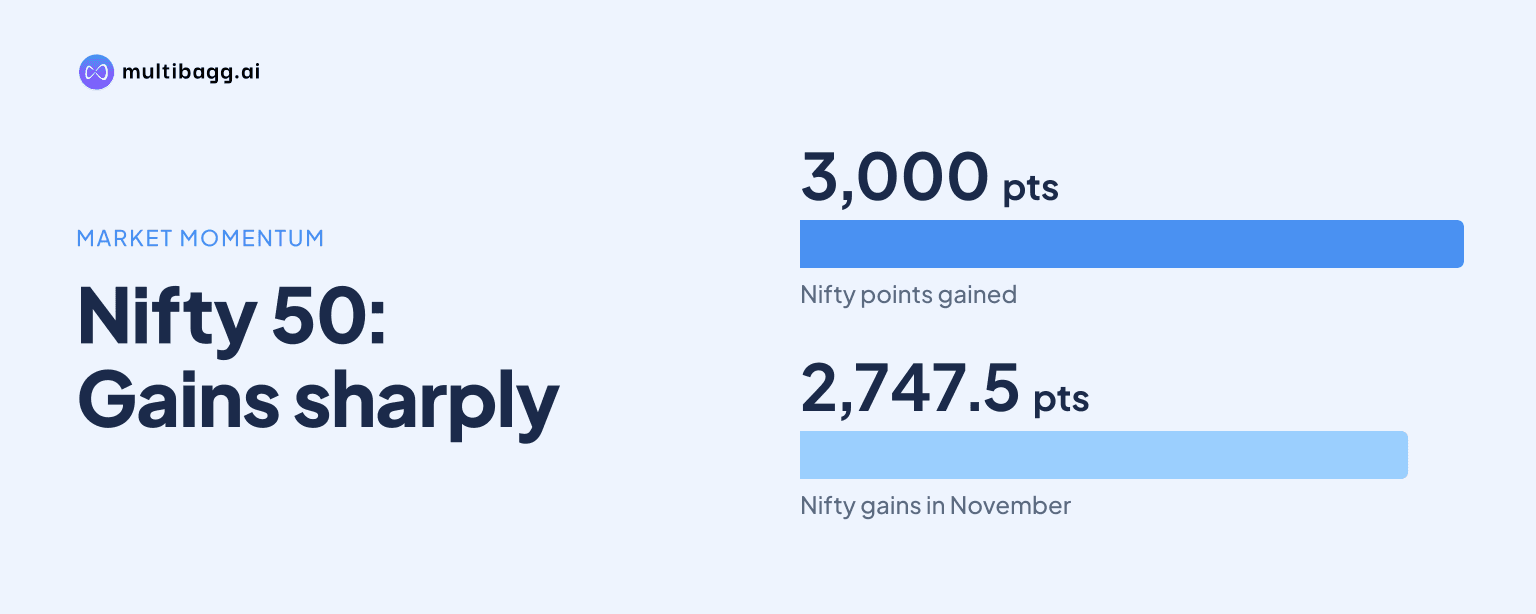
Nifty 50 gained roughly 3,000 points during November, closing at 25,800.60 on November 20 after a 286.30-point, or 1.12%, rise, as $12.21 billion of monthly foreign inflows, easing crude oil prices and stronger earnings offset a global retreat from AI-linked stocks.
Why did Nifty rise while AI-linked shares fell?
Nifty rose because overseas investors rotated towards Indian equities as global AI and chip stocks came under pressure, while domestic market conditions remained supportive. The benchmark held near nine-month highs even as Asian markets faced a broader technology-led sell-off. Social-media discussion around the move focused on India having relatively limited exposure to AI chipmakers and hardware companies.
The contrast was visible within the market. AI-linked shares including E2E Networks and Hitachi Energy India fell by as much as 5% amid concerns surrounding global AI trades. Yet the pressure on those names did not prevent a wider advance in Indian large-cap equities, where liquidity and foreign buying supported the benchmarks.
What market data shows the scale of the rally?
Nifty's advance was substantial both over the month and in the latest week, with the index gaining 2,747.5 points, or 11.91%, so far in November and 2.6% during the week ended November 20. The four-week winning run took the index to a nine-month closing high, while the Sensex also reached a nine-month high of 83,919.71.
The move has put Nifty on course for its strongest monthly performance in six years, according to the reported market commentary. One set of data put its gain at 10.7% in 13 trading days, while other reports described a rise of more than 10% for the month. These measures point to the same outcome: a sharp and fast rebound led by benchmark stocks.
How did foreign flows, crude and earnings support Nifty?
Record monthly foreign inflows of $12.21 billion were a key support for Nifty, adding liquidity as global investors reassessed crowded AI-linked positions. The reported rotation favoured Indian equities and, in particular, liquid large-cap sectors such as private banks. The return of foreign investors also helped the rupee strengthen past 93 per dollar for the first time since April.
Easing crude oil prices and upbeat corporate earnings provided the other main supports cited for the rally. Softer crude is important to the market narrative because elevated crude prices had been among the factors behind Indian equities' underperformance against emerging-market peers over the previous two years. Better earnings visibility, alongside domestic institutional buying, strengthened the case for a rebound even when global risk appetite weakened.
Got a follow-up? Ask IRIS
Which sectors and stocks participated in the advance?
Nifty IT participated in the rally, rising 2.70% to 31,754.65 by 10:50 a.m. on November 20 and becoming the best-performing sector at that point. Market commentary said the cooling AI trade eased concerns about disruption to traditional IT services, helping investors rotate towards Indian IT companies despite the overseas sell-off in AI and chip shares.
Private banks also extended their record run as foreign capital favoured the sector's liquidity. Healthcare names were among the prominent gainers: Max Healthcare rose 14.1% and Apollo Hospitals gained 7.9% after Macquarie double-upgraded both companies on improving earnings prospects. The participation was not uniform, however, as reports said smallcaps had barely joined a rally driven largely by large-cap stocks.
Is the rally broad enough to avoid consolidation?
Nifty's gains were broad enough to lift the benchmarks and selected sectors, but the rally was not equally shared across the market. Large caps, private banks, IT and certain healthcare stocks drew attention, whereas smallcaps saw far less participation. That gap matters because it shows the move has been closely linked to foreign flows into liquid stocks rather than a uniform rise across all company sizes.
Strategists nevertheless expect consolidation after the steep advance. The reported gains of around 10% to nearly 12% in a short period, combined with the four-week winning streak, leave the market exposed to shifts in foreign buying, crude oil prices or global technology sentiment. The declines in E2E Networks and Hitachi Energy India also show that Indian equities are not fully insulated from a reassessment of AI-related risk.
Conclusion
Nifty's roughly 3,000-point November advance reflects a reallocation into Indian large caps as global AI-linked trades weakened. Record foreign inflows, softer crude prices and improved earnings sentiment supported the index's climb to 25,800.60, while IT, private banks and selected healthcare stocks contributed to the move.
Investors will next watch whether foreign inflows remain strong, whether crude prices stay supportive and whether corporate earnings continue to validate the higher benchmark levels. The unresolved issue is whether the rally can broaden beyond large caps and whether the global AI sell-off continues to redirect capital towards Indian equities.