










NSE Nifty 50 Gains 10.7% as AI Sell-Off Redirects Flows
Key highlights
- Nifty 50 gained 10.7% in 13 trading days during November.
- Nifty 50 closed at a nine-month high of 25,800.60 after gaining 286.30 points on Friday.
- Foreign investors bought a record $12.21 billion of Indian equities in November so far.
- Nifty 50 rose 2.6% for the week while the Sensex gained 2.9%.
powered by IRIS
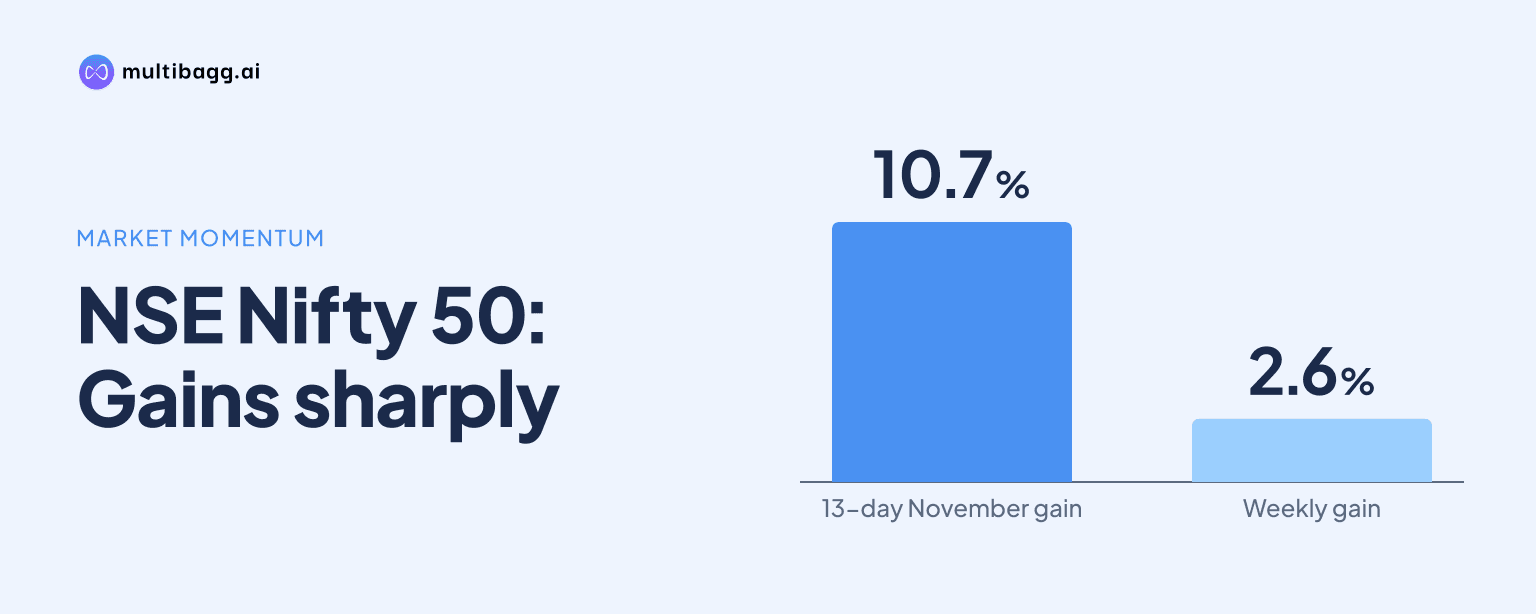
In November, the National Stock Exchange Nifty 50 gained 10.7% in 13 trading days as a global retreat from AI-linked shares redirected record $12.21 billion of foreign equity buying towards Indian stocks, helping the index close at a nine-month high of 25,800.60.
Why did the Nifty 50 rise during the global AI stock sell-off?
Nifty 50 rose because investors moved capital towards a large market with relatively limited direct exposure to AI supply chains while AI-linked shares came under pressure globally. The index gained 286.30 points, or 1.12%, on Friday to close at 25,800.60, even as broader Asian markets weakened.
The contrast reflects the composition of Indian equities cited in the market discussion. India has greater representation from banks, consumer companies and industrial businesses, and lacks the semiconductor concentration of markets such as South Korea and Taiwan. That made Indian large-cap shares a potential destination for funds seeking less dependence on spending tied to data centres, chips and software.
What numbers show the scale of the Nifty 50 rally?
Nifty 50's November advance was accompanied by a fourth consecutive weekly gain and a nine-month closing high. The benchmark rose 2.6% during the reported week, while the BSE Sensex gained 2.9% and ended at 83,919.71.
The rally was led more by frontline shares than by the broader market. Nifty 50 had gained nearly 11% in November so far, compared with 7.5% for the Nifty Midcap 100 and 6.2% for the Nifty Smallcap 250. Market commentary also noted weakness in mid- and small-cap shares during a session when banking and FMCG buying supported benchmark indices.
Which domestic factors supported the Nifty 50?
Nifty 50 had support from foreign buying, lower crude oil prices, stronger financial stocks and improving corporate earnings. These domestic influences helped the index withstand the negative global sentiment around technology valuations and AI-related investment.
Lower oil prices matter particularly for India because the country imports about 88% to 90% of the oil it consumes, according to the discussion. The context also pointed to a nearly 20% fall in Brent crude over the week. Alongside oil, strength in financial stocks was important because banks and financials make up a substantial part of the Indian market structure described by investors.
Got a follow-up? Ask IRIS
Are foreign flows driving the Nifty 50 move?
Foreign flows are a central explanation for the Nifty 50 move, with foreign investors buying a record $12.21 billion of Indian equities in November so far. The inflows came after Indian equities had lagged emerging-market peers over the prior two years, when the market's limited AI exposure and elevated crude prices had been viewed less favourably.
The flow reversal has also been described as a portfolio rotation rather than an India-specific AI boom. One social-media estimate put net foreign portfolio investment at ₹45,970 crore in November so far, while the Reuters-reported dollar figure was $12.21 billion. Both measures point to strong demand, but the durability of the rally remains tied to whether overseas buying continues.
What could determine the next phase for the Nifty 50?
The next phase for Nifty 50 is likely to depend more on earnings delivery than on further valuation expansion. Market participants have cautioned that India's valuation premium over some other markets will need support from corporate results, particularly if the global correction in AI-linked shares remains unsettled.
The AI correction has not been described as conclusively over, and concerns around technology valuations, inflation and interest rates persist. Nifty 50's relative resilience has been strongest in large caps, while weaker mid- and small-cap performance indicates that gains have not been equally broad across the market.
Conclusion
Nifty 50's 10.7% advance in 13 trading days shows how global capital rotation can outweigh a weak regional market backdrop. Record foreign buying, softer crude, financial-sector strength and improving earnings expectations combined to support Indian large caps while AI-heavy Asian markets faced selling pressure.
Investors will watch whether foreign inflows remain strong, whether lower crude prices persist and whether upcoming corporate earnings justify Indian valuations. The unresolved global AI correction is also important, because a further shift in technology-market sentiment could alter the flow advantage that has supported Nifty 50.