










Nifty gains 10.7% as global AI sell-off redirects flows
Key highlights
- Nifty has surged 10.7% in 13 trading days this month.
- Foreign portfolio investors reportedly put a net ₹45,970 crore into Indian equities in November so far.
- The MSCI India Index has risen 11% from its October low and added more than $400 billion in market value.
- The Nifty IT index has gained 17% this month, according to the reported data.
powered by IRIS
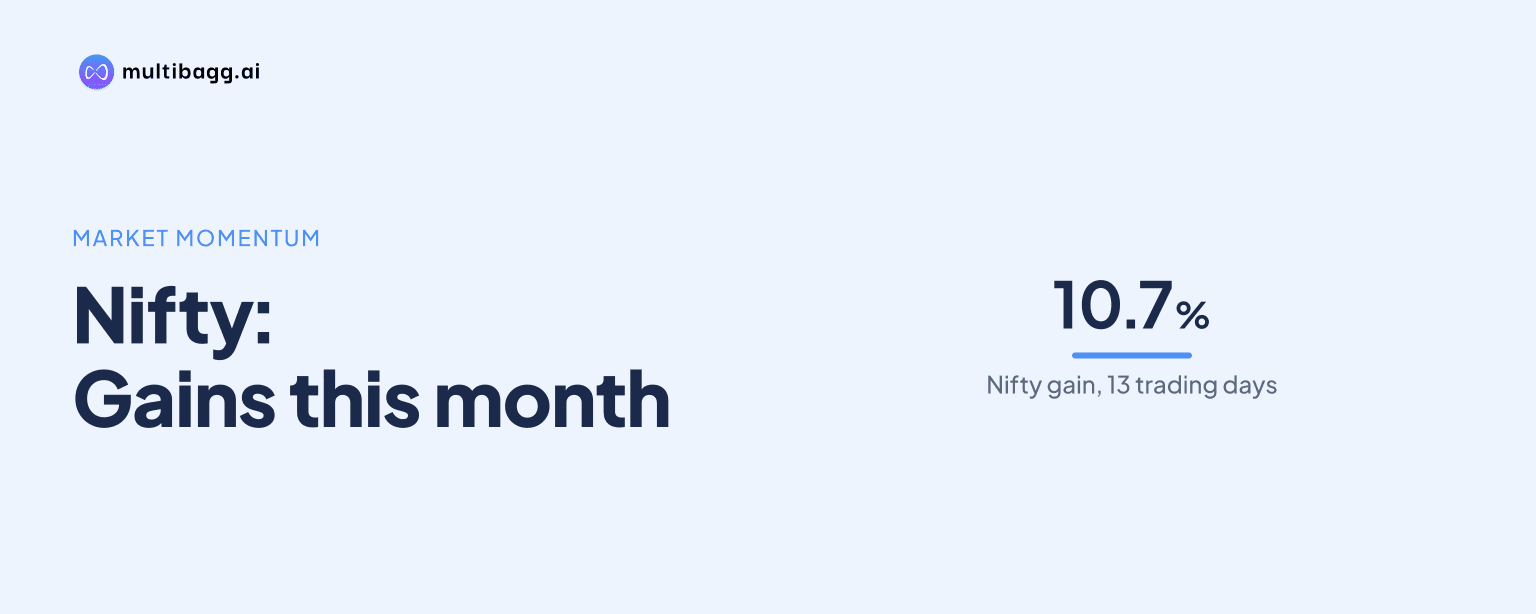
Nifty has surged 10.7% in 13 trading days this month as global investors reassess artificial intelligence-linked equities, with sustained foreign buying, easing crude oil prices and stronger corporate earnings supporting Indian stocks.
Why is Nifty rising while AI-heavy markets are falling?
Nifty is rising because India is being viewed as a lower direct-exposure alternative while artificial intelligence-linked stocks face a broad global correction. Markets in the United States, Japan and South Korea have come under pressure as investors question elevated valuations, heavy spending on AI infrastructure, borrowing costs and the uncertain return on such investments.
The contrast has been pronounced in Asia. Japan's Topix recorded its worst weekly decline since April 2025 as technology shares were sold, while major Asian markets also weakened despite Anthropic's initial public offering. India, by comparison, has attracted attention as global funds move away from crowded technology trades and towards a market with a more diversified sector mix.
The move is being described by market participants as a reverse AI trade. It does not mean India is insulated from global risk, but its relatively lower exposure to companies spending heavily on chips and data centres has made it a potential destination for capital leaving AI-heavy markets.
What numbers show the scale of the Nifty rally?
Nifty's 10.7% rise in 13 trading days is the clearest measure of the current rally, while foreign investor activity has added momentum. Reports cited net foreign portfolio investor inflows of ₹45,970 crore into Indian equities in November so far, following earlier net sales exceeding $31 billion.
The recovery has also extended beyond a single benchmark move. The MSCI India Index has risen 11% from its October low, adding more than $400 billion in market value and recovering much of its losses for 2026. On one reported session, the Sensex rose 1,360.61 points, or 1.68%, to 82,467.26, while Nifty gained 357.45 points, or 1.43%, to 25,402.10.
These figures point to a sharp change in sentiment rather than a narrow defensive bid. A short squeeze, in which bearish positions were unwound, has also been cited as an additional force behind the rapid move in the benchmark.
Got a follow-up? Ask IRIS
Which Indian sectors are attracting investor money?
Financials, IT, automobiles and telecom have been identified as the main recipients of foreign buying, while analysts also expect capital goods, select automobile companies and pharmaceutical majors to participate in the next leg. The rally has been led largely by large-cap stocks that had become more attractively valued.
Indian IT has drawn particular attention during the global technology retreat. HCL Technologies, Infosys and Tata Consultancy Services rose 1-2% in early trade in one session, while Wipro, Persistent Systems and Coforge were each up around 1%. At noon on that day, the Nifty IT index was marginally higher at 32,111.75 and was the only gaining domestic sector.
Analysts see Indian IT as a possible relative hedge because service providers may benefit from demand for AI consulting, integration and managed services without committing the same level of capital to data centres and chips as global hyperscalers. However, some analysts say it is premature to draw a direct correlation, and one market view was that domestic institutional investors, rather than foreign investors, were driving IT-sector buying.
What risks could slow the Nifty rally?
Nifty could face volatility if the global AI-driven sell-off develops into wider deleveraging that triggers foreign selling across emerging markets. India has lower direct exposure to the AI infrastructure trade, but globally sensitive stocks, including IT, could still face immediate pressure during an extended international risk-off phase.
The current advance also relies on several supporting conditions continuing at the same time: sustained foreign inflows, lower crude oil prices, better-than-expected corporate earnings and reasonable large-cap valuations. Profit booking is already occurring, even as buying has kept the broader market resilient.
A further risk is that the rapid rise reflects position unwinding as well as fundamental allocation changes. If short-covering fades or global investors again favour technology-heavy markets, the pace of gains could moderate. The market's response will therefore depend not only on India's earnings outlook but also on whether concerns over AI spending, data-centre expansion and global valuations persist.
Conclusion
Nifty's 10.7% advance has been supported by a reallocation away from AI-heavy markets rather than by an Indian AI-stock boom alone. Foreign inflows, easing crude prices, improved earnings and interest in attractively valued large caps have combined to make Indian equities comparatively appealing during a global technology correction.
Investors will next watch whether foreign buying remains sustained after the ₹45,970 crore of November inflows reported so far, and whether crude prices and corporate earnings continue to support sentiment. The unresolved issue is whether the AI sell-off remains focused on global technology shares or broadens into a wider reduction in risk exposure that could eventually affect Indian equities.