










Infosys ADR Gains 4% Despite Weak Wall Street Trade
Key highlights
- Infosys ADR rose 4% despite weak Wall Street trade.
- Wipro ADR gained more than 2% in the same market discussion.
- US inflation cooled to 2.4% in January 2026.
- Wipro ADR gained 6.75% after the US cut reciprocal tariffs on India from 50% to 18%.
powered by IRIS
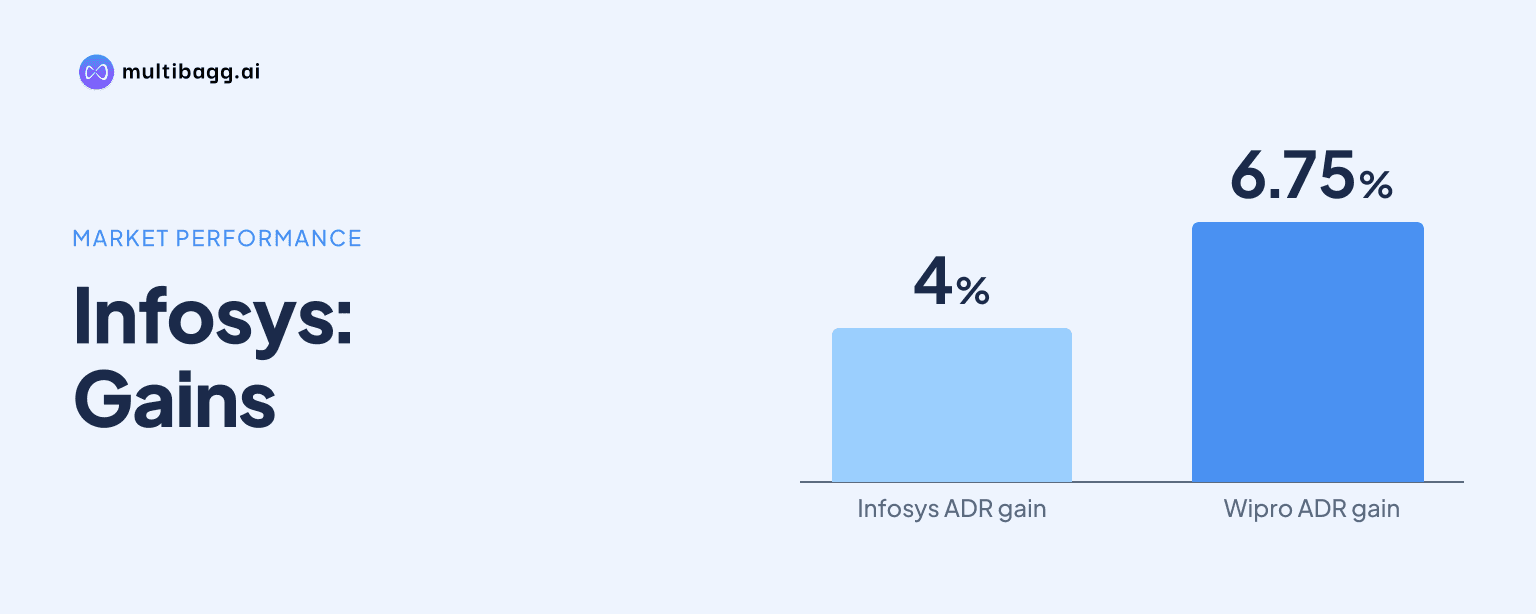
Infosys Limited's ADR gained 4% despite weak Wall Street trade, while Wipro Limited's ADR rose more than 2%, indicating that selected Indian IT exporters found support even as broader technology and domestic IT sentiment remained under pressure.
Why did Infosys ADR rise despite weak Wall Street trade?
Infosys rose 4% and Wipro rose more than 2% even as the broader Nasdaq was weak, according to the market discussion. The move stood out because Indian technology shares had faced pressure both in domestic trading and in the US market amid concerns around artificial intelligence-driven disruption and global demand.
The immediate backdrop included US inflation cooling to 2.4% in January 2026. That reading raised expectations that it could influence future Federal Reserve rate-cut decisions. For IT exporters with substantial exposure to the US market, shifts in the US economic and interest-rate outlook can affect investor views on client technology spending.
The gains do not establish a broad or sustained reversal in the IT sector. The same discussion noted continuing pressure from strong US employment data and concerns about AI-led disruption. The session instead showed that company and sector-specific buying can emerge even when the wider Wall Street tone is soft.
How have Infosys and Wipro ADRs moved in recent sessions?
Infosys and Wipro ADRs have experienced sharp swings, reflecting rapidly changing views on US technology spending, corporate earnings and macroeconomic risks. In one earlier session, Infosys fell 2.34% in regular trading before recovering 1.60% in extended trade to $12.70, while Wipro was unchanged at $2.16.
In another New York session, Infosys rose 5.66% in regular trading and added 0.08% later to $12.14. Wipro gained 3.89% during regular trading before declining 0.53% in subsequent trading to $1.86. These changes underline why overnight ADR moves can be closely watched before Indian market trading begins.
Earlier weakness was also pronounced. Infosys ADRs had slumped more than 7% in one Thursday session, reaching an intraday low of $14.59, while Wipro ADRs fell 5.4% to $2.26. The context linked that sell-off to weakness in Indian IT stocks spilling over to Wall Street.
Got a follow-up? Ask IRIS
What is supporting sentiment toward Indian IT ADRs?
A better outlook from Accenture was one source of support for Indian IT ADRs, as its forecast for stronger-than-expected annual revenue growth eased concerns over global technology spending. The discussion also pointed to steady consulting, managed-services and AI demand as factors improving sentiment toward Indian IT exporters.
Broader market conditions have also mattered. Strong gains in US technology stocks supported Infosys and Wipro ADRs in some sessions, while falling crude oil prices and optimism around renewed Iran-US peace talks softened macro concerns. Such drivers can lift risk appetite, although their effect can change quickly as global news evolves.
A separate rally followed the US decision to reduce reciprocal tariffs on Indian goods from 50% to 18%. During that move, Infosys ADR rose 4.32%, Wipro gained 6.75%, ICICI Bank ADR increased 4.95% and HDFC Bank ADR advanced 4.35%. That reaction was tied to an improvement in US-India trade relations rather than only to the technology outlook.
Do ADR gains indicate the same move in Indian shares?
ADR gains can influence sentiment for Indian shares, but they do not ensure an identical move on Dalal Street. The market discussion noted that domestic returns are generally less negative than US ADR returns because of rupee depreciation, different trading hours, liquidity and investor sentiment on each exchange.
That difference is relevant when interpreting overnight moves in Infosys and Wipro. An ADR price is quoted in US dollars and reacts to US-market conditions after Indian markets close, whereas the underlying Indian shares respond to local flows and developments during their own trading hours.
Banking ADRs have also moved independently across sessions. HDFC Bank's ADR rose 1.78% in one regular session and added 0.24% later to close at $25.20, while ICICI Bank advanced 4.18% before slipping 0.79% in the later session to $33.62. Investors should therefore separate a one-night ADR reaction from a confirmed broader trend.
What should investors watch after the Infosys ADR rally?
Investors should watch whether evidence on global technology demand continues to support the recent resilience in Infosys and Wipro ADRs. Accenture's outlook, US technology-stock performance and signals on consulting, managed services and AI demand remain important reference points in the discussion.
US macroeconomic data will also remain relevant after January inflation cooled to 2.4%. The market response to future inflation and employment readings could alter expectations on Federal Reserve policy, while developments around AI disruption and global uncertainty may continue to drive sharp moves in Indian IT ADRs.
Conclusion
The 4% rise in Infosys ADRs and more than 2% gain in Wipro ADRs during weak Wall Street trade showed selective support for Indian IT exporters. Cooling US inflation and improving views on technology demand helped sentiment, but the sector's recent volatility shows that the rebound should be assessed alongside wider market conditions.
The next signals to watch are developments in US technology spending, future inflation and employment data, and the durability of demand cited in Accenture's outlook. Investors will also track whether overnight ADR strength is reflected in Indian IT shares after accounting for currency, liquidity and different market hours.