










IFCI Shares Fall 7% as NSE IPO Terms Hit Investor Sentiment
Key highlights
- IFCI shares fell 7% after reports of lower NSE IPO pricing and a smaller stake offering.
- IFCI earlier rallied 6% after Sebi approved the National Stock Exchange of India IPO.
- IFCI reported Q2 FY27 net sales of Rs 733.04 crore and PBDIT of Rs 521.87 crore.
- IFCI stood at Rs 60.35 on November 20, 2026, versus a 52-week high of Rs 107.45.
powered by IRIS
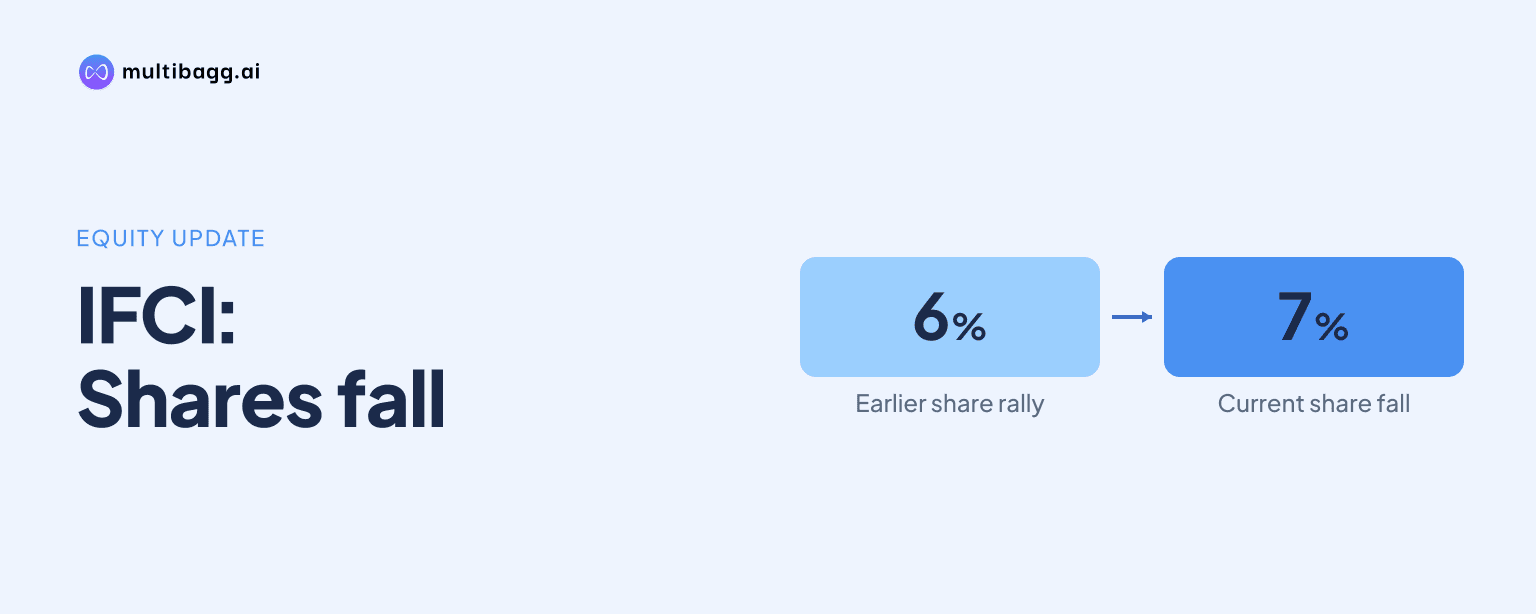
IFCI Ltd. shares fell 7% after a sharp recent rally as reports indicated that the National Stock Exchange of India IPO could be priced below earlier expectations and involve a smaller stake sale. The move put attention on IFCI's indirect National Stock Exchange of India exposure through Stock Holding Corporation of India.
Why did IFCI shares react to the NSE IPO?
IFCI shares reacted because the company has indirect exposure to the National Stock Exchange of India through its majority stake in Stock Holding Corporation of India. Social-media discussion around the exchange's proposed listing has therefore made IFCI a closely watched proxy whenever expectations around the IPO change.
The stock had earlier rallied 6% after the Securities and Exchange Board of India approved the National Stock Exchange of India IPO, clearing a significant regulatory hurdle for the listing. It also gained attention alongside New India Assurance and other stocks when the Rs 22,569 crore IPO opened for subscription. That enthusiasm later gave way to a 7% fall after reports suggested that the price and stake-sale terms could be lower than previously indicated.
The proposed price band of Rs 1,700 to Rs 1,785 was reported to value the National Stock Exchange of India at about Rs 4.4 lakh crore. For IFCI investors, the key point is that the market is responding not only to the existence of the IPO but also to changing expectations over its valuation and the size of the stake being offered.
What do the reported NSE IPO terms mean for IFCI?
The reported IPO terms matter for IFCI because a lower-than-expected valuation or a smaller stake offer may alter how investors assess the value of its indirect exposure. The available information does not quantify the financial impact on IFCI, but the share-price response shows that this linkage has become an important near-term sentiment driver.
The following figures frame the discussion around the IPO and IFCI's market reaction.
The sequence also illustrates the risk of treating IFCI solely as an NSE-related trade. The stock's move followed both positive regulatory news and subsequent concerns around possible IPO terms. The eventual offering details, including the final price and stake sale, remain central to whether this narrative changes again.
How did IFCI perform in the September quarter?
IFCI reported a quarterly turnaround for Q2 FY27, with net sales of Rs 733.04 crore and record quarterly PBDIT of Rs 521.87 crore, according to the information provided. The results for the quarter and half-year ended September 30, 2026, were announced on November 12.
The reported sales figure was 47.5% above the previous four-quarter average. The company had also followed two consecutive quarters of negative results with a positive turnaround in Q2 FY27. Its debt-to-equity ratio was reported at 0.28 times, pointing to a relatively low level of leverage under the cited assessment.
However, commentary around the results remained mixed. One assessment cited modest financial trends, expensive valuation metrics and weak long-term quality scores despite the quarterly improvement. Another said that a significant profit decline over the past year limited the benefit of recent favourable financial developments. These differing observations mean the quarterly numbers should be considered alongside the broader performance record rather than in isolation.
Got a follow-up? Ask IRIS
What is IFCI's current share-price and technical picture?
IFCI closed at Rs 60.35 as of November 20, 2026, after a volatile period marked by NSE IPO-related moves and mixed technical assessments. The share price was reported at Rs 61.41 on November 19, when it was up 2.78% for the day, showing that short-term trading remained unsettled.
Over six months, IFCI was down 0.57%, while its year-on-year gain stood at 14.81%. Another data point placed the one-month return at negative 5.30%, compared with a 12.42% gain in the Sensex over the same period. The stock's 52-week range was Rs 46.20 to Rs 107.45, underlining the scale of the swings during the year.
Technical commentary was not uniform. One assessment described the technical grade as having shifted from sideways to mildly bearish, while another dated November 17 described IFCI as mildly bullish. MarketsMojo rated the stock Sell, with a Mojo Score of 44.0, and a separate assessment downgraded it to Strong Sell on November 19. These are third-party views rather than company disclosures, but they reflect the divided sentiment around the stock.
What should IFCI investors watch after the NSE IPO news?
IFCI investors should watch final National Stock Exchange of India IPO pricing, the final size of the stake offer and any disclosures that clarify the implications of Stock Holding Corporation of India's exposure. These details could determine whether the market's earlier valuation expectations are sustained, revised or reset.
Company-specific disclosures also remain relevant. IFCI issued a Regulation 30 update on November 18, following its November 12 results announcement and a November 5 credit-rating-related announcement. Its next reported operating and financial updates will be important in testing whether the Q2 FY27 improvement can be maintained.
Conclusion
IFCI's recent price action has been shaped by two separate forces: its indirect link to the National Stock Exchange of India IPO and a reported Q2 FY27 financial turnaround. The 7% fall after reports on possible IPO pricing and stake-sale changes shows that sentiment around the listing can quickly outweigh the effect of a positive quarterly update.
The next focus is the final structure of the National Stock Exchange of India IPO, particularly its price and offered stake, alongside IFCI's subsequent disclosures after the September-quarter results. Investors will also watch whether the company's reported sales and PBDIT improvement is followed by a more durable improvement in its wider financial trend.