










India Volatility Index Signals Expected 30-Day Market Swings
Key highlights
- India VIX measures expected Nifty 50 volatility over the next 30 calendar days.
- A reading of 20 implies an estimated 30-day one-standard-deviation move of about 5.7% in either direction.
- A reading of 15 implies an approximate 30-day move of 4.3% on either side.
- Readings above 35 are commonly associated with high expected market fluctuations.
powered by IRIS
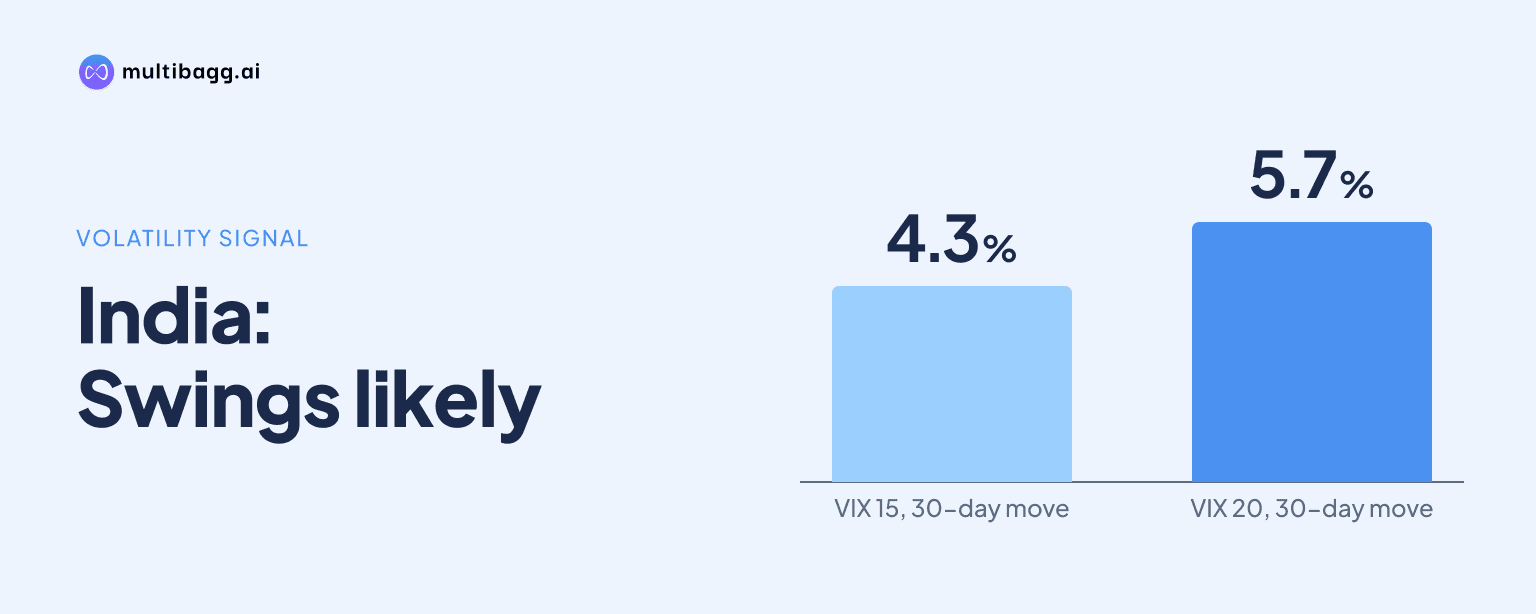
India Volatility Index measures the expected magnitude of Nifty 50 price swings over the next 30 calendar days, rather than their direction. Also called India VIX, it is expressed as an annualised percentage and is derived from Nifty 50 option prices, making it a forward-looking gauge of expected market turbulence.
What does India VIX measure for investors?
India VIX measures the options market's expectation of how widely the Nifty 50 may move during the coming 30 calendar days. It does not state whether the index will rise or fall. Instead, it reflects the expected size of potential moves as priced by options traders.
The National Stock Exchange publishes the index using prices of out-of-the-money Nifty 50 options, following the CBOE VIX methodology referenced in market discussions. When participants expect uncertainty or a major market-moving event, demand for options protection can lift option premiums. That higher implied volatility is reflected in a higher India VIX reading.
How should investors interpret an India VIX reading?
India VIX is quoted as annualised volatility, so a reading should not be read as a direct 30-day percentage forecast. A reading of 20 means the market is pricing annualised volatility of roughly 20% over a constant 30-day horizon, not that the Nifty 50 will move exactly 20%.
A rough statistical estimate converts the annualised figure into a 30-day expected move using the square root of time. These figures indicate a one-standard-deviation range in either direction and are not forecast boundaries. A low reading can indicate calmer expectations, but it does not eliminate the possibility of a sudden market move.
Social-media discussions commonly use a level near or below 15 as a sign of relatively low volatility and a level above 35 as a sign of high fluctuations. These are broad reference points rather than trading signals or guaranteed thresholds.
Does a rising India VIX mean the Nifty 50 will fall?
A rising India VIX does not necessarily mean the Nifty 50 will fall because it measures expected movement, not market direction. A large upward move is also volatile, and the Nifty 50 can rise while India VIX rises if traders are preparing for a significant event.
The two indices often show an inverse relationship during periods of stress. Sharp market declines can increase demand for protection and push India VIX higher, while a steadily rising market can coincide with lower volatility expectations. However, the relationship is not mechanical: the Nifty 50 can decline gently while India VIX remains subdued, or advance while implied volatility increases.
Got a follow-up? Ask IRIS
Why does India VIX affect option prices?
India VIX affects option prices because expected volatility is a core component of option premiums. When traders expect larger moves in the Nifty 50, calls and puts can become more expensive as the market prices a greater chance of sizeable movement before expiry.
This connection makes India VIX particularly relevant to options participants. Higher implied volatility generally means higher premiums for both calls and puts, while lower implied volatility is associated with cheaper options. The index therefore helps explain why an option's price can change even when the underlying index has not made a large directional move.
How can retail investors use India VIX responsibly?
Retail investors can use India VIX as a measure of expected market conditions, not as a standalone buy or sell indicator. A rising reading can signal that price reactions may be sharper and faster, while a lower reading is associated with narrower daily movement and more stable conditions.
It can also provide context around elections, Reserve Bank of India policy decisions, global shocks and corporate earnings, all of which can alter risk perceptions. Investors should distinguish between implied volatility, which India VIX reflects, and realised volatility, which is the market movement that actually occurs. The expectation priced today may not match what ultimately happens.
Conclusion
India VIX is a forward-looking measure of expected Nifty 50 volatility over 30 calendar days, built from option prices rather than past index moves. Its main value is in showing the likely scale of market movement and the level of uncertainty that options traders are pricing, without predicting whether the market will rise or fall.
The next reading should be assessed alongside the events investors expect to drive risk, including policy decisions, elections, global developments and corporate earnings. Investors can also watch whether option premiums and actual Nifty 50 movement support or diverge from the volatility expectation reflected in India VIX.