










Indian Broker Stock Price: ₹251 to ₹2.51 Signals Adjustment
Key highlights
- ₹2.51 is exactly one-hundredth of ₹251, implying a 100-for-1 price adjustment.
- A separate price alert showed ₹251.00 moving to ₹250.00, a decline of 0.40%.
- Sebi's revised closing auction session framework is scheduled to take effect on 7 December 2026.
- Angel One traded at ₹289.05 at 1:21 PM on 27 October 2026, up 2.28% in the cited sector update.
powered by IRIS
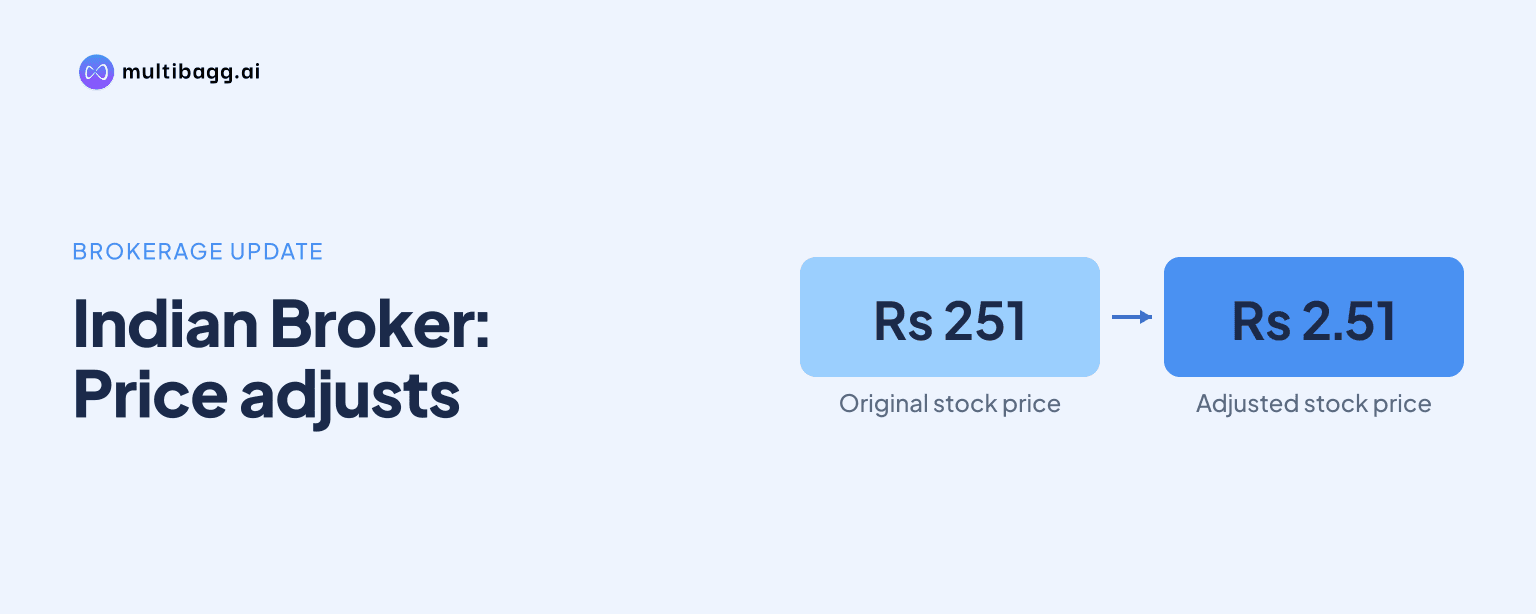
The Indian broker stock price move from ₹251 to ₹2.51 implies a 100-for-1 adjustment in the displayed per-share price, not automatically a 99% loss for investors. The available social-media context identifies the two price points but does not name the listed company, confirm a corporate action, or provide a record date.
Why did the broker stock price change from ₹251 to ₹2.51?
A move from ₹251 to ₹2.51 is consistent with a 100-for-1 mathematical adjustment to the quoted share price. Under such an adjustment, the price is divided by 100, while the corresponding number of shares held would ordinarily need to be multiplied by 100 for the holding value to remain comparable.
The supplied discussion labels the development as a stock price adjustment and refers to bonus shares, but it does not establish whether the event is a stock split, a bonus issue, or another corporate-action-related adjustment. Investors should therefore avoid treating the ₹2.51 quote alone as evidence of a steep intraday fall. The company name, exchange notice, adjustment ratio, eligibility date and demat credit details are not available in the supplied material.
Does a ₹251 to ₹2.51 adjustment reduce an investor's wealth?
No, a price adjustment by itself does not reduce an investor's wealth if the share quantity changes in the matching ratio. For example, a holding of one share at ₹251 would need to become 100 shares at ₹2.51 for the gross holding value to remain ₹251, before considering any subsequent market movement or trading costs.
That distinction is important because market apps, watchlists and broker portfolios can show sharp percentage changes when adjusted and unadjusted reference prices are compared. The context separately shows a price-alert move from ₹251 to ₹250, or 0.40%. That small change is different from the ₹251-to-₹2.51 ratio implied by the adjustment-related discussion.
What should investors check after a stock price adjustment?
Investors should check their demat quantity, broker portfolio value and the corporate-action communication before judging the impact of the lower quoted price. The supplied stock-split guidance specifically says investors should review the demat balance and broker portfolio quantity after adjusted shares are credited and begin trading.
A practical comparison uses both price and quantity. An investor should compare the value of the holding immediately before the adjustment with the post-adjustment quantity multiplied by the post-adjustment price. If the quantity has not yet been updated, a temporary mismatch on a broker platform may not reflect the final settled position. The available context does not disclose when adjusted shares will be credited or traded for the unnamed broker stock.
Got a follow-up? Ask IRIS
How do bonus shares and stock splits differ for a broker stock?
Bonus shares and stock splits can both lower the per-share market price, but they work differently and the available discussion does not confirm which applies here. A split changes the face value and increases the number of shares in a specified ratio, while a bonus issue adds shares to eligible holders from reserves in a stated ratio.
In either case, the key investor question is the announced ratio and whether the account holds the revised quantity. A price of ₹2.51 is exactly one-hundredth of ₹251, but that arithmetic alone cannot identify the mechanism. Investors should rely on the formal company and exchange notice rather than a social-media price screenshot or a search result label.
Why are brokerage stocks being discussed alongside market-rule changes?
Brokerage stocks have also drawn attention because Sebi's revised closing auction session framework is scheduled to take effect on 7 December 2026. The context says expiry-day derivatives will settle on the volume-weighted average price of the final 30 minutes of cash-market trading, and cites Jefferies as saying the change helps brokers more than exchanges.
On 27 October 2026 at 1:21 PM, the cited brokerage-stock prices were ₹289.05 for Angel One, ₹968.35 for Motilal Oswal, ₹324.30 for 5paisa Capital and ₹3,445.70 for BSE. Those figures concern a broader sector discussion and do not identify the stock associated with the ₹251-to-₹2.51 adjustment. Investors should keep a corporate-action-driven price reset separate from sector movements linked to regulation, trading activity or quarterly results.
Conclusion
The ₹251-to-₹2.51 broker stock quote points to a 100-for-1 price adjustment on arithmetic, rather than proving a 99% destruction of value. The meaningful measure is the post-event holding value after matching the revised share quantity with the adjusted market price. The supplied context does not identify the company or formally confirm the type of adjustment.
The next item to watch is the official corporate-action notice for the ratio, record date, eligibility terms and timing of revised share credit. Investors should also verify that their demat quantity and broker portfolio update correctly before interpreting returns from the lower displayed price.