










Watrana Rentals IPO: 18% FY26 Growth Faces Debt Risks
Key highlights
- Watrana Rentals reported FY26 revenue from operations of Rs 211.36 crore, up from Rs 179.48 crore in FY25.
- Watrana Rentals' FY26 profit after tax increased to Rs 29.16 crore from Rs 24.43 crore in FY25.
- Watrana Rentals reported FY26 borrowings of Rs 164.08 crore against net worth of Rs 85.55 crore.
- Watrana Rentals plans to allocate Rs 98.13 crore of IPO proceeds to MHE, AWP and battery purchases.
powered by IRIS
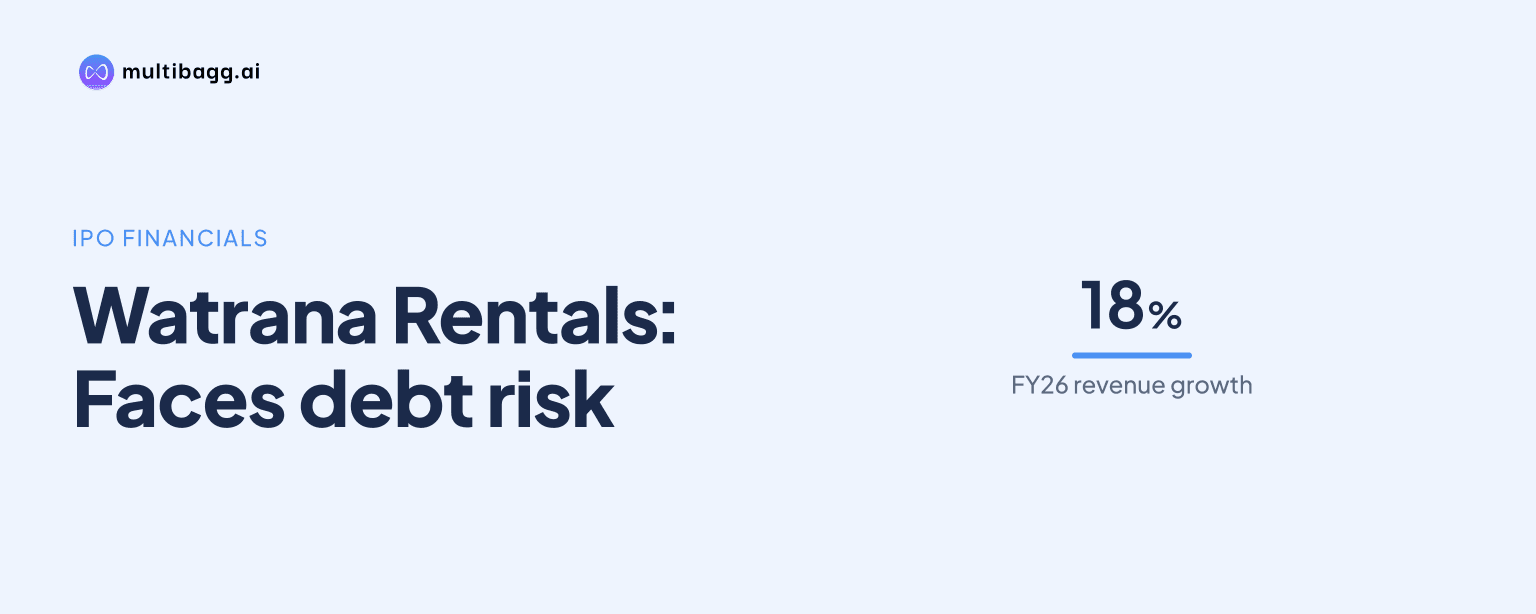
In FY26, Watrana Rentals reported an 18% increase in total income to Rs 212 crore, but borrowings of Rs 164.08 crore and the thinner liquidity of an NSE SME listing remain central considerations for IPO investors. The issue is priced at Rs 232-Rs 245 per share and is entirely a fresh issue.
What does Watrana Rentals do?
Watrana Rentals operates a business-to-business equipment rental model focused on material handling equipment, or MHE, and aerial work platforms, or AWP. Its equipment offering includes forklifts, reach trucks and stackers, while the company also sells new and used equipment, batteries and spare parts. The business serves industrial customers and provides trained operators alongside rented equipment.
The company had an operational fleet of 2,679 units as of June 30, 2026, comprising 2,646 MHE units and 33 AWPs. This fleet was deployed across more than 500 client sites in 24 states, while other discussion around the issue cites operations across 25 states and more than 630 rental and customer sites. The scale of the fleet is a core part of the investment case because rental income depends on equipment deployment and customer demand.
India's equipment-rental market is supported by infrastructure, manufacturing, warehousing and logistics activity, according to the discussion around the offer. The material handling equipment market is projected to expand from USD 4.20 billion in 2026 to USD 13.04 billion by 2036, with rental projected to grow at about 13% to USD 7.90 billion. These are sector projections rather than company forecasts, and they do not assure future revenue for Watrana Rentals.
How fast did Watrana Rentals grow in FY26?
Watrana Rentals increased revenue from operations to Rs 211.36 crore in FY26 from Rs 179.48 crore in FY25, while profit after tax rose to Rs 29.16 crore from Rs 24.43 crore. The FY26 revenue number was also well above Rs 130.12 crore reported in FY24, showing a sharp expansion in the reported business over two years.
Profitability was relatively stable across the three reported financial years. PAT margin was 13.8% in FY26, compared with 13.6% in FY25 and 13.9% in FY24. FY26 EBITDA margin was reported at 30.76%, while return on equity was 41.08% and return on capital employed was 19.06%. Investors should note that a stable margin does not eliminate the capital requirements of maintaining and expanding a rental fleet.
Posts discussing cash generation add an important qualification. Over three years, Watrana Rentals reportedly generated Rs 115 crore in cash from operations but spent Rs 188 crore on fixed assets. That Rs 73.2 crore gap illustrates why fleet growth can require ongoing funding beyond internally generated cash.
How will Watrana Rentals use its IPO proceeds?
Watrana Rentals plans to raise Rs 120.10 crore through a fresh issue of 49.02 lakh equity shares, with Rs 98.13 crore earmarked for purchasing MHE, AWP and batteries. Since the offer is entirely fresh, the proceeds are intended to go to the company rather than to selling shareholders.
The proposed equipment purchases are consistent with the operating model: a larger fleet can support more deployments if demand and utilisation remain adequate. At the same time, adding assets raises the need to manage maintenance, replacement, financing and site-level utilisation. The use of proceeds therefore links the offer directly to the execution of the company's expansion plan.
The bidding window is stated as November 19 to November 23, 2026, with basis of allotment expected on November 25 and a tentative NSE SME listing on November 27. SME IPOs require a minimum application value of Rs 1 lakh, and NSE Emerge trading can be thinner than trading in main-board shares. Those features can affect both access for retail applicants and post-listing liquidity.
Got a follow-up? Ask IRIS
What are the main risks in the Watrana Rentals IPO?
Watrana Rentals' largest disclosed financial concern is leverage, with total borrowings of Rs 164.08 crore in FY26 against net worth of Rs 85.55 crore. The company depends substantially on rental income, so a slowdown in industrial activity, construction, warehousing or customer equipment demand could affect fleet utilisation and cash flows while debt obligations remain.
The company also faces the normal risks of an asset-heavy rental model. Equipment must be acquired, deployed, maintained and eventually replaced, and the reported three-year fixed-asset spending exceeded operating cash generation. Social-media analysis also cited cases involving Rs 16 crore. The context does not provide details on these cases, so their potential financial or operational impact cannot be assessed from the available information.
Valuation discussion around the IPO has varied. One analysis put the price at about 8.41 times FY26 profit, while another cited 13.73 times FY26 earnings and 13.03 times post-issue annualised earnings. The differing measures underline the need for investors to check the underlying share count and earnings basis. Peer comparisons cited in the discussion included Seemax Resources at a P/E of 15.06 and Leap India at 6.19, although the available peer data are incomplete.
How should investors interpret the grey market premium?
Reported grey market premium figures for Watrana Rentals have ranged from Rs 25 to Rs 67, with several posts citing Rs 62, or about 25% above the upper price band of Rs 245. At Rs 25, the implied price would be about Rs 270, while a Rs 62 premium would imply a materially higher level. The variation itself shows that GMP reports can change quickly and may not be consistent across sources.
A grey market premium is informal and is not a guarantee of listing performance. It does not substitute for assessing the company's reported growth, borrowings, capital expenditure needs and SME-market liquidity. For this issue, the reported FY26 profit growth and fleet expansion plan must be weighed against the funding intensity of the model and the leverage already on the balance sheet.
Conclusion
Watrana Rentals brings a profitable, growing equipment-rental business to the NSE SME platform, supported by FY26 revenue from operations of Rs 211.36 crore and PAT of Rs 29.16 crore. The IPO's proceeds are largely directed towards fleet and battery purchases, aligning the fund raise with the business model. However, the Rs 164.08 crore borrowing level and the gap between operating cash generation and fixed-asset spending are important counterweights.
Investors should watch subscription data through the November 23, 2026 close, the allotment process expected on November 25 and the tentative NSE SME listing on November 27. They should also track whether the new equipment purchases improve deployment and whether borrowing, fleet utilisation and cash generation remain manageable as the company expands.