










Additional Surveillance Measure rules raise trading costs
Key highlights
- Long-term ASM Stage I can require 100% margin from T+3 day.
- Stage II escalation cited requires 25% or more close-to-close variation for five days and 30% or more client concentration.
- Stage IV can impose trade-to-trade settlement, 100% margin and a 5% price band.
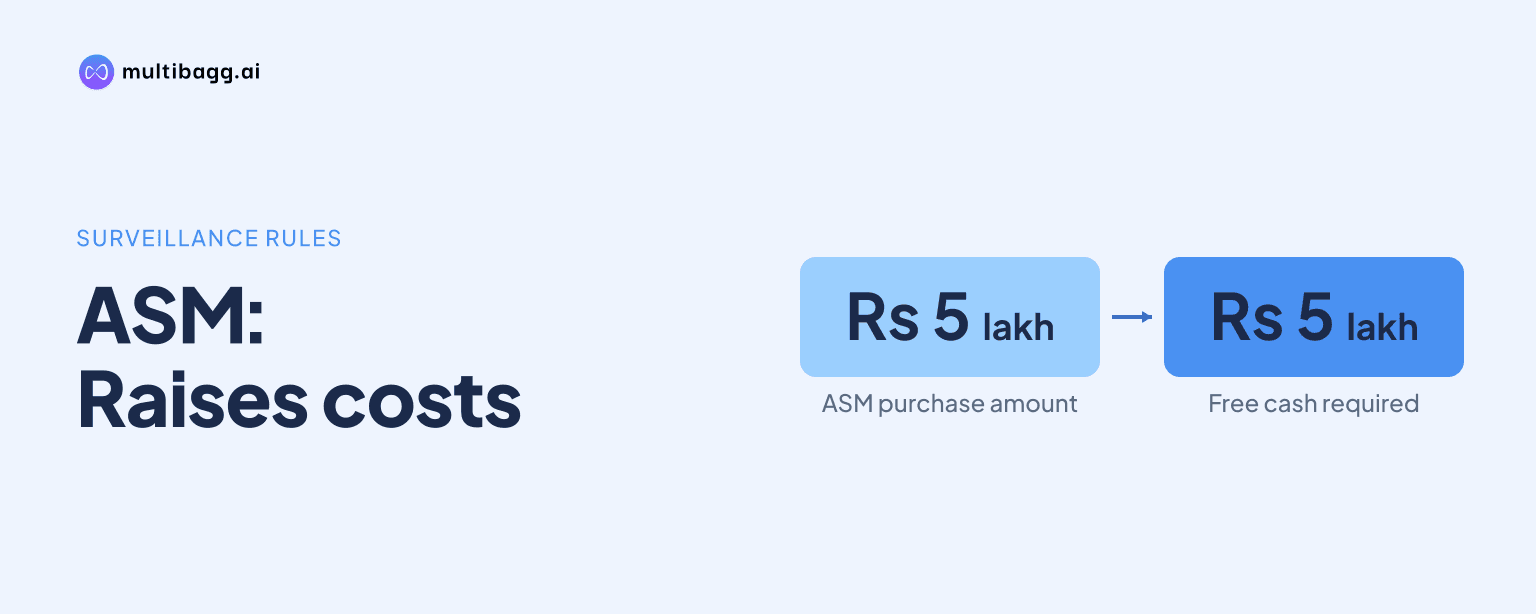
- A ₹5,00,000 ASM purchase under full-margin rules requires ₹5,00,000 in free cash.
powered by IRIS
Additional Surveillance Measure rules can make a stock substantially more cash-intensive to trade, with the long-term framework described requiring 100% margin and, at Stage IV, trade-to-trade settlement with a 5% price band. Additional Surveillance Measure is a surveillance mechanism, not a finding about a company’s fundamentals or an adverse action against it.
What is ASM in the Indian stock market?
ASM is a framework jointly used by the Securities and Exchange Board of India and recognised stock exchanges to monitor securities showing unusual price moves, volume changes or trading patterns. The framework was introduced in March 2018 and is intended to impose risk controls where predefined surveillance parameters are met.
The factors cited in the discussion include high-low variation, price variation relative to the market index, close-to-close movement, concentration among the top 25 clients, market capitalisation, volume variation, delivery percentage, the number of unique PANs and price-to-earnings measures. A stock’s inclusion therefore reflects trading and market-data conditions covered by the framework rather than a verdict on the underlying business.
ASM shares remain tradable, but exchanges can change the terms under which they trade. The possible actions include higher margin requirements, tighter daily price bands, periodic call auctions and trade-to-trade settlement. The practical result is that trading can become more restrictive even though buying and selling have not necessarily stopped.
How do ASM inclusion rules affect margins and leverage?
ASM inclusion can require 100% margin, meaning a buyer must provide the entire value of the purchase upfront rather than use broker-funded leverage. For example, a ₹5,00,000 purchase would require ₹5,00,000 of free cash in the trading ledger where the full-margin requirement applies.
The long-term stages described in the source material progressively tighten restrictions when the relevant abnormal conditions continue. Stage I carries 100% margin from T+3 day. In Stage II, a stock already in Stage I may face escalation when close-to-close variation of at least 25% persists for five days alongside client concentration of 30% or more.
The discussion also distinguishes short-term and long-term monitoring. Short-term tracking may operate over days to weeks, while long-term tracking is a multi-stage process for conditions that persist. Margin requirements and restrictions can therefore differ by track and stage.
Can retail investors trade ASM stocks intraday?
Retail investors may be unable to use intraday trading or leverage in ASM shares, particularly where delivery-based or trade-to-trade conditions apply. Broker product types associated with intraday positions, including MIS, CO and BO, may be blocked under the restrictions described.
Trade-to-trade, also called gross settlement, requires compulsory delivery for buy and sell transactions. A purchase must be credited to the demat account before it can be sold, preventing an investor from buying and squaring off the same position during the session to capture a short-term move.
For investors with pledged holdings, the effect can extend beyond a new purchase. ASM stocks may carry large haircuts or become ineligible as collateral. If a holding was already pledged before entering ASM, the margin available against that holding may be reduced to the extent it had supported trading exposure.
Got a follow-up? Ask IRIS
Why do price bands and settlement rules matter to shareholders?
Price bands and settlement rules matter because they can reduce liquidity, or the ease of exiting a holding at a desired price. At advanced stages, the cited framework sets a 5% price band, limiting the size of a price move in either direction during a session.
A narrow band can slow the market’s adjustment to new information. During lower-circuit phases, shareholders can find it difficult to sell because potential buyers may be limited, while the price can decline in constrained daily steps. The concern is not just the quoted price but the ability to complete a transaction.
Where a security moves to trade-to-trade settlement, speculative volume and same-day activity can fall further. This can lower the number of immediate trading opportunities for both buyers and sellers. It also means a retail investor needs to plan position size, cash availability and holding period more carefully than in a stock eligible for normal leveraged trading.
Does ASM inclusion mean a company has poor fundamentals?
ASM inclusion does not mean that a company has poor fundamentals or that an investor has been told not to trade its shares. It is a market-surveillance tool designed to monitor unusual activity and apply risk controls based on preset parameters.
That distinction is important because the framework focuses on observable trading behaviour such as price variation, volumes, delivery patterns and client concentration. Investors should not treat the ASM label alone as a conclusion about earnings, governance, assets or a company’s long-term prospects, none of which is established by inclusion itself.
At the same time, the restrictions can materially affect market behaviour. Full upfront funding can reduce participation by leveraged traders, while tighter bands and delivery rules can change liquidity. An investor considering an ASM stock must therefore separate the reason for surveillance from the trading constraints that surveillance creates.
Conclusion
ASM changes the mechanics of trading more than it makes a statement on a listed company’s quality. The strongest practical impact is the potential for 100% margin, alongside lower price bands and delivery-based settlement at higher stages. These measures can curb leverage and intraday speculation, but they can also tie up cash and make exits harder when liquidity weakens.
Investors should watch the stock’s applicable ASM track and stage, its margin requirement, the daily price band and whether trade-to-trade settlement has been imposed. The disclosed framework indicates that escalation depends on persistent conditions over successive five-day periods, while relaxation is also expected to occur in stages under preset conditions.