










Nifty 50 Closed Higher in 15 of 20 Diwali Muhurat Sessions
Key highlights
- Nifty 50 closed higher in 15 of 20 Muhurat sessions between 2006 and 2025.
- Nifty 50 gained 6.35% in the 2008 Muhurat session, its biggest cited rise.
- Nifty 50 closed higher in each Muhurat session from 2018 through 2025.
- Nifty 50 surged 9.7% from its October 30 close to reach 25,299 on November 12.
powered by IRIS
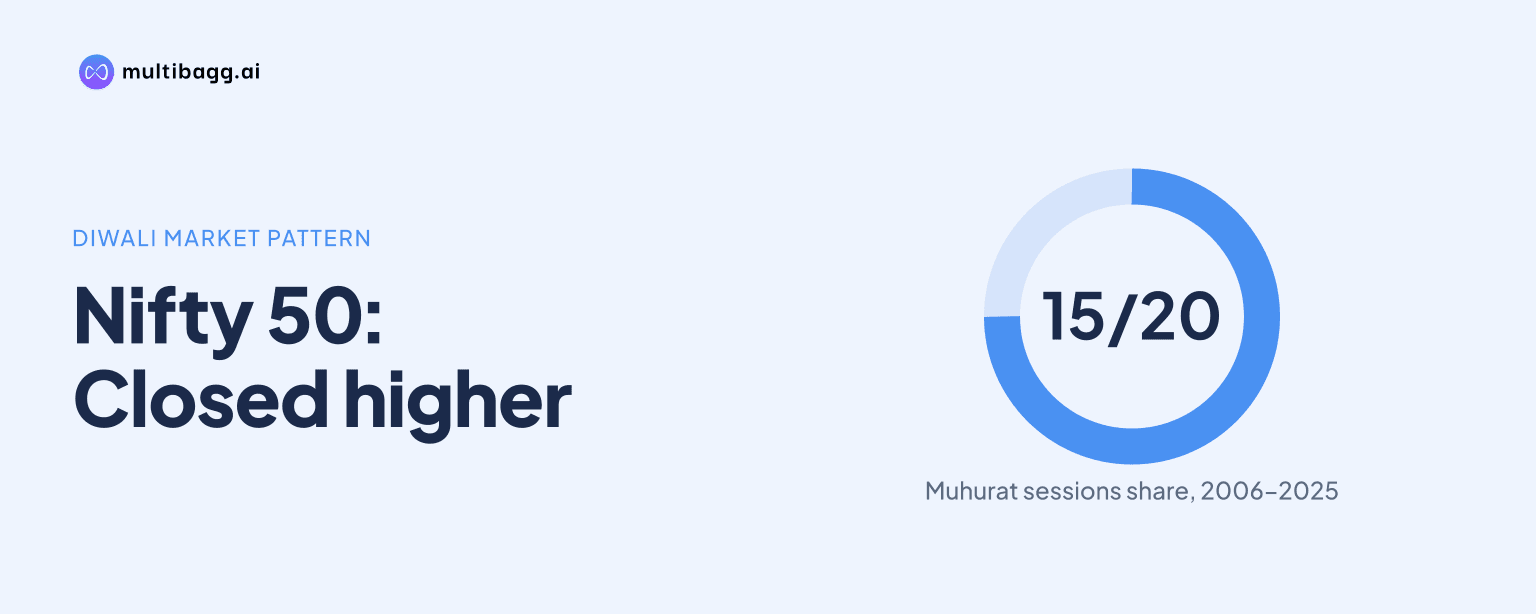
Nifty 50 closed higher in 15 of the 20 Diwali Muhurat trading sessions held between 2006 and 2025, showing a favourable historical bias but not a dependable annual outcome. Its returns ranged from a 6.35% jump in 2008 to a 0.63% decline in 2017, underlining the variation behind the record.
How often has Nifty 50 risen during Muhurat trading?
Nifty 50 ended in the green in 15 of 20 Muhurat sessions between 2006 and 2025. The record places the index's success rate at 75% across this period, while the Sensex rose in 16 of those 20 sessions. Another NSE Market Pulse analysis covering 2005 to 2024 similarly found that Nifty 50 had closed lower in only five of 20 Muhurat sessions.
The pattern has received attention because Muhurat trading is a short, symbolic Diwali session rather than a normal full market day. A positive close has been common, but the historical figures do not establish that the session will rise every year or that purchases made around Diwali will produce gains. Market participants have also cautioned against treating festive sentiment as a reliable seasonal trading signal.
Which Muhurat sessions produced the biggest Nifty 50 moves?
Nifty 50 recorded its biggest gain in the cited 20-year period on October 28, 2008, when it rose 6.35% during the Muhurat session. The largest movement shows why the average impression from a green-close count needs context: individual annual outcomes have differed sharply.
At the other end, Nifty 50 fell 0.63% on October 19, 2017, one of the weaker Muhurat sessions. The index also recorded losses in 2007, 2012 and 2016, while its 2009 result was marginally lower by 0.01%. These instances demonstrate that the historical strike rate has included meaningful exceptions.
What has Nifty 50 done in recent Muhurat sessions?
Nifty 50 closed higher in every Muhurat session from 2018 through 2025, according to the historical data cited. That eight-session run followed declines in 2016 and 2017 and has contributed to the current focus on the Diwali trading pattern.
The gains in this recent stretch were generally modest. Nifty 50 rose 0.70% in 2018, 0.37% in 2019, 0.47% in 2020 and 0.50% in 2021. It rose 0.87% in 2022, followed by gains of 0.50% in 2023, 0.40% in 2024 and 0.10% in 2025. The figures indicate consistency in closing direction, not consistency in the size of returns.
Got a follow-up? Ask IRIS
Does a positive Muhurat session predict Nifty 50 annual returns?
A positive Muhurat session does not predict Nifty 50's return over the following Diwali-to-Diwali period. The context notes that short-session gains can differ substantially from annual performance, making it important to separate the one-hour trading result from the longer market cycle.
In Diwali-to-Diwali comparisons, Nifty 50 delivered its strongest yearly return of 39% in 2020, followed by 23% in 2023 and 18% in 2016. The weakest annual gain mentioned was 1% in 2021. This range reinforces that the Muhurat session's historical tendency is only one data point and does not determine returns across a full Samvat year.
Is the post-Muhurat market trend also positive?
The post-Muhurat week has also been positive more often than not, although it has not been uniformly so. The Sensex rose in the week after Muhurat in 19 of 29 years through 2025, or almost two-thirds of the observations, and the average gain across 30 years through 2026 was 1.53%, including a 0.73% rise in the latest year.
Broader market conditions can outweigh a seasonal pattern. In November, Nifty 50 surged 9.7% from its October 30 close to reach 25,299 on November 12, reversing a phase of persistent foreign selling. Separately, the index reclaimed 25,000 on November 6, closing at 25,030.35 after a 2.01% advance. Those moves reflect the market environment at the time rather than a conclusion that Diwali alone drove prices.
Conclusion
Nifty 50's 15 gains in 20 Muhurat sessions through 2025 provide a clear historical positive bias, strengthened by eight consecutive positive sessions from 2018 to 2025. Yet the spread between the 6.35% rise in 2008 and the 0.63% fall in 2017 shows why the record should be viewed as context rather than a return forecast.
Investors can watch whether the recent run of positive closes continues in the next Muhurat session and whether broader market conditions remain supportive afterward. The unresolved issue is not the historical frequency of gains, but whether prevailing buying, foreign flows and company-specific developments support the market beyond the brief Diwali trading window.