










Indian Households Face Weaker Savings as Debt and Housing Rise
Key highlights
- Indian households are estimated to hold ₹950 lakh crore in gold and residential property combined.
- The overall household savings rate fell to 18.1% of GDP in 2024-25 from 23.3% in 2019-20.
- Preliminary gross household financial savings declined to 10.8% of GDP in 2024-25 from 15.4% in 2020-21.
- Household debt reached 45.5% of GDP by late 2025, while India's price-to-income ratio was around 7.5 times in 2026.
powered by IRIS
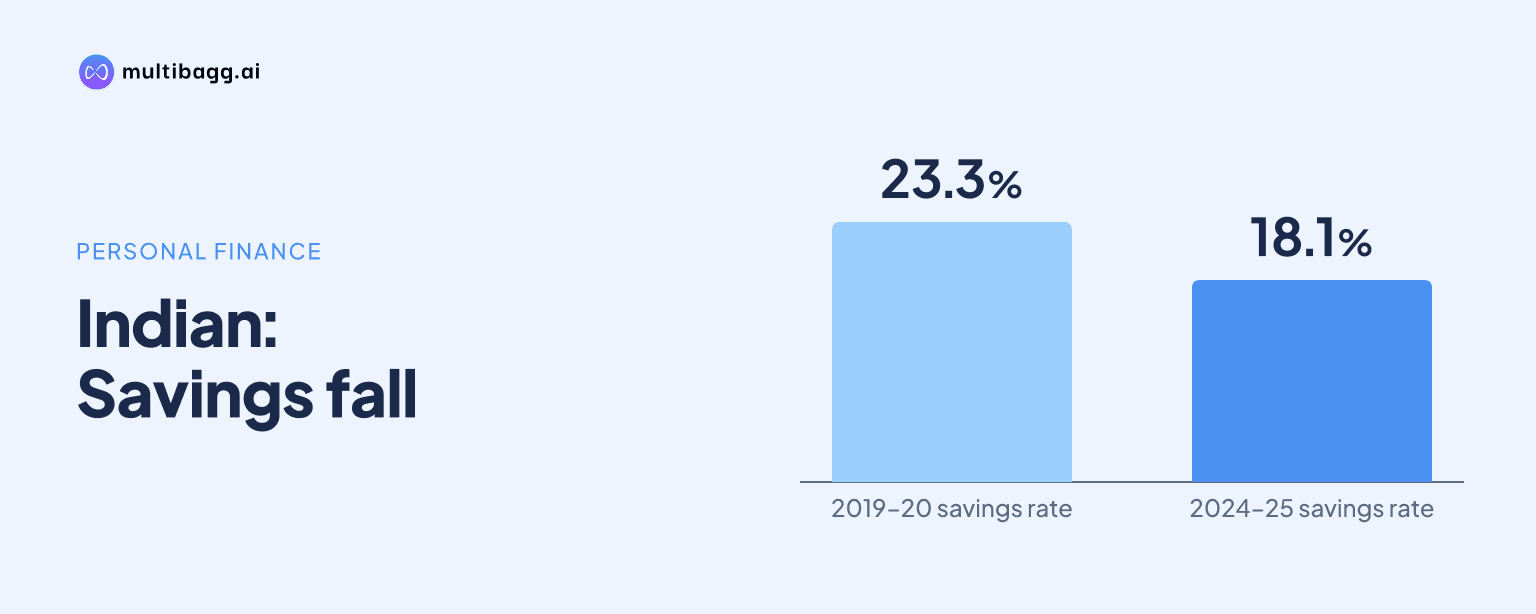
Indian households' overall savings rate fell to 18.1% of GDP in 2024-25, while their estimated ₹950 lakh crore held in gold and residential property highlights how debt, housing costs and essential expenses are reshaping household finances.
Why are Indian households' savings declining?
Indian households' savings are declining because a greater share of income is going towards loan repayments and recurring essentials. The Ministry of Finance's Rajya Sabha response, using MoSPI and RBI data, placed preliminary gross household financial savings at 10.8% of GDP in 2024-25, down from 15.4% in 2020-21. The overall household savings rate was 18.1% of GDP in 2024-25, compared with 23.3% in 2019-20.
The pressure is not limited to headline inflation. Social-media discussions point to rent, education and healthcare as costs that can rise faster than incomes experienced by many middle-income families. Traditional savings products offering returns of around 7% may not preserve purchasing power for households facing estimated real inflation of 10% to 12% in their own expenditure baskets. This can narrow the room for emergency reserves, retirement savings and long-term investing.
Why do Indian households still prefer gold and property?
Indian households still prefer gold and property because these assets remain major stores of household wealth, even as financial products gain some share. Estimates in the discussion place household holdings at roughly ₹450 lakh crore in gold and ₹500 lakh crore in housing. Together, this ₹950 lakh crore concentration shows the enduring importance of physical assets in family balance sheets.
Yet the pattern is not static. The share of physical assets in household savings is estimated to have declined from about 55% in 2012 to around 38% to 40% currently, suggesting a gradual move towards financial products. Digitisation, access to mutual funds, insurance, equities and pensions, and broader banking access have supported this transition. However, account access does not necessarily mean sustained use, and physical assets continue to dominate household wealth.
Gold demand may also face constraints from a lower household savings rate, weak agricultural wages and increasing access to alternative savings products. The World Gold Council was cited as identifying these as headwinds, alongside limited policy support. Gold therefore remains both a savings asset and, increasingly, collateral when cash flows are strained.
Got a follow-up? Ask IRIS
How are debt and gold loans affecting Indian households?
Debt is affecting Indian households by reducing net financial savings and increasing dependence on credit for expenses that may not create assets. RBI figures cited in the discussion put household debt at 45.5% of GDP by late 2025, above a five-year moving average of 42.9%. Non-housing retail credit accounted for 58.4% of non-productive credit flows, according to the material shared.
Gold loans have become a closely watched sign of this shift. One set of figures cited gold loans expanding at a 42.4% compound annual rate since March 2024, almost twice the pace of overall non-housing retail credit. The discussion also notes that much of the growth came from existing borrowers using higher gold prices to raise larger loans or roll over earlier debt, rather than from new borrowers funding fresh activity.
This matters because credit can meet a temporary gap between income and expenditure but cannot replace durable income growth. When borrowing is repeatedly used for ordinary consumption or to refinance past obligations, a household's financial buffer can weaken even if it owns gold or property. Wider access to lenders can improve inclusion, but it can also create vulnerability if incomes and social protection do not keep pace with repayment burdens.
Why is housing affordability changing household financial planning?
Housing affordability is changing household financial planning by requiring larger down payments, bigger loans and longer repayment commitments. India's price-to-income ratio was cited as rising from around 6.6 times in 2020 to around 7.5 times in 2026. Ratios of 7 to 10 in major cities are above the cited global affordability benchmark of below 5.
The result is a greater reliance on dual incomes, family wealth and expected future earnings. Some households may delay buying a home or accept longer commutes instead. Rental pressure adds to the constraint: residential rents in major cities reportedly rose 7% to 9% in 2025, after annual increases of 12% to 24% in earlier years.
The mortgage mix also signals a more divided housing market. Loans below ₹25 lakh, which accounted for 60.6% of outstanding mortgages in 2014, have diminished in significance, while mortgages above ₹50 lakh account for 44.7%. At the same time, the discussion cites an urban housing shortage of roughly 10 million units that could reach 30 million by 2030, with new supply increasingly tilted towards premium homes.
Conclusion
The combined picture is of Indian households holding substantial wealth in gold and residential property while saving a smaller portion of current income and taking on more debt. Financial inclusion and wider access to investment products can diversify savings, but the benefit is limited when essential costs, weak real wage growth and recurring loan repayments absorb household cash flows.
The next markers to watch are the national price-to-income ratio and affordability data for Gurugram and Mumbai, along with trends in household financial savings, debt and gold-loan growth. Faster real wage growth, more secure employment and lower out-of-pocket health and education costs are the factors identified in the discussion as necessary to reduce reliance on borrowing.