










Goldman Sachs Sees Nifty at 28,500 by December 2027
Key highlights
- GS set a Nifty 50 target of 28,500 for December 2027.
- The target implies about 12% upside from 25,413 on November 18.
- GS forecasts 15% Nifty earnings growth in both 2027 and 2028.
- GS expects 75 basis points of further rate tightening to a 6.25% repo rate by the second quarter of 2027.
powered by IRIS
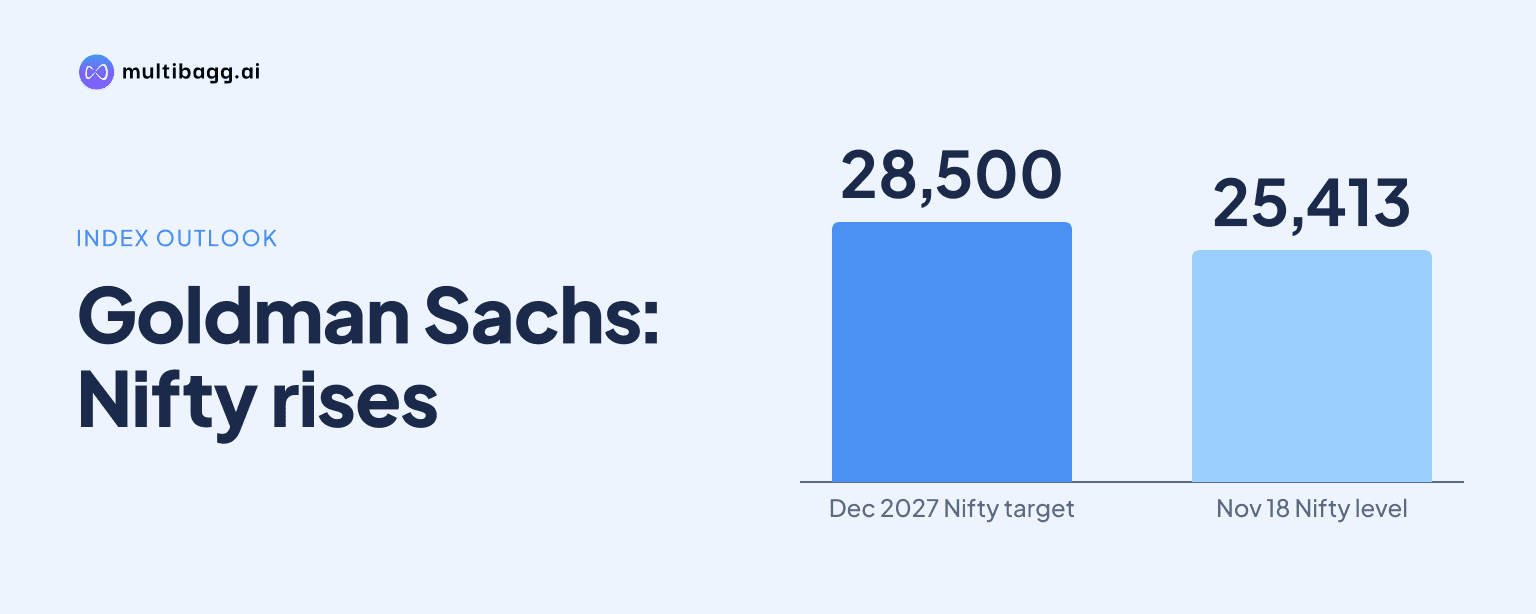
Goldman Sachs expects the Nifty 50 to reach 28,500 by December 2027, a target supported by projected 15% earnings growth, resilient domestic demand and low foreign investor positioning. The upgrade to overweight reflects its view that Indian equities can diversify portfolios as AI-related investment remains concentrated in other Asian markets.
Why did GS upgrade Indian equities to overweight?
GS upgraded Indian equities from Marketweight to Overweight because it expects a recovery in earnings growth, continued domestic demand and a potential return of foreign investor interest. The brokerage said India has underperformed for two years, but that period may be approaching an inflection point as risks appear more balanced than at the 2024 peak.
A central part of the case is foreign ownership, which GS described as the lowest in more than a decade. Light foreign positioning could matter if India’s growth appeal regains attention. GS also said that Indian companies have exceeded consensus estimates for five consecutive quarters, pointing to improving corporate earnings momentum.
The brokerage views India as an alternative to the AI-led trade that has been concentrated in North Asian markets. It cited possible slowing growth in technology hardware-heavy South Korea and Taiwan, alongside an expected peak in AI-related capital expenditure, as factors that could increase India’s diversification appeal.
What does the 28,500 Nifty target imply?
GS’s Nifty 50 target of 28,500 for end-December 2027 implies approximately 12% upside from 25,413 on November 18. A separate reference point of 25,227.95 at Wednesday’s close put the implied upside at about 13%, showing that the percentage changes with the starting index level.
The target is based on the brokerage’s expectation of 15% Nifty earnings per share growth in both calendar 2027 and calendar 2028. GS described this as the strongest earnings trajectory in the region outside South Korea and Taiwan. The target is therefore tied primarily to an anticipated earnings recovery rather than a stated assumption of a broad valuation expansion.
Which sectors does GS favour in India?
GS favours banks, industrials, defence, utilities, telecom and internet stocks within its India strategy. Its preference is for domestic cyclicals, which could benefit if domestic demand remains resilient and private capital expenditure strengthens.
Industrials were upgraded to overweight, with GS citing early signs of a private capital expenditure recovery. The brokerage also pointed to exposure to infrastructure, power, defence and data centres as relevant supports for the sector. These themes are aligned with the bank’s broader expectation that domestic activity will remain an important driver of Indian corporate performance.
Banks are among the preferred areas, alongside utilities and telecom. Energy is rated neutral. The recommendations reflect a tilt toward sectors linked to domestic demand and investment rather than a broad positive call on every segment of the market.
Got a follow-up? Ask IRIS
Which sectors is GS cautious about?
GS is underweight on IT, healthcare, metals, cement and chemicals, while remaining neutral on energy. The caution indicates that its overweight India view is selective and does not amount to a uniform positive assessment of all listed sectors.
The distinction is particularly important because the upgrade is partly framed as a diversification opportunity away from the AI-driven investment cycle. Companies more exposed to global demand or commodity conditions may not benefit in the same way as domestic cyclicals, based on the brokerage’s sector positioning.
GS’s preference for banks and industrials, combined with its underweight stance on IT and commodity-linked groups, suggests that the expected earnings recovery is intended to be led by specific parts of the market. Investors assessing the call would therefore need to separate the index target from the brokerage’s sector-level views.
What could affect GS’s India outlook?
GS’s outlook depends on earnings delivering the expected 15% growth and domestic demand staying resilient. Its economists expect growth to moderate to 7.2% in 2027, while still describing the expansion as supported by a nascent private capital expenditure cycle.
Inflation and interest rates are also part of the stated backdrop. GS forecasts headline inflation of 5.7% year-on-year in 2027, citing El Niño-related weather disruptions and elevated input costs. It expects a further 75 basis points of Reserve Bank of India tightening, taking the repo rate to 6.25% by the second quarter of 2027.
The brokerage also forecasts USD/INR at 94, 95 and 96 over the three-, six- and 12-month horizons. It noted that successive years of depreciation have left the rupee modestly undervalued on a trade-weighted basis. These forecasts underline that the equity target sits alongside assumptions about growth, inflation, rates and currency conditions.
Conclusion
GS’s 28,500 Nifty 50 target by December 2027 rests on a defined combination of 15% earnings growth, durable domestic demand and historically low foreign ownership. Its India upgrade also reflects a relative market view, with the brokerage seeing scope for capital to diversify beyond AI-focused investment themes in other Asian markets.
The next factors to watch are evidence of a private capital expenditure recovery, the pace of corporate earnings delivery and whether foreign positioning changes. Investors will also track the projected 7.2% growth rate, the 5.7% inflation forecast and the expected path to a 6.25% repo rate by the second quarter of 2027.