










India’s demonetisation: cash ratio returns near 2016 level
Key highlights
- India’s cash-to-GDP ratio was 12.1% by March 2026, close to 12.08% in 2015-16.
- Approximately 99.3% of Rs 15.42 lakh crore in demonetised currency returned to banks.
- Research estimated employment and output were about 2 percentage points lower in October-December 2016.
- Direct tax collections rose from 5.53% of GDP in FY17 to 5.86% before falling to 4.78% by FY21.
powered by IRIS
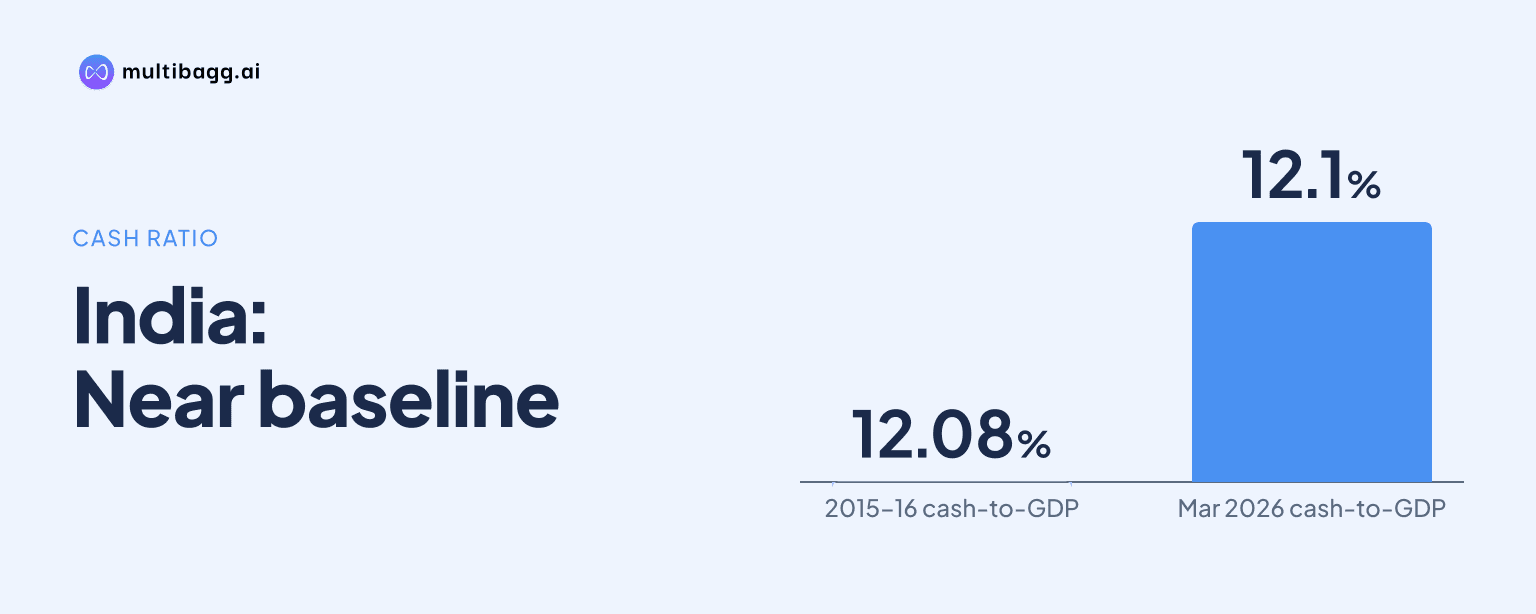
India’s demonetisation left the cash-to-GDP ratio at 12.1% by March 2026, essentially back at its pre-demonetisation level, despite a substantial expansion in digital payments and a documented short-term hit of about 2 percentage points to employment and output in the final quarter of 2016.
What was demonetisation’s immediate economic impact?
Demonetisation caused substantial but largely temporary disruption, with the burden falling unevenly on cash-dependent households and businesses. Research using district-level variation in cash shortages estimated that employment and night-lights-based output were about 2 percentage points lower in October-December 2016 than they otherwise would have been. Bank credit was also estimated to be 2 percentage points lower in that quarter.
The disruption was especially significant for daily-wage workers, small traders, agricultural households and informal enterprises, which had limited reserves to manage a sudden liquidity shortage. An International Monetary Fund assessment in 2018 said the impact on growth was more severe and longer-lasting than initially anticipated, estimating growth slowed by about 180 basis points between the announcement and May 2017. Aggregate recovery later does not remove the losses experienced by vulnerable households and firms during the shortage.
A weekly survey of poor households in the Sundarbans estimated a welfare loss of about 15.6% of income over two months, with larger losses for female-headed households. Later pressures from GST and the pandemic compounded the challenges faced by parts of the informal economy, making the distinct long-term effect of demonetisation difficult to isolate.
Did demonetisation make India less dependent on cash?
No, demonetisation did not produce a lasting reduction in India’s reliance on cash when measured by cash relative to GDP. The cash-to-GDP ratio fell sharply to 8.7% in 2016-17, then rose to 14.4% during the COVID-19 pandemic. It stood at 12.1% by March 2026, broadly in line with the 12.08% recorded in 2015-16.
The amount of currency held by the public is now more than double its level a decade earlier, even as UPI and other digital transaction channels have grown rapidly. This points to a financial system in which digital payments and cash use have expanded together rather than one simply displacing the other.
The return of approximately 99.3% of the Rs 15.42 lakh crore in withdrawn currency to the banking system also limits the case that the measure permanently removed a large stock of unaccounted cash. Deposits created scope for scrutiny through PAN-linked records, but return of notes is not by itself evidence that black wealth was eliminated.
Got a follow-up? Ask IRIS
Did demonetisation improve tax compliance and digital payments?
Demonetisation appears to have contributed to more tax filings and a lasting change in payment behaviour, although its separate contribution cannot be measured cleanly. Cash deposits made during the exchange process could be traced to PAN records, and the number of people filing tax returns increased in the following years.
The direct-tax-to-GDP data, however, show a mixed outcome rather than a sustained step-up. Direct tax collections rose from 5.53% of GDP in FY17 to 5.86% in the following year, before falling to 4.78% by FY21. These movements do not establish a durable improvement in collections attributable solely to demonetisation.
Digital payments have expanded substantially, and this is the clearest enduring change associated with the period. Yet attribution remains complicated by other developments in India’s payments system and wider policy changes. The available evidence supports a shift in how people pay, while also showing that cash remains an important medium of exchange.
Did demonetisation meet its stated objectives?
The evidence suggests limited success against several stated objectives rather than an unqualified success or outright failure. Almost all demonetised notes returned to banks, leaving no clear evidence that the exercise eliminated black wealth. It created opportunities for tax scrutiny, but a one-time currency withdrawal did not resolve broader sources of unaccounted wealth.
Counterfeit notes of the new Rs 500 denomination have continued to be detected, according to recent Reserve Bank of India data cited in the discussion. This underlines the limitation of currency invalidation as a standalone response to counterfeit currency. Better security features are presented as a more plausible explanation for any aggregate reduction in counterfeiting, though that benefit may weaken over time.
The longer-term employment picture also highlights unresolved concerns around informal enterprises. Employment in unincorporated enterprises declined from 11.13 crore in 2015-16 to 10.96 crore in 2022-23, while unincorporated manufacturing lost about 54 lakh jobs. These figures cover a period affected by multiple developments, so they cannot be assigned wholly to demonetisation.
Conclusion
Ten years on, demonetisation’s economic record is mixed: it brought acute short-term disruption, particularly for the informal sector, and was followed by more tax filings and changed payment habits. But cash use has returned to roughly its earlier share of GDP, nearly all withdrawn notes returned to banks, and the evidence does not show that the measure met all of its stated objectives.
The key issue to watch is whether digital payments continue to grow alongside, rather than replace, cash use. Policymakers and investors will also need clearer evidence on whether data-driven tax administration can convert increased filing visibility into durable revenue gains without imposing disproportionate costs on cash-dependent households and smaller businesses.