










Indian Stock Market: Nifty Up 10.1% Despite Global Weakness
Key highlights
- The Nifty 50 gained about 10.1% this month, while the Sensex rose about 10.8% in the reported update.
- Foreign portfolio investor inflows surged to a reported record $9.53 billion this month.
- The Sensex closed at 82,532.19 and the Nifty 50 at 25,387.40 after a second consecutive session of gains.
- Brent crude declined to around $91.56 per barrel from $95.4 in one reported period.
powered by IRIS
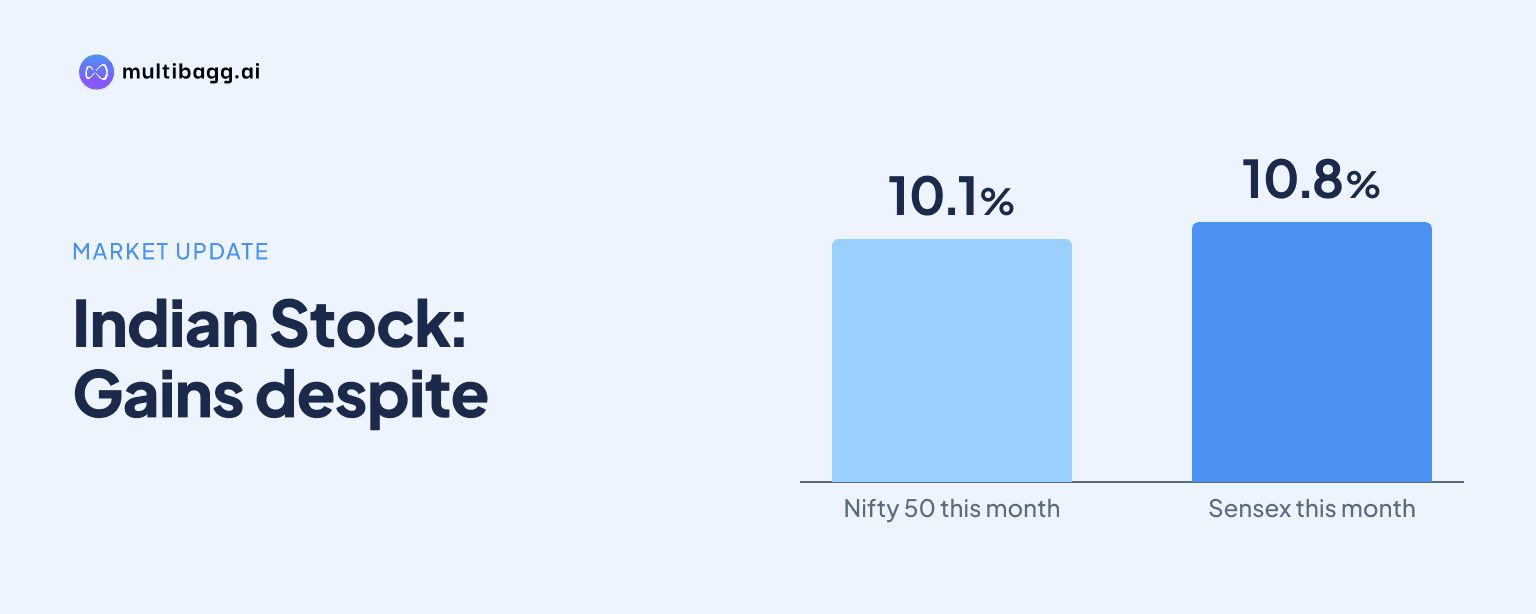
The Indian stock market's Nifty 50 gained about 10.1% this month by Tuesday despite weak Asian peers and a technology-led global selloff, while the Sensex rose about 10.8%, supported by record $9.53 billion foreign portfolio investor inflows, softer crude prices and buying in banks and other large-cap shares.
Why has the Indian market risen despite global weakness?
The Indian market has advanced because foreign inflows, falling crude prices and resilient corporate earnings have outweighed the impact of weaker global technology shares. Investors also shifted some money towards Indian equities as global technology stocks came under pressure over AI-related concerns and restrictions on China's access to advanced chips.
The contrast has been notable. The Nasdaq 100 had declined 2.67% in the previous session in one reported update, while the Nasdaq Composite fell 5.52% on another session and South Korea's KOSPI dropped more than 8% in early trade. Yet domestic benchmarks continued to find support from financial stocks, especially private lenders, as overseas investors favoured large-cap shares.
The rally has not moved in a straight line. A reported 13% Nifty rise over 12 sessions was followed by profit booking, while concerns around inflation, crude oil and a weaker rupee also caused periodic consolidation. These moves show that strong inflows have supported sentiment, but they have not removed market risks.
Which figures show the Indian market's recent strength?
The Indian market's recent gains are visible in benchmark closes, a seven-session winning streak and the scale of reported foreign buying. The Nifty and Sensex reached more than eight-month highs in one reported week, before later sessions pushed the benchmarks higher again.
The 82,532.19 Sensex close and 25,387.40 Nifty close came after a second consecutive session of gains despite weak global markets. In that update, foreign investors had invested around Rs. 84,290 crore in Indian equities during the first half of November after two months of selling, helping support domestic sentiment.
What does GIFT Nifty signal for the Indian market?
GIFT Nifty offers an early indication of possible opening sentiment, but the reported signals have been mixed and have not always predicted the final direction of the Indian market. It traded with modest gains on one Monday morning after mild profit booking during the special Diwali Muhurat Trading session, pointing to a potentially positive start.
Other pre-market readings were negative. GIFT Nifty was down 64 points, or 0.28%, at 22,669 in one update, and down 71 points, or 0.28%, at 25,151 in another. It also stood at 25,253 against a previous Nifty close of 25,387.40 in a separate report, indicating a weaker opening outlook after the benchmark's sharp recent rise.
These contrasting signals matter because they underline the difference between opening indications and all-day market performance. On several occasions, the Indian market advanced despite a softer GIFT Nifty indication and weak overseas cues, as domestic buying and financial stocks altered the direction after trading began.
Got a follow-up? Ask IRIS
What factors are supporting the Indian market rally?
Foreign portfolio investor buying and softer oil prices have been the main supports for the Indian market rally. Reported foreign portfolio inflows reached a record $9.53 billion this month, while overseas investors put a net $1.9 billion into local shares through Wednesday of one reported week, followed by provisional net inflows of $1.6 billion on Thursday.
Crude prices also improved India's relative macro appeal. Brent crude declined to around $91.56 per barrel from $95.4 in one reported period, easing a key concern for domestic equities. Moderate crude prices, sustained domestic investor inflows and improving earnings expectations helped investors look past global risk aversion.
Banking stocks have been central to the advance. Private banks reached record levels in one update, while banks and financial shares led several market sessions and helped push the banking index to a fresh high. Realty and financial stocks also led a 427-point Sensex gain, showing that the rally extended beyond a narrow group of shares.
What could test the Indian market's gains next?
The Indian market's ability to hold its gains may be tested by profit booking, inflation concerns, crude-price movements and continued global technology volatility. The Nifty had closed lower at 25,144 in one session as investors reacted to higher inflation concerns and crude prices after three days of gains.
Broader-market caution is another consideration. One reported recovery was supported by IT shares and positive earnings, but continued selling pressure in mid-cap and small-cap stocks remained visible. The rupee's decline against the dollar, linked to weak domestic equities and a stronger greenback in another update, is also a factor investors will monitor.
Conclusion
The Indian market has shown relative strength against global weakness because record foreign inflows, lower crude prices, resilient earnings and leadership from banks have supported benchmark indices. The Nifty's about 10.1% monthly advance and the Sensex's about 10.8% rise demonstrate the scale of the move, but periodic selloffs show that sentiment remains sensitive to macro risks.
Investors will next watch whether foreign buying remains sustained, whether crude stays moderate and whether the recent gains can survive profit booking. GIFT Nifty will continue to provide an early opening cue, while inflation developments, the rupee and global technology-market volatility remain unresolved factors for the domestic market.