










NSE Nifty 50 Climbs to 25,800.60 Despite Global AI Sell-Off
Key highlights
- Nifty 50 closed at a nine-month high of 25,800.60 after gaining 286.30 points on Friday.
- Nifty 50 rose 656.30 points, or 2.61%, from 25,144.30 during the week.
- Foreign investors reportedly put a record $12.21 billion into Indian equities during the month.
- The MSCI Asia-Pacific index fell 3.3% on Friday and was heading for an 8.5% weekly loss.
powered by IRIS
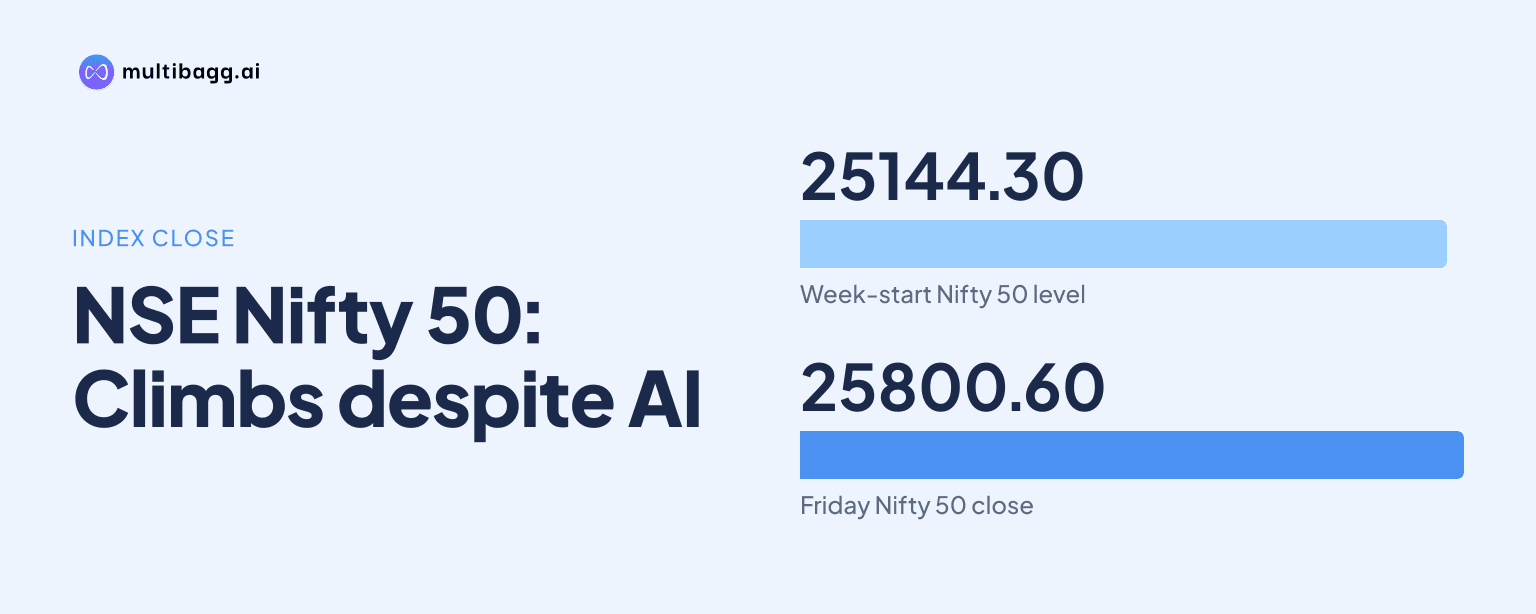
NSE Nifty 50 climbed to a nine-month high of 25,800.60 on Friday, gaining 286.30 points as record foreign equity inflows, lower crude prices and strong financial stocks outweighed a global sell-off in AI-linked shares and weakness across Asian markets.
Why did Nifty 50 rise despite weak global markets?
Nifty 50 rose because domestic support from foreign buying, softer oil prices, improving earnings and financial-sector strength proved stronger than the negative global mood. The index closed firmly higher even as investors elsewhere were responding to a deepening correction in AI-linked shares and a sharp fall across parts of Asia.
The move was notable because the session did not begin with broad confidence. Social-media discussion pointed to an initially weak opening and losses before the market recovered, with futures and contracts seen as possible contributors to the turnaround. By the close, Nifty 50 had moved more than 430 points, or nearly 1.7%, from its opening level and finished near the day's high.
The wider backdrop was difficult. The MSCI Asia-Pacific index fell 3.3% on Friday and was heading for an 8.5% weekly decline, its worst week since 2020, according to the material provided. Weakness was concentrated in AI, semiconductor and data-centre shares, where concerns about spending, safety and valuations had unsettled investors.
What were the key numbers behind the Nifty 50 rally?
The market's strength was reflected in a fourth consecutive weekly advance and nine-month highs for both major benchmarks. Nifty 50 rose 656.30 points, or 2.61%, from 25,144.30 during the week, while the Sensex ended Friday at 83,919.71 after gaining 897.96 points.
Foreign portfolio flows were the central factor cited across the discussion. One report put monthly foreign inflows into Indian equities at a record $12.21 billion, while another described more than ₹1 lakh crore entering equities during November so far. Earlier reports in the same discussion cited $9.53 billion and roughly $10 billion, indicating that the figures refer to different points during the month rather than a single final tally.
How did oil, the rupee and financial stocks support Nifty 50?
Lower crude prices, a stronger rupee and gains in banking and financial shares improved the domestic setup for Nifty 50. India is dependent on oil imports, so falling crude prices were viewed as supportive for domestic equities and the currency.
Brent crude was reported around $92 to $93 a barrel, with expectations of a supply surplus linked to recovering Middle East exports. Another report said Brent had fallen 22% during the month, while WTI was down 18%. The rupee strengthened to an intraday 92.82 per dollar before settling at 93.32 on Friday, and was also reported to have appreciated 32 paise to 93.92 on Monday in a separate session.
Banking shares added to the market's resilience. Bank Nifty closed one session at 61,575.90, up 0.89% and close to its reported all-time high of 61,712.80. Commentary also pointed to improving corporate earnings, especially among large-cap companies, as a reason investors viewed Indian valuations more favourably.
Got a follow-up? Ask IRIS
Did US ADR gains cause the Indian market rally?
The available discussion does not establish that gains in US-listed Indian ADRs caused the Nifty 50 rally. It notes that some key US companies performed well despite broader weakness, but it provides no ADR prices, company-level ADR data or evidence linking ADR trading directly to the Indian benchmark's move.
What the material does support is a broader rotation away from the crowded AI trade and towards Indian equities. Commentary described India as benefiting when US technology stocks sell off, with overseas investors seeking value outside AI-linked shares. This remains an interpretation of the market flow rather than proof of a lasting separation between Indian and global markets.
The distinction matters for retail investors. A single session of relative outperformance does not mean Indian stocks are insulated from Wall Street, higher US Treasury yields or changes in global risk appetite. The discussion itself says that not all indices move together, while also warning that the trend can reverse quickly if foreign flows weaken.
What could challenge the Nifty 50 rally from here?
Nifty 50's rally could be challenged if foreign inflows slow, crude prices rise again or global risk appetite deteriorates further. The market's advance has depended heavily on the combination of overseas buying, lower oil, a firmer rupee and a resilient earnings outlook.
Elevated US Treasury yields were identified as a continuing restraint on riskier assets, making investors more selective. Uncertainty around interest rates and the possibility that global technology weakness broadens beyond AI-related stocks could also affect sentiment. While domestic equities have recently outperformed Asian peers, the reported outlook remains conditional rather than assured.
Conclusion
Nifty 50's rise to 25,800.60 showed that foreign buying, lower crude prices, currency support and financial-stock strength were enough to offset a severe global retreat from AI-linked shares. The four-week advance and nine-month high underline India's recent relative strength, but the rally has been closely tied to capital flows and favourable external conditions.
Investors will watch whether foreign portfolio inflows remain strong, whether oil stays near the reported $92 to $93 a barrel range, and whether corporate earnings continue to improve. The unresolved issue is whether the global AI-led sell-off remains confined to technology shares or develops into a wider risk-off move that eventually affects Indian equities.