










Foreign Institutional Investors Set Record ₹1 Lakh Crore Inflows
Key highlights
- FIIs invested more than ₹1 lakh crore in Indian equities during November 2026, according to provisional reports.
- The Sensex and Nifty gained around 10% in November as foreign buying returned.
- FIIs had withdrawn about ₹6.32 lakh crore from Indian equities between July 2025 and October 2026.
- Financial services led FII buying, followed by telecom, auto and consumer services.
powered by IRIS
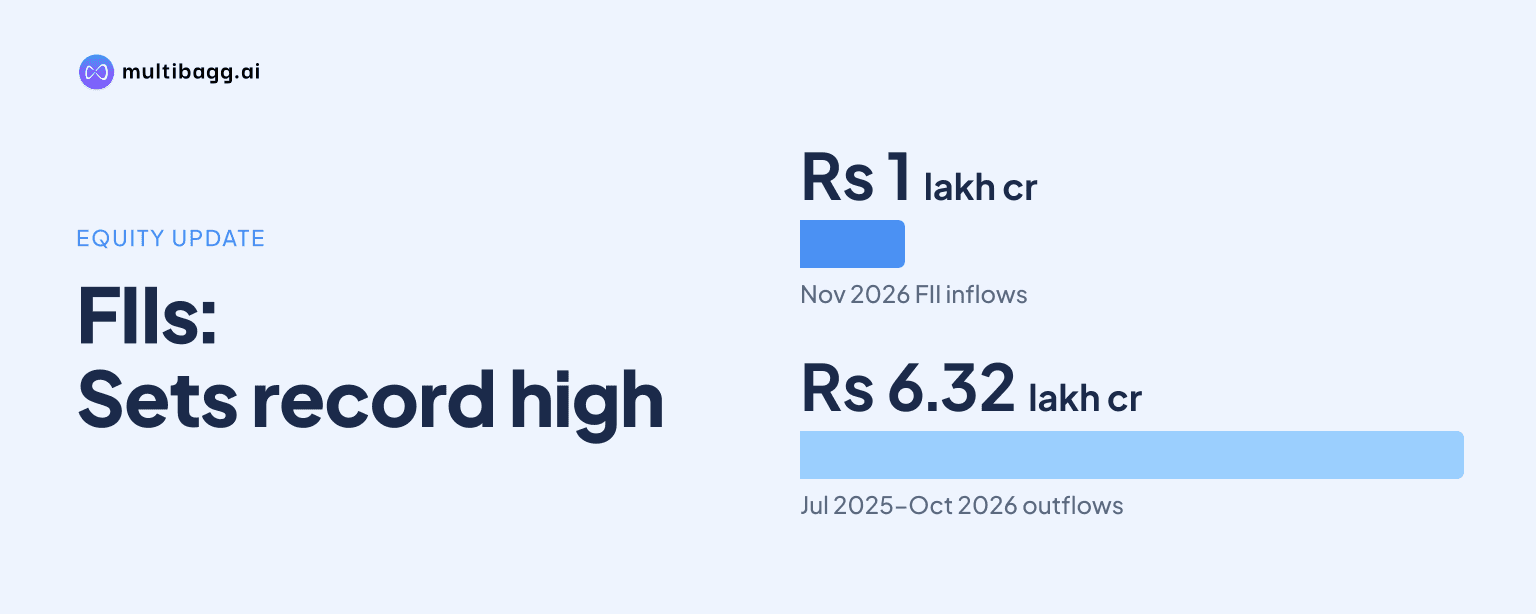
Foreign institutional investors (FIIs) invested more than ₹1 lakh crore in Indian equities in November 2026, ending a 16-month selling streak and helping the Sensex and Nifty rise by around 10% during the month. Provisional reports cited inflows ranging from ₹1.01 lakh crore to ₹1.22 lakh crore as the month progressed.
Why did FIIs return to Indian equities in November 2026?
FIIs returned as corporate earnings improved, crude oil prices eased and large-cap valuations became more appealing after prolonged foreign selling. Reports also point to easing geopolitical tensions and better global sentiment as factors supporting the change in foreign investor positioning.
A shift in global investment preferences linked to the artificial intelligence trade has also coincided with the move. South Korea and Taiwan recorded nearly $45 billion of foreign investor outflows in October 2026, according to the cited reports, with some capital appearing to move towards India. The reports do not establish that all of these outflows were redirected to Indian equities, but they identify the regional shift as part of the backdrop.
How large are November FII inflows into Indian equities?
FIIs recorded their strongest monthly inflow on record, with provisional November estimates exceeding ₹1 lakh crore. The variation in reported totals reflects different reporting dates during the month, rather than a disagreement over the broad direction of flows.
The scale of the reversal is notable because FIIs had been sellers for 16 months. They were also reported to have bought for 14 consecutive trading sessions, their longest buying run since April-May 2023. Even after the November surge, however, foreign investors remained net sellers for 2026 on a cumulative basis in the reports cited.
Which sectors received the most FII buying?
Financial services received the largest share of FII buying, followed by telecommunications, automobile and auto components, and consumer services. The concentration in financials indicates that the rebound was broad-based but not evenly distributed across the market.
The sectoral pattern matters because foreign flows can influence index performance when they are directed towards large, heavily weighted companies. The context does not provide individual company-level purchase data or sector-wise investment values. It does show that the buying coincided with stronger benchmark indices and a recovery in market confidence after earlier foreign outflows.
Got a follow-up? Ask IRIS
How did the FII comeback affect the Sensex and Nifty?
The FII buying coincided with gains of around 10% in the Sensex and Nifty during November, while the Sensex reclaimed levels seen before the Middle East war. On November 20, the Sensex closed at 83,919.71 after rising 897.96 points in one session, according to the supplied context.
Past episodes cited in reports show that FII reversals have sometimes been followed by further Nifty gains, including 23% over three months after May 2020 and 14% over two months after November 2023. These are historical comparisons, not forecasts. Market outcomes after the current inflows will depend on earnings, valuation, global rates and risk conditions rather than foreign buying alone.
Can FII inflows into Indian equities continue?
Sustained FII inflows will depend on stable crude prices, global interest rates, macroeconomic conditions and a continued recovery in corporate earnings. Analysts cited in the discussion cautioned that it is too early to treat the November buying as proof of a lasting change in foreign portfolio flows.
Inflation, geopolitical risks and a rise in US bond yields could slow or reverse the return of foreign capital. The global AI investment cycle is another unresolved variable, with market participants watching whether changes in AI-related allocations continue to support India. Domestic institutional investors had offset earlier foreign selling, with reported January-November net investments of ₹6.45 lakh crore versus FPI net outflows of ₹3.47 lakh crore.
Conclusion
November's record FII buying marks a major shift from the heavy selling that preceded it. Improving earnings, lower crude prices, more attractive valuations and changes in global investment preferences have supported the turnaround, while financial services led the identified sector beneficiaries.
The key test is whether foreign buying persists beyond November. Investors will watch upcoming corporate earnings, crude oil prices, global interest-rate conditions, geopolitical developments and the direction of AI-related international capital flows before treating this as a durable reversal.