










Indian rupee closes at ₹92.67 after gaining 65 paise
Key highlights
- The rupee closed provisionally at ₹92.67 per US dollar on November 20, 2026.
- The rupee gained 65 paise on November 20, its fifth consecutive daily advance.
- USD/INR moved from ₹94.24 on November 13 to about ₹92.68 on November 20 and 21, a gain of more than 1.6% over five sessions.
- Foreign investment inflows were cited at ₹84,290 crore between November 2 and 13.
powered by IRIS
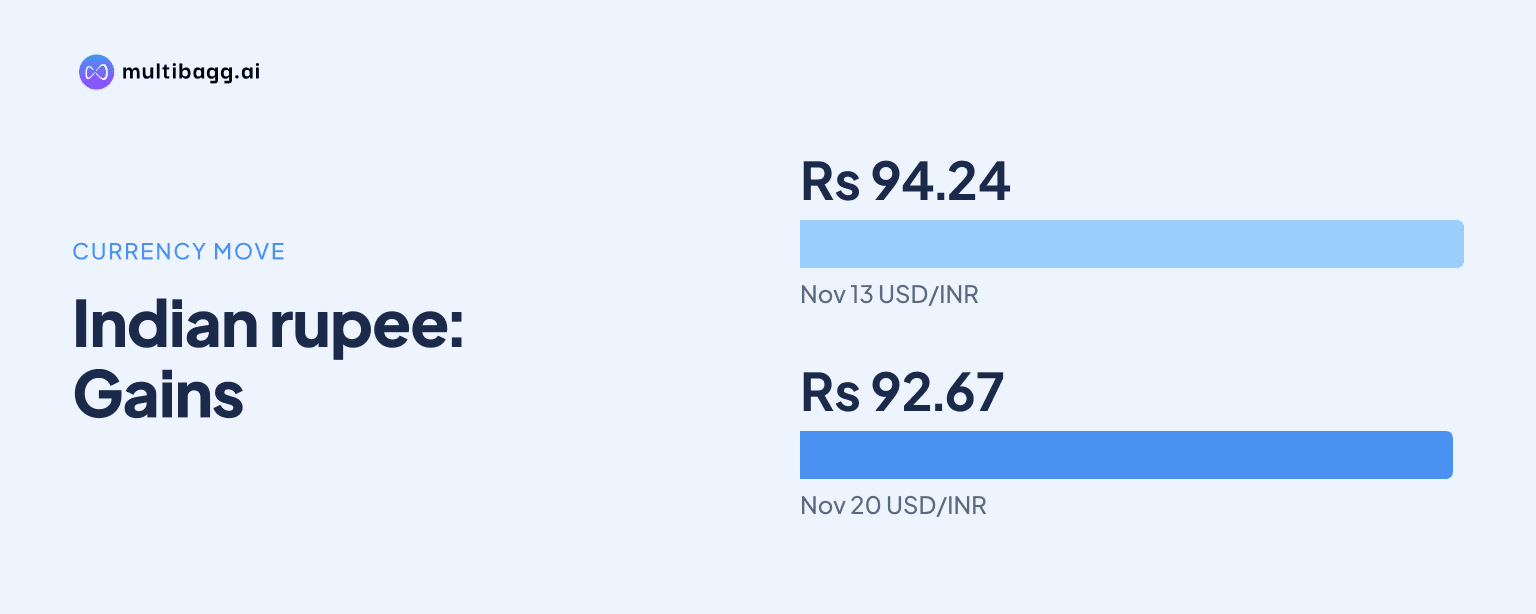
Indian rupee closed at ₹92.67 per US dollar on November 20, 2026, gaining 65 paise in the session and recording a fifth straight day of gains. The move took the currency below the ₹93-per-dollar level for the first time in more than seven months, according to the market data shared online.
Why did the rupee move below ₹93 per dollar?
The rupee moved below ₹93 per dollar as foreign investment inflows, lower crude oil prices and reduced bearish currency positioning supported demand for the domestic currency. Market commentary also pointed to the Reserve Bank of India’s special foreign-exchange window for state-run oil companies as a factor curbing spot-dollar demand.
The November 20 session began at ₹93.25 per dollar and the pair reached ₹92.65 intraday, before a provisional close at ₹92.67. That compared with a Thursday close of ₹93.32. Separate indicative and mid-market quotes available on November 21 clustered near ₹92.64 to ₹92.72, reflecting differences in timing and rate methodology rather than an official fixing.
How large was the rupee’s recent gain?
The rupee gained more than 1.6% over five sessions, moving from ₹94.24 per dollar on November 13 to about ₹92.68 on November 20 and 21. It had also strengthened from ₹94.95 on November 1, based on the daily rates cited in the discussion.
The latest move followed a period of rupee weakness. One data feed showed USD/INR at ₹92.7130 on November 20, down 0.68% for the day, while reporting that the rupee remained down 3.45% over the preceding 12 months. The same context placed the 52-week USD/INR range between ₹85.8629 and ₹96.9600, showing that the current level remains within a wide annual trading band.
What is supporting the rupee’s strength?
Foreign portfolio inflows and softer crude prices are the two main supports cited for the rupee. Foreign investors reportedly bought ₹84,290 crore of Indian assets between November 2 and 13, while buying on November 19 alone was cited at ₹7,411.41 crore. November inflows were described as exceeding ₹1.12 lakh crore in the provided market commentary.
Lower crude prices can reduce the cost of India’s energy imports and support the country’s external balance. This matters because India remains reliant on energy imports. Social-media discussion also noted renewed foreign buying in Indian government bonds after three months of outflows, although the data supplied did not give a precise value for those bond purchases.
Got a follow-up? Ask IRIS
What does a stronger rupee mean for investors and households?
A stronger rupee can lower the rupee cost of dollar-priced imports, overseas travel and foreign education, while potentially reducing imported inflation pressure. For companies, the effect differs by business model: import-dependent businesses may benefit from lower input costs, whereas exporters may receive fewer rupees for each dollar of overseas revenue.
The rate seen on financial websites is generally a market or mid-market reference, not necessarily the rate available to individuals. Banks, card providers and money-transfer services can apply a spread or fee. Retail users comparing travel or remittance rates should therefore distinguish between an indicative USD/INR quote and the final conversion rate offered by their provider.
What could limit further rupee appreciation?
Further rupee gains could be limited by trade, inflation and global-dollar risks. The supplied context said India’s October trade deficit reached a one-year high and inflation exceeded the Reserve Bank of India’s 6% upper tolerance level. A stronger dollar, higher energy prices or renewed risk aversion could also increase dollar demand.
Analysts cited in the discussion placed a near-term USD/INR range at ₹92.40 to ₹93.00, while Goldman Sachs was reported to expect about ₹94 in the next quarter. These are market views rather than outcomes. The dollar index was also reported near 103.76 to 103.87 after approaching 104 in the prior session, underlining that external currency conditions remain relevant.
Conclusion
The rupee’s close at ₹92.67 marked a notable recovery from levels above ₹94 earlier in November, aided by reported foreign inflows, softer crude prices and reduced spot-dollar demand. The five-session advance shows improved near-term currency sentiment, but it does not remove broader pressures from trade and inflation.
Investors will watch whether USD/INR holds within the cited ₹92.40 to ₹93.00 range, whether foreign portfolio inflows continue, and how crude prices develop. The reported forecast of about ₹94 for the next quarter and the still-elevated dollar index leave the direction beyond the immediate rebound unresolved.