










Fine Organic H1 FY27 EBITDA rises 39.5% as margin expands
Key highlights
- Fine Organic's H1 FY27 EBITDA rose 39.5% year on year to Rs 360.9 crore.
- Fine Organic's H1 FY27 EBITDA margin rose to 25.4% from 21.8% in H1 FY26.
- Exports accounted for about 58% of Fine Organic's H1 FY27 revenue of Rs 1,423.6 crore.
- Fine Organic completed its 80% Oleofine Organics acquisition for Rs 80.17 crore on September 9, 2026.
powered by IRIS
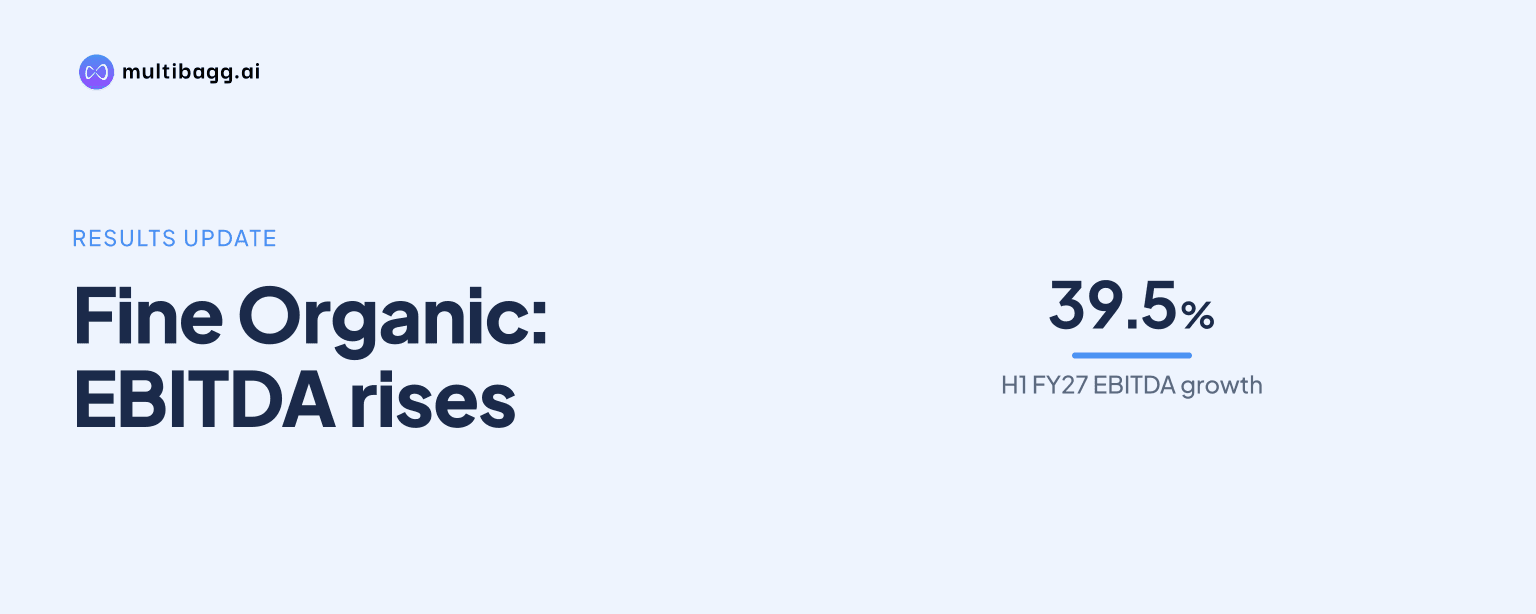
Fine Organic Industries Limited reported H1 FY27 EBITDA of Rs 360.9 crore, up 39.5% year on year, as EBITDA margin rose to 25.4% from 21.8% despite higher raw-material, utility and ocean-freight costs. Revenue from operations increased 20.1% to Rs 1,423.6 crore in the half year ended September 30, 2026.
Know Fine Organic Industries inside out
Results, valuation, peers and who's buying, in one view.
How did Fine Organic's H1 FY27 earnings change?
Fine Organic's EBITDA, or earnings before interest, tax, depreciation and amortisation, increased faster than revenue in H1 FY27. EBITDA rose 39.5% to Rs 360.9 crore from Rs 258.8 crore in H1 FY26, while revenue from operations grew 20.1% to Rs 1,423.6 crore from Rs 1,185.7 crore.
The difference between EBITDA and revenue growth was reflected in the margin. Fine Organic's H1 FY27 EBITDA margin rose 3.6 percentage points to 25.4%, while profit after tax, or PAT, increased 28.6% to Rs 290.3 crore and PAT margin rose to 20.4% from 19.0% a year earlier.
In Q2 FY27, Fine Organic reported Rs 184.9 crore of EBITDA, up 36.8% from Rs 135.2 crore in Q2 FY26. Q2 revenue rose 22.1% to Rs 729.4 crore, EBITDA margin was 25.4% versus 22.6%, and PAT increased 40.1% to Rs 152.1 crore.
What did Fine Organic report about demand and revenue mix?
Fine Organic said demand remained stable during H1 FY27, when revenue reached Rs 1,423.6 crore. Exports accounted for about 58% of total half-year revenue and domestic demand made up 42%, making exports the larger revenue component for the period ended September 30, 2026.
The Q2 FY27 mix was somewhat less export-led than the H1 FY27 mix. Exports represented 56% of Q2 revenue of Rs 729.4 crore and domestic demand represented 44%, compared with export contribution of about 58% for the full six-month period.
Fine Organic said it manufactures more than 600 products, including plant-derived oleochemical-based additives used in food, polymer, cosmetics, paint, ink and coatings applications. The November 3, 2026 release describes Fine Organic as India’s largest manufacturer of oleochemical-based additives and says its manufacturing facilities are in Maharashtra.
Why did Fine Organic face higher costs in H1 FY27?
Fine Organic said raw-material prices increased substantially in H1 FY27 compared with H1 FY26. It also said raw-material prices rose only marginally in Q2 FY27 compared with Q1 FY27, indicating a slower quarter-on-quarter increase during the second quarter.
Utility costs increased substantially year on year in H1 FY27, primarily because of higher fuel prices resulting from the ongoing West Asia crisis, according to Fine Organic. Utility costs stabilised marginally in Q2 FY27 compared with the previous quarter, while EBITDA margin was 25.4% in both Q2 and H1 FY27.
Ocean freight costs also increased substantially in H1 FY27 from H1 FY26 and continued rising quarter on quarter. Fine Organic attributed the increase in freight and forwarding costs mainly to supply-chain disruptions arising from the ongoing geopolitical crisis, while exports accounted for about 58% of H1 FY27 revenue.
Got a follow-up? Ask IRIS
What funding has Fine Organic approved for its SEZ subsidiary?
Fine Organic infused Rs 55 crore during Q2 FY27 into wholly owned subsidiary Fine Organic Industries (SEZ) Pvt. Ltd. through 1% non-convertible, non-cumulative, non-participating redeemable preference shares. The infusion brought its cumulative investment in the subsidiary to Rs 247.5 crore.
Fine Organic had board approval for Rs 300 crore of equity infusion into the subsidiary, of which Rs 247.5 crore had been infused by the release date. The board additionally approved Rs 120 crore of equity infusion for the ongoing SEZ project, but the release did not provide a completion date, capacity or expected financial return.
How did Fine Organic's Malaysia acquisition change its structure?
Fine Organic completed its acquisition of an 80% stake in Oleofine Organics Sdn. Bhd., Malaysia, on September 9, 2026, for RM 34,208,000, equivalent to Rs 80.17 crore. It acquired 50% from Smoothex Chemicals Pvt. Ltd. and the remaining 30% from other Oleofine shareholders; Oleofine operates in specialty chemicals.
The transaction changed the status of Fine Organic Industries (Thailand) Co. Ltd., which had been a joint venture. Fine Organic directly holds 45% of the Thailand company and Oleofine holds 10%; the release says Fine Organic consequently controls about 53% of total voting power directly or indirectly, making the Thailand company a subsidiary.
Fine Organic also reported a final Rs 4.35 crore insurance settlement in July 2026 for property damage and inventory losses from the January 2024 Badlapur plant fire. It had received Rs 1.80 crore through interim settlements in earlier periods, while the business-interruption claim was received in the quarter ended June 30, 2025.
Conclusion
Fine Organic's H1 FY27 figures show EBITDA growth of 39.5% exceeding revenue growth of 20.1%, lifting EBITDA margin by 3.6 percentage points to 25.4%. The result was reported alongside substantial year-on-year increases in raw-material, utility and ocean-freight costs, with exports contributing about 58% of half-year revenue.
The disclosed developments to watch are execution of the ongoing SEZ project, for which the board has additionally approved Rs 120 crore of equity infusion, and the financial effect of the Rs 80.17 crore Oleofine acquisition. Fine Organic did not disclose a project completion date, capacity target or expected return for the SEZ investment in its November 3, 2026 release.