










Fine Organics ROCE rises to 16.63%, remains below FY23
Key highlights
- Fine Organics reported TTM consolidated ROCE of 16.63% in H1FY27, versus 15.63% in FY26.
- Fine Organics’ H1FY27 ROCE was 33.19 percentage points below FY23’s 49.82%.
- Fine Organics’ H1FY27 revenue rose 20.1% year on year to Rs 1,423.6 crore, while EBITDA margin reached 25.4%.
- Fine Organics had Rs 170.7 crore of consolidated capital work-in-progress at September 2026, versus Rs 62.5 crore in March 2026.
powered by IRIS
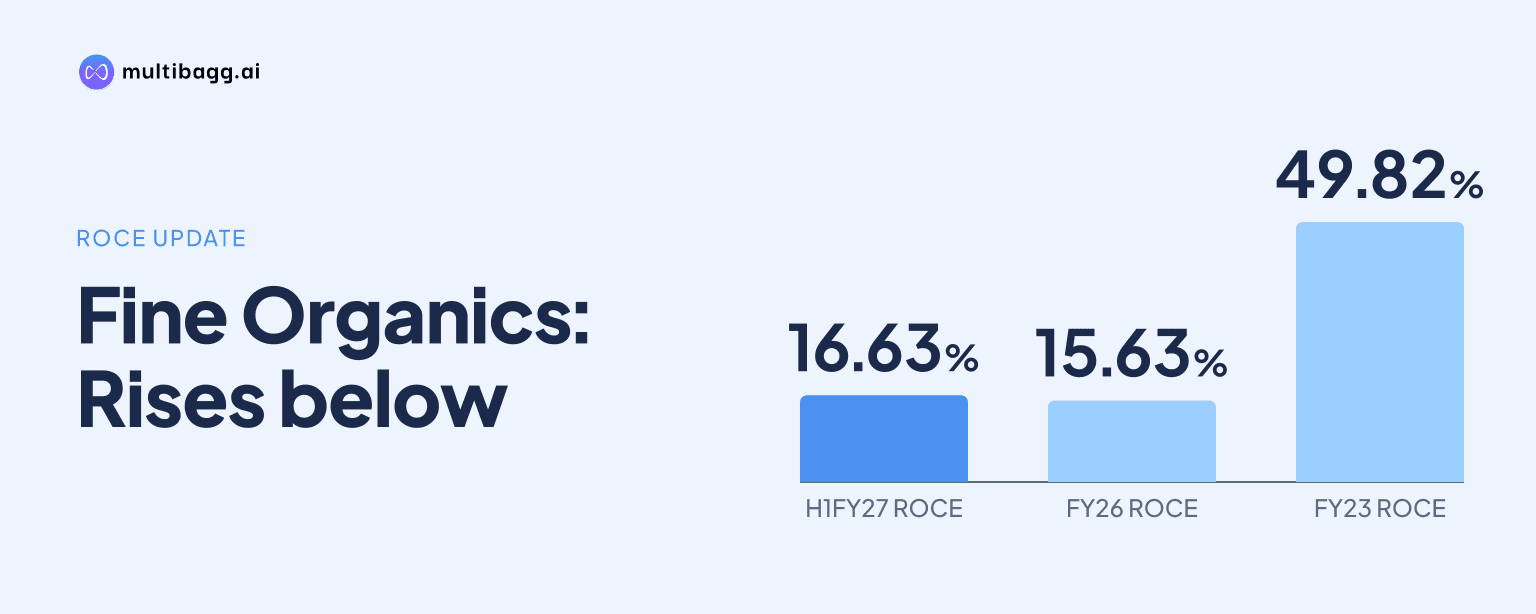
Fine Organics reported consolidated return on capital employed, or ROCE, of 16.63% on a trailing-12-month basis in H1FY27, up from 15.63% in FY26 but 33.19 percentage points below FY23’s 49.82%. The recovery coincided with H1FY27 revenue growth of 20.1% and an earnings before interest, tax, depreciation and amortisation, or EBITDA, margin of 25.4%.
Know Fine Organic Industries inside out
Results, valuation, peers and who's buying, in one view.
What was Fine Organics’ ROCE in H1FY27?
Fine Organics’ consolidated ROCE was 16.63% in H1FY27, calculated on a trailing-12-month, or TTM, basis. This was 1.00 percentage point higher than the 15.63% reported for FY26, following declines from 49.82% in FY23 to 24.74% in FY24 and 20.03% in FY25.
Fine Organics defines ROCE as earnings before interest and tax, or EBIT, excluding other income and including share of profit or loss from joint ventures net of tax, divided by total debt plus total net worth. H1FY27 EBIT was Rs 387.5 crore, up 31.3% from Rs 295.1 crore in H1FY26, although the reported ROCE uses TTM earnings rather than the six-month EBIT figure alone.
Return on net worth, or RONW, also increased on the same basis. Fine Organics reported TTM RONW of 16.23% in H1FY27, compared with 15.65% in FY26, while FY23 RONW was 40.10%; the company defines this measure as profit after tax divided by total net worth.
How far are Fine Organics’ returns below FY23?
Fine Organics’ H1FY27 ROCE was 33.19 percentage points below FY23, while RONW was 23.87 percentage points below its FY23 reading. The figures show that the latest increase was a recovery from FY26 rather than a return to the capital-return levels recorded in FY23.
The fall in returns after FY23 occurred alongside lower annual revenue and operating profit. Revenue declined from Rs 3,023 crore in FY23 to Rs 2,123 crore in FY24, while EBITDA decreased from Rs 831 crore to Rs 534 crore and the EBITDA margin narrowed from 27.5% to 25.2%.
By FY26, revenue had reached Rs 2,366 crore, but EBITDA was Rs 483 crore and the EBITDA margin was 20.4%. Profit after tax was Rs 618 crore in FY23, Rs 412 crore in FY24 and Rs 417 crore in FY26, while ROCE declined by 34.19 percentage points between FY23 and FY26.
What supported Fine Organics’ H1FY27 return recovery?
Fine Organics’ return recovery coincided with higher revenue, margins and profit in H1FY27 than in H1FY26. Consolidated revenue increased 20.1% year on year to Rs 1,423.6 crore, EBITDA rose 39.5% to Rs 360.9 crore and profit after tax increased 28.6% to Rs 290.3 crore.
Gross profit margin expanded to 44.3% in H1FY27 from 41.0% in H1FY26, while EBITDA margin rose to 25.4% from 21.8%. EBIT margin increased to 27.2% from 24.9%, and this operating movement matters to ROCE because Fine Organics excludes other income from its stated return calculation.
Other income declined to Rs 54.9 crore in H1FY27 from Rs 61.0 crore a year earlier, while profit after tax margin increased to 20.4% from 19.0%. Cash profit after tax, defined by Fine Organics as net profit after tax plus depreciation, was Rs 319 crore in H1FY27 with a 22.4% margin, compared with Rs 473 crore and a 20.0% margin in FY26.
The H1FY26 comparison includes a disclosed exceptional item of Rs 6.98 crore, described as a full and final insurance settlement for business interruption. Fine Organics reported no exceptional item in H1FY27, so the year-on-year profit comparison includes that difference in the prior-period base.
Got a follow-up? Ask IRIS
Does Fine Organics have a net cash position?
Fine Organics remained in a net cash position in H1FY27, reporting net debt to equity of negative 0.46 times. The ratio was negative 0.52 times in FY26 and has been negative in every displayed year since FY22, when it was negative 0.18 times.
Fine Organics defines net debt as long-term debt, short-term debt and current maturities of long-term debt less cash and bank balances. At September 2026, consolidated non-current borrowings were Rs 149.4 crore and current borrowings were Rs 5.3 crore, against Rs 252.6 crore of cash and cash equivalents plus Rs 1,277 crore of other bank balances.
Total equity rose to Rs 2,967.7 crore at September 2026 from Rs 2,664.5 crore at March 2026. Over the same period, inventories increased to Rs 518 crore from Rs 402.5 crore and trade receivables rose to Rs 420.4 crore from Rs 351.1 crore.
How is Fine Organics using its fixed assets?
Fine Organics reported gross fixed-asset turnover of 2.80 times in H1FY27, compared with 2.78 times in FY26 and 5.19 times in FY23. Net fixed-asset turnover was 6.25 times, below 6.56 times in FY26 and 12.24 times in FY23.
Fine Organics calculates gross fixed-asset turnover as net revenue from operations divided by total gross block of fixed assets including land. Its net measure uses the total net block including land; both H1FY27 measures remain below the corresponding FY23 levels shown in the presentation.
Property, plant and equipment stood at Rs 414.2 crore at September 2026, compared with Rs 363.7 crore at March 2026. Capital work-in-progress rose to Rs 170.7 crore from Rs 62.5 crore over the same period, while the presentation does not give a commissioning date or expected revenue contribution for that work.
Conclusion
Fine Organics’ H1FY27 figures indicate that capital returns have begun to recover as revenue, operating margins and profit improved from FY26 and H1FY26. TTM ROCE of 16.63% and RONW of 16.23%, however, remain materially below the 49.82% and 40.10% respectively reported in FY23.
The next disclosures should show whether H1FY27’s 25.4% EBITDA margin is sustained as the capital base expands. Fine Organics had Rs 170.7 crore of capital work-in-progress at September 2026, up Rs 108.2 crore from March 2026, but the presentation provides no completion timetable or return target for this amount.